TLDR
- Hitting is a distress signal, not defiance. Toddlers lack the brain wiring to process big feelings verbally. Their bodies become the outlet for emotions they can't name yet.
- Your calm is the prerequisite, not a bonus. Pain sends you straight into fight-or-flight. You need to regulate yourself before you open your mouth, or whatever you say will make things worse.
- Connect first, correct second. Name the feeling before you state the rule. A toddler mid-meltdown cannot hear instructions, but they can feel understood.
- Hold the boundary the first time. Saying 'stop hitting' six times teaches your kid the rule has no teeth. State it once, then physically follow through.
- The real teaching happens hours later. When everyone is calm and happy, revisit the incident and ask your child what they could do instead next time.

Why your toddler just hauled off and smacked you
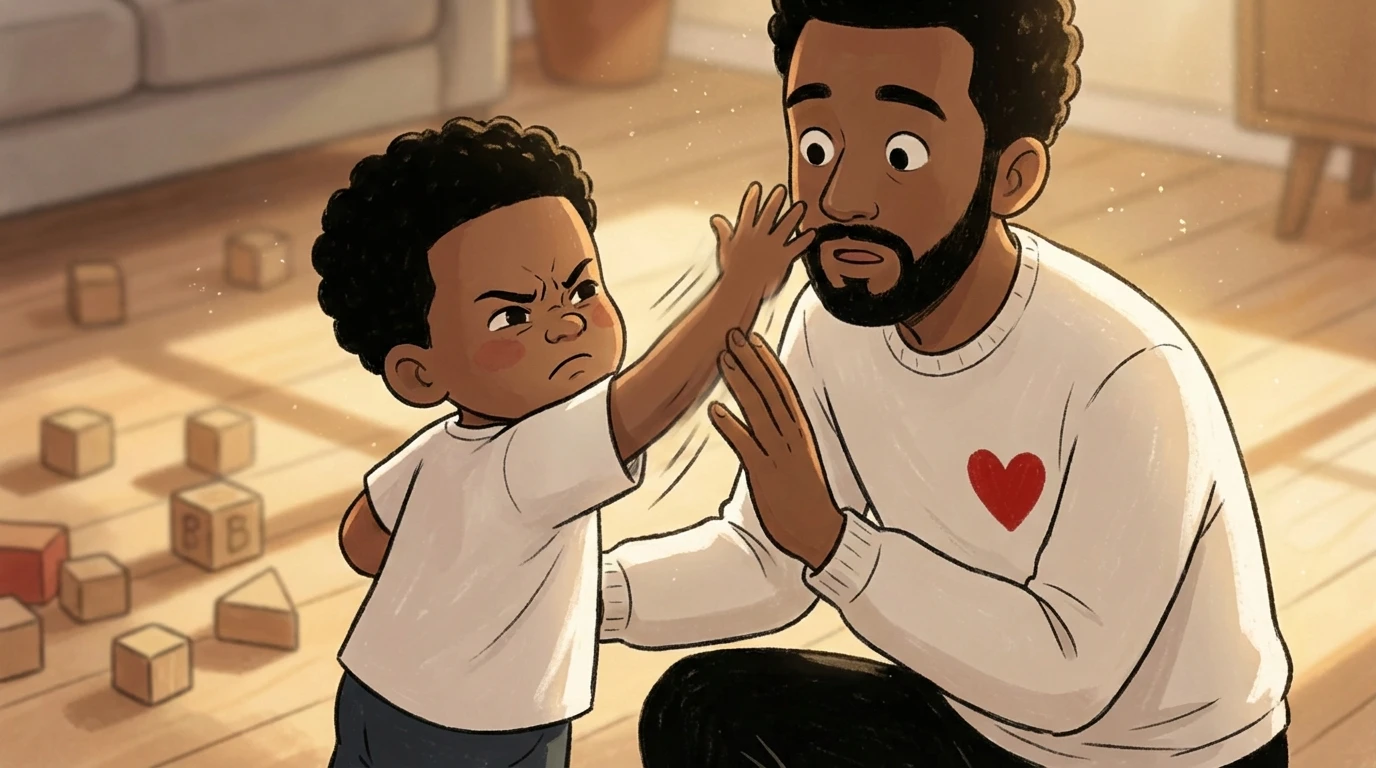
Here's what happened inside your toddler's brain 0.3 seconds before their hand connected with your face: absolutely nothing strategic. No scheming. No power play. Just a tidal wave of feeling and a prefrontal cortex that won't be fully online for another five years.
Toddlers hit because two things are still under construction: the part of the brain that manages emotions and the part that produces language. When disappointment or frustration floods their system, they have no words and no internal brakes. Their body becomes the only outlet for feelings they cannot process any other way.
That's why a previously sweet kid can start whacking you out of nowhere. It's also why they sometimes hit during perfectly nice moments. When a toddler feels safe with you, deeper feelings of fear or frustration that have been stored up can surface. The safety you provide is what lets those feelings emerge, and hitting is how they escape. It looks random, but it tracks.
And that laugh? The one that makes you want to lose your mind? It's a tension-release mechanism, not enjoyment. Your child is so overwhelmed they can't even cry. The giggling is their nervous system short-circuiting, not mockery.
Small fists, your face
The Beyond Hitting course will give you scripts for mid-hit moments
You'll catch the arm, say the right four words, and move on without a twenty-minute spiral.
What your brain does when it hurts
Let's be honest about the moment of impact. When a tiny fist connects with your nose, staying calm is nearly impossible. Pain sends you straight into your brain stem, which is the neighborhood where fight-or-flight lives. In that instant, your beloved child looks like the enemy.
Any action you take while reacting from physical pain will make things worse for both of you. Snarling through clenched teeth, yelling, getting rough: these are the "low road" responses, and they feel completely justified in the moment. They also pour gasoline on the fire.
So before you ever open your mouth, you need to get yourself back online. Take a breath. Remind yourself: this child is two. They are acting like a child because they are a child. If you were raised with "stop crying or I'll give you something to cry about," overriding that programming takes practice. That's normal. The instinct to match intensity with intensity is natural. It just doesn't work.
When you notice yourself spiraling into rage at your child's behavior, that's your cue to pause, not power through.

The three-step response that works
When your toddler hits you, you need a framework you can run on autopilot. Here's the one that holds up across the research.
Step one: name what they're feeling
Your first words should not be a correction. A toddler mid-meltdown cannot hear "stop hitting." What they can register is that someone sees them.
Try: "You're so mad. You wanted that and I said no."
This feels backwards if you grew up with correction-first parenting. But have you ever met a toddler who responded well to a lecture during a tantrum? Naming the feeling shifts the dynamic from adversarial to collaborative: you helping them through something hard.
Step two: state the boundary and hold it
After you've acknowledged the feeling, set the limit: "I won't let you hit me. I'm going to move my body to stay safe."
Then follow through. Move. If your child follows and tries again: "You're angry and that's okay. It's not okay to hurt anyone with your body. I'm going to hold your hands to keep us both safe."
The boundary matters less as words and more as action. Saying "don't hit" six times and then yelling it teaches your child that the first five warnings are free. Hold the limit calmly the first time, then physically follow through. That might mean gently restraining their hands, moving the sibling to safety, or creating physical distance.
Step three: repeat as needed
You may need to cycle through steps one and two several times in a single incident. This is normal. Enter broken-record mode: name the feeling, restate the boundary, physically enforce it. Stay boring. Stay steady. The tantrum will end.
How to respond when your toddler hits you
- Regulate yourself firstPause before speaking. Take a breath, unclench your jaw, remind yourself this is developmental, not personal. You cannot de-escalate anyone while you're escalated.
- Name their feeling out loudSay what you see: 'You're so frustrated' or 'You're really mad right now.' This makes them feel seen and begins the de-escalation before any correction.
- State the boundary onceUse clear, short language: 'I won't let you hit me.' No lectures, no repeated warnings. One sentence.
- Follow through physicallyMove your body away, hold their hands gently, or create distance. The boundary has to be real, not just verbal.
- Let them feel itIf they cry, that's the goal. The tears mean they've moved past the defensive anger into the real feelings underneath. Stay close and let them finish.
- Teach alternatives laterHours later, when everyone is happy, revisit: 'When you feel mad, what could you do instead of hitting?' Let them generate ideas: stomp feet, shout 'mad,' do a self-hug.
What never to do (and why it backfires)
Yelling matches the child's chaos and teaches them that hitting is a reliable way to get a big reaction from you. Negative attention is still attention. The louder you respond, the more your child learns that hitting works as a communication strategy.
Timeouts isolate a child who is already feeling alone and overwhelmed. Research shows they worsen behavior by damaging the parent-child connection, which is the only tool you have for teaching self-regulation in the first place.
And ignoring? Also a dead end. Your child needs help during a tantrum, not silence. Ignoring a hitting child leaves them doubly frustrated: the original feeling is still unresolved and now they've lost their connection to you. The behavior escalates because the underlying need goes unmet.

The part that prevents next time
Stopping the hit handles the crisis. Without teaching replacement skills, the hitting will keep cycling back because your child has no alternative wired in yet.
The teaching happens much later. Not five minutes later while your child is still recovering. Hours later, in a completely different emotional context, when everyone is regulated and probably doing something unrelated.
The script: "Earlier today, you were so mad when I took the markers away. It's okay to feel mad. Hitting isn't okay. When you feel that mad, what could you do instead?"
Ask, don't lecture. When your child generates the alternatives themselves (stomp, yell "mad," squeeze a pillow, come find you), they're more likely to remember them in the heat of the moment. You can also teach the self-hug: arms wrapped around their own shoulders while shouting "MAD." It gives the hitting impulse somewhere to go.
Will they test you? Absolutely. Consistency is the only thing that makes this stick. The same boundary, the same calm, the same sequence, over and over, until the new wiring takes hold.
When hitting means something bigger
Sometimes increased aggression tracks with something specific: other physical behaviors like scratching or hair pulling ramping up alongside hitting, big household changes, or a child who seems generally more wound up than usual.
If your child specifically hits you (and not other people), it often means your relationship needs more deposits. More roughhousing, more one-on-one time, more moments where they have your undivided attention when they're not melting down. A child who hits their safest person is a child who has big feelings stored up and is bringing them to the one human they trust enough to fall apart with.
That's a compliment, even though it doesn't feel like one when your lip is split.

FAQ
Yes. Most toddlers experiment with hitting because their brains cannot yet regulate big emotions or express them in words. The emotion management center and language areas are still developing. This is a developmental phase, not a sign of a behavioral disorder or bad parenting.
No. Research shows timeouts worsen behavior by damaging the parent-child relationship, which is your primary tool for teaching self-regulation. Instead, set a clear limit, stay close, and help your child process the feelings driving the aggression.
The laughter is a tension-release mechanism, not enjoyment. Your child is so overwhelmed by their feelings that they cannot cry. The laughing is their nervous system trying to discharge emotional pressure. It is not mockery or defiance.
Hours later, when everyone is calm and happy. During a tantrum, your child's brain is flooded and cannot absorb lessons. Wait until they are fully regulated, then revisit the incident, validate the feeling, restate the boundary, and ask them to brainstorm alternatives.
Repeat the cycle: name the feeling, restate the limit, physically enforce it. Toddlers will test whether you mean it. Consistency over weeks is what builds the new pattern, not perfection in a single moment.