TLDR
- Scary words are a power experiment, not a sign of violence. Kids who say 'I want you dead' have stumbled on the most effective sentence in the English language for making adults panic. They're testing it the same way a toddler tests 'no.'
- The limit must be absolute and immediate. Threatening language is like hitting: it is always off limits. State it once, enforce it every time, and coordinate with school so the rule is the same everywhere.
- Anger is always covering something else. Underneath the scary words is hurt, fear, or sadness. Help your child find that underlying feeling and you take the fuel out of the verbal aggression.
- Consequences alone won't fix this. A consequence stops the immediate behavior. But without teaching replacement skills, the aggression just shapeshifts into something else.
- Your own discipline style is part of the equation. If you use threats and power plays to control your child, they learn that threats and power plays are how people handle conflict.

The sentence that stops your heart
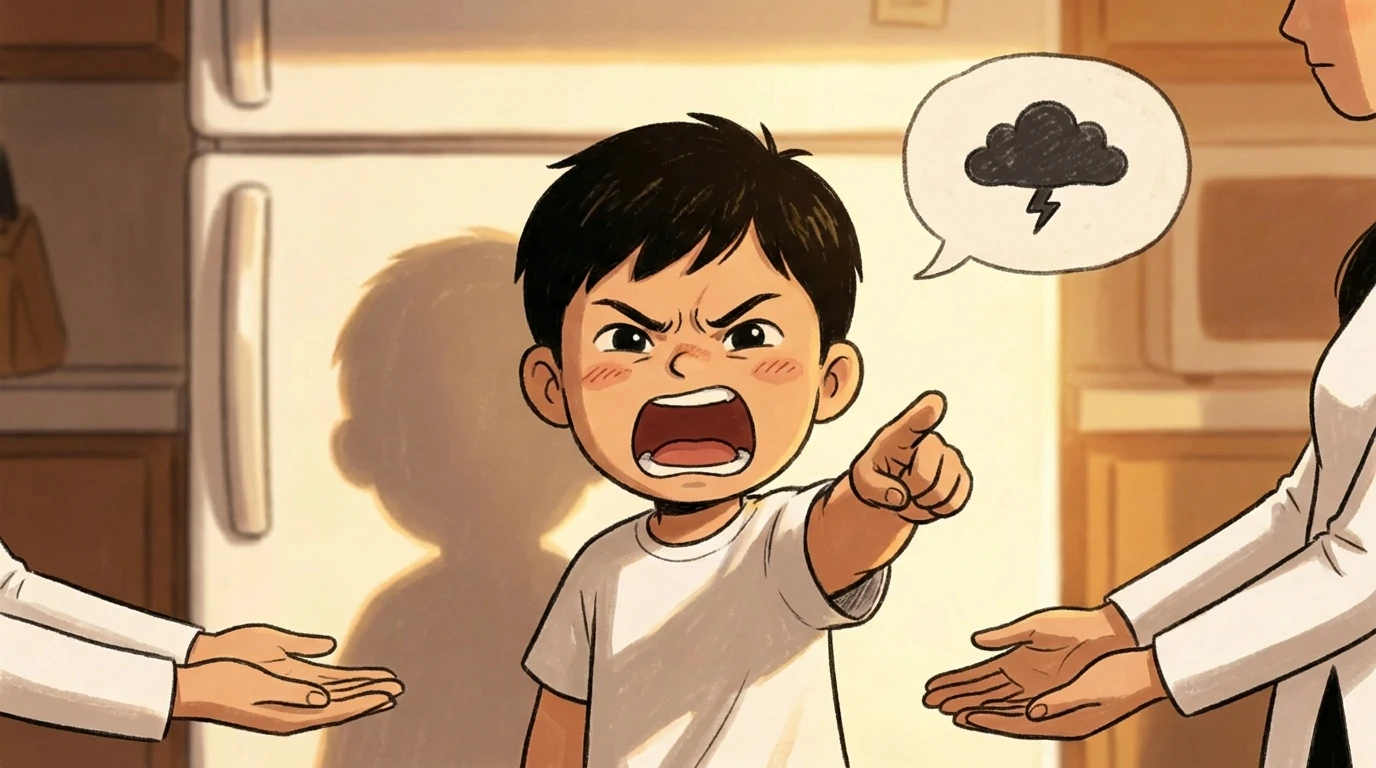
Your kid is five. They're in the backyard, or at school, or standing in your kitchen, and they look another human being in the eye and say: "I want you dead."
Every alarm in your body fires at once. What is wrong with my child? Where did they learn this? Is this who they are?
Take a breath. Your five-year-old just discovered the verbal equivalent of a nuclear launch code, and they're going to push that button again because it worked so spectacularly the first time.
Kids who use threatening language have stumbled on an incredible power tool. Much like a toddler reveling in the power of "no," a preschooler who says "I'll kill you" has learned that certain word combinations make every adult in a half-mile radius snap to full attention. That's intoxicating when you're small and the world mostly ignores what you want.
This is different from backtalk and sass that every preschooler experiments with. "You're not the boss of me" is boundary testing. "I want you dead" is territory that needs a different response.
Screaming I hate you
The Beyond Hitting course will teach you to respond to scary words calmly
You'll hear the worst sentence your child can construct and know it's a feeling, not a verdict.
Why schools take it seriously (and you should too)
You might be tempted to dismiss it. They don't even know what death means. They're just angry. Both things are true, and neither one is a reason to let it slide.
Five-year-olds have been known to get their hands on dangerous objects. Any responsible school knows that when a kid threatens another kid, it must be taken seriously. The school is being responsible, and you'd be doing your child no favor by treating these words as harmless.
The distinction that doesn't matter
"But they said 'I want you dead,' not 'I will make you dead.'" One is technically a desire, the other a direct threat. This is splitting hairs. The distance between the two is a bad afternoon. Both are off limits.
When to call a professional
If threatening language is the only issue your child is having, firm limit-setting combined with skill coaching should resolve it. If they're also acting out in other ways, talk to a psychologist.
Here's another test: if you've applied the same consequence more than twice and the behavior continues, the consequence isn't working. Either your child doesn't perceive it as unpleasant, or they're getting something so rewarding from the threatening behavior that the consequence can't compete. Both scenarios mean professional support is warranted.
Setting the limit
The limit must be stated in terms a five-year-old cannot misinterpret. Sit down with your child when everyone is calm and say: "Threatening to hurt someone is like hitting. It is always off limits. If you say threatening words to anyone, here is what will happen."
Then tell them what will happen. And then do it every single time.
Coordinate with the school
Sit down with the school, agree on the consequence, and stick to it. If the consequence at school is losing recess, then no exceptions. If the school sends them home, you need to make sure home becomes boring. Many kids prefer being home with a parent and a TV over being at school. If getting sent home is more pleasant than staying, you've accidentally turned the consequence into a reward.

What's underneath the scary words
Anger is always a secondary emotion. Underneath your child's "I want you dead" is hurt, fear, or sadness they don't have words for. The threatening language is a pressure valve for feelings they can't articulate.
When your child says something that sounds like a threat against themselves or others, the first question is always: what happened right before? Somebody took their toy. Somebody called them a name. Somebody excluded them from the game. The threat is their attempt to make the pain stop by making the other person feel afraid.
Reflecting the emotional chain
Once your child is calm (not during the incident, hours later), try this: "You were really mad at Henry today. It sounds like you were hurt when he called you that name, so you wanted to hurt him back, and you said scary things."
You're connecting the dots for them. Anger, to hurt, to threat. When a child can see the chain, they have a chance of interrupting it next time. When they can't see it, they just feel the explosion.
Teaching replacement skills
Stopping the threatening behavior with consequences handles the crisis. But a consequence without skill-building is like pulling a weed without getting the root. The behavior will resurface wearing a different costume.
How to coach your child away from verbal threats
- Wait until everyone is calmDo not attempt this conversation while anyone is still upset. Wait hours, not minutes. You need your child's prefrontal cortex online, and it takes time for the stress hormones to clear. A calm Tuesday evening works better than five minutes after the incident.
- Name what happened without judgmentSay: 'Remember when you told Marcus you wanted him dead? You were so angry.' You're narrating, not lecturing. Your child needs to see the event clearly before they can learn from it. Keep your tone flat and factual.
- Help them find the feeling underneathAsk: 'What happened right before you said that? How did it feel in your body?' You're teaching them to trace the chain from trigger to anger to words. Most kids will identify the hurt or fear if you give them space to look for it.
- Practice alternative responses togetherAsk: 'If that happens tomorrow, what could you say instead of scary words?' Let them generate options. Then role-play it: 'Okay, pretend I just called you a name. Show me what you'll do.' Rehearsal primes their automatic responses so the new behavior is available when they're flooded.
- Give them a physical release toolSome kids need something for their body to do when the anger hits. A squeezy ball in their pocket, stomping their feet three times, or walking to the water fountain. Give them a concrete action that replaces the verbal explosion with a physical one that hurts nobody.

Check your own playbook
This is the uncomfortable part. If your child is using threats and power plays to control other kids, look at how conflict gets handled in your house.
Do you use threats? ("If you don't stop right now, I'm throwing that toy away.") Do you use punishment as a power play? Do you use social exclusion through time-outs?
You don't want to model the exact behaviors you're trying to eliminate. A child who sees threats used as a conflict resolution tool at home will use threats as a conflict resolution tool at school. The mechanism is simple and brutal.
Children whose parents use empathy as their primary tool are receiving constant training in empathy and are far less likely to be mean to others. The parenting approach itself becomes the curriculum.
And watch for the moments when your child's scary words trigger something volcanic in you. That flooding you feel? That's your own nervous system activating. If you react from that place, you'll say and do things that teach your child exactly what you're trying to unteach.
The power question
Kids are more likely to threaten peers when that's the only time they get to feel powerful. If your child's life is mostly adults telling them what to do, where to go, what to eat, and when to sleep, they'll find their power wherever they can. Sometimes that's through terrifying words.
Make sure your child gets plenty of opportunities to make real choices and feel genuinely in control. Not fake choices ("red cup or blue cup?") but real agency. Let them decide what's for lunch. Let them choose the family activity on Saturday. When children have legitimate outlets for autonomy, they have less need to weaponize language to feel big.

FAQ
Almost certainly not in the way you do. Most five-year-olds have a vague concept of death at best. What they do understand, with perfect clarity, is that this particular sentence makes adults react with maximum intensity. The power of the reaction is the point, not the content of the words.
Use a consistent consequence, but pair it with empathy and skill-building. A consequence alone teaches 'don't get caught.' A consequence plus coaching teaches 'here's what to do instead.' If the same consequence has been applied twice with no improvement, it's not working and you need a different approach or professional guidance.
This is common. School is where peer conflict lives, and peer conflict is the trigger for most verbal aggression at this age. Coordinate closely with teachers, agree on consistent consequences across both environments, and practice social scenarios at home so your child has rehearsed responses ready for the playground.
In developmental terms, 'I hate you' and 'I'm not inviting you to my birthday' are standard preschool language. By age five, most kids are moving past that. 'I want you dead' has escalated into threat territory and needs a firmer, more structured response with explicit limits and active skill-building.