TLDR
- Most childhood fears follow a predictable developmental timeline. Stranger anxiety at 8 months, monsters at 3, real-world dangers by 7. These fears arrive because the brain is building new capabilities, not because something is wrong.
- Pushing a scared child backfires every time. When you force a child toward something they fear, their brain shifts into survival mode. They become less capable of handling the fear, not more.
- Label the feeling, skip the pep talk. Saying 'you're feeling scared' does more than 'there's nothing to be afraid of.' Naming the emotion gives your child a handle on something that otherwise feels like drowning.
- Fears that appear suddenly often have a trigger. A new sibling, a parent traveling, a scary scene in a movie. Look at what changed in the past month before assuming your child developed a disorder.
- Worry when the fear grows instead of fading. Normal fears shrink over weeks or months. If a fear is intensifying, spreading to new situations, or preventing your child from daily activities, talk to your pediatrician.

The fear schedule your pediatrician never mentioned
Your child's fears are not random. They show up on a rough timeline, and the sequence maps directly onto how the brain develops new abilities at each stage.
Babies (0-12 months) startle at loud noises, lose it when handed to unfamiliar people, and panic when you leave the room. This is the brain's first security system coming online.
Toddlers (1-3 years) develop fears that come from nowhere. One day your kid loves the bath; the next day the drain is a portal to the underworld. They fear animals, loud machines, costumed characters, and sometimes very specific things (a particular toy, a page in a book, a green crayon) that make zero sense to you. Their imagination switched on before their logic caught up.
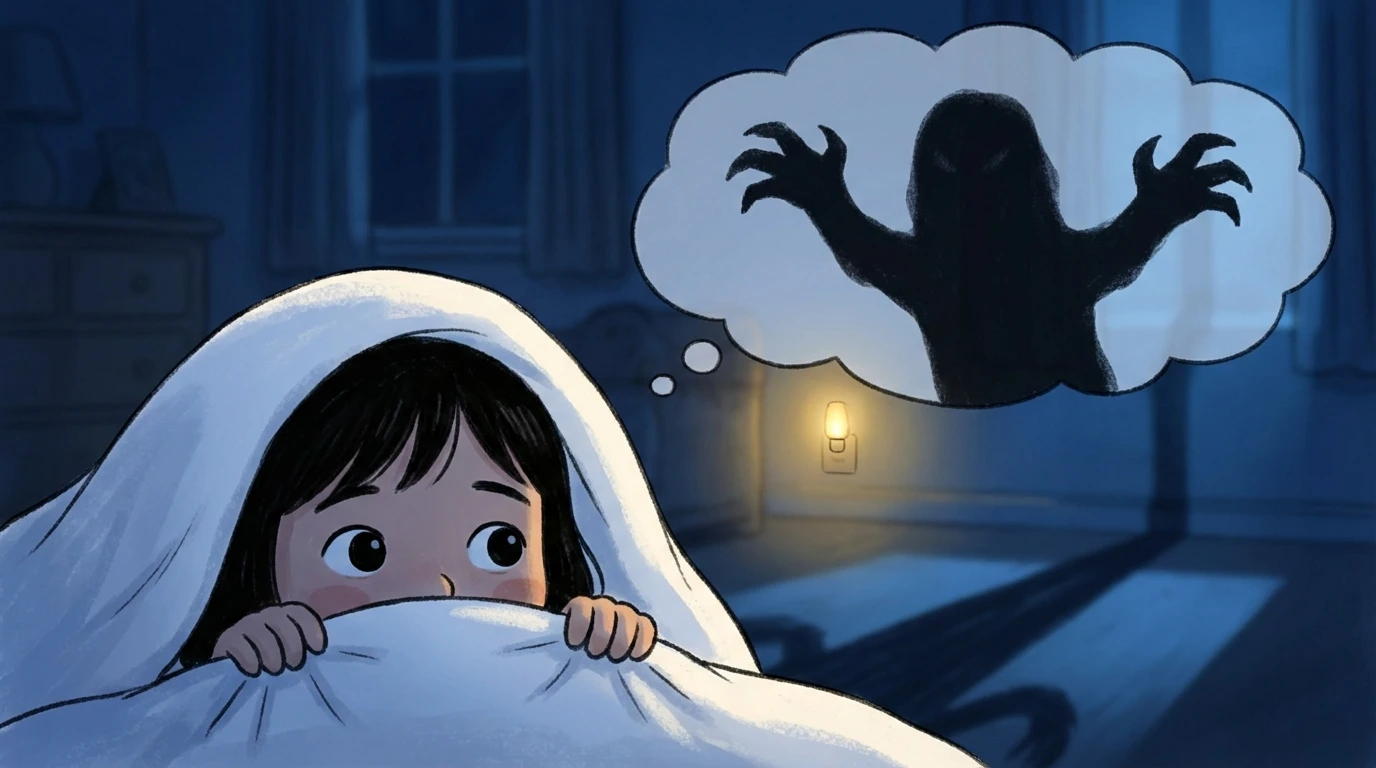
Preschoolers (3-5 years) have imaginations running at full power with no reality-check system yet. Monsters, ghosts, thunderstorms, the dark. Bedtime fears peak here because nighttime is when the imagination has nothing to compete with.
School-age kids (6-12 years) shift from imaginary threats to real ones. Death, burglars, war and natural disasters, getting sick, something happening to a parent. Their brain is mature enough to understand that bad things happen.
Monsters under the bed
The Childhood Anxiety course will show you what's age-appropriate
You'll stop second-guessing every fear and know when to comfort versus when to intervene.
Why the "wrong" fears are still the right ones
Your 2-year-old screams at the blender but runs toward traffic. Your 4-year-old is terrified of a butterfly but unfazed by a barking dog. Your 7-year-old watches a zombie movie but can't sleep without the hall light.
The fears don't match the actual danger because the brain is evaluating novelty, loss of control, and separation from you. Those three ingredients trigger fear at every age, and they explain why a child who handled something fine last week suddenly can't handle it today.
When "irrational" fears need the same response
Parents instinctively validate fears they understand (thunder, big dogs) and dismiss fears they find baffling (a page in a book, a hat, the toilet flushing). The apparent logic of the fear is irrelevant to your response. The emotional experience in your child's body is identical whether the fear makes sense to you or not. Treat it identically.

What helps (and what doesn't)
Pushing doesn't help
"But you LOVE the park!" "This will be so fun!" "There's nothing to be scared of!"
Every time, the kid clung harder or shut down completely. Pushing activates the survival brain, which makes a child less capable of exploration, not more. If you're scared of heights, someone dragging you to the edge of a building and saying "isn't this great?!" does not convert you.
Name the feeling
"You're feeling scared right now. That's okay."
That sentence communicates empathy, teaches vocabulary, and normalizes the experience all at once. Kids who can name what they feel can start to manage what they feel. Kids who can't name it just drown in it.
Offer yourself as a base
"I'm right here. You can stay with me until you're ready."
The word "until" does all the work. It tells your child you expect them to be ready eventually, but the timeline is theirs.
Narrate, don't persuade
Instead of selling the experience, describe it neutrally. "I see a kid going down the slide. They're wearing red shoes." Neutral narration grounds your child in concrete reality. The moment you insert your opinion ("See? It's not scary!"), you've switched back to pushing.
How to respond when your child is scared
- Name what you seeGet on their level and describe what's happening: 'I can see you don't want to go in. Your body is telling you something feels scary right now.' No judgment, no fixing.
- Give the feeling a wordSay 'that feeling is called scared' or 'nervous' or 'worried.' You're handing them vocabulary for a sensation they can't articulate yet. This is how emotional regulation starts.
- Skip the pep talk entirelyDo not say 'there's nothing to be afraid of' or 'you'll be fine.' Both sentences tell your child you don't understand what they're experiencing.
- Offer your presence, not a solutionSay 'I'm right here, and you can stay with me as long as you need.' You are the safe base. From that base, courage becomes possible on their timeline.
- Narrate the environment neutrallyDescribe what's happening around you without opinions. 'That dog is sniffing the grass. The other kids are on the swings.' Facts only. Let your child draw their own conclusions.
- Notice the brave moments laterWhen your child takes even a small step forward, say what you see: 'You walked a little closer to the water today.' Describe the action, skip the cheerleading.
What to do at each stage
Babies and toddlers (0-2)
Stay close. That's most of the job. Separation anxiety peaks between 8 and 18 months, and no amount of reasoning speeds it along.
For random toddler fears (the vacuum, the drain, a page in a book where a character makes a mistake), respect the boundary. If your 18-month-old slams a book shut before the page where the bear breaks a bowl, say "you don't like that part, do you?" and read something else. They'll come back when their brain is ready.
Preschoolers (3-5)
Imagination fears peak here, and bedtime is ground zero. Do not check under the bed for monsters. Checking validates that monsters could plausibly be there. Address the real need: safety and your presence.
What works: a predictable bedtime routine, a transitional object (stuffed animal, your old t-shirt), and a nightlight the child controls. Control reduces helplessness, and helplessness fuels fear at this age.
If your child saw something unsettling, they may not tell you directly. Ask at bedtime: "Did anything feel tricky today?" Make it explicit that they won't get in trouble for telling you.

School-age kids (6-12)
Your 7-year-old who asks "will you die?" at bedtime is not being dramatic. They just figured out that death is permanent, and they need you to sit with that realization.
Recurring nightmares at this age are a signal. If the same theme shows up night after night, your child's brain is stuck processing something it can't resolve alone. Look at the past month: a new school, a parent traveling, a fight they overheard. Then help them rewrite the dream. "What if next time the scary thing appears, you tell it to leave?" Give them agency inside the story their brain keeps replaying.
For the kid who can't fall asleep alone at 7, that's more common than anyone admits. Gradual withdrawal of your presence (sit next to them, then across the room, then in the doorway, then outside the door) teaches the skill without yanking the safety net.
When normal fear crosses a line
Most childhood fears fade on their own. Some disappear in days, others take months. The red flags are intensity, duration, and interference.
Talk to your pediatrician if your child's fear is getting worse over several weeks, spreading to new situations, or preventing them from school, sleep, or eating.
A specific phobia is different from a developmental fear. Developmental fears follow the timeline. Phobias are outsized, persistent, and resistant to reassurance. The worried parent quiz can help you figure out whether your response to your child's fears might be accidentally reinforcing them.

The thing nobody tells you
Your child's fears are going to make you uncomfortable. Not because the fears are scary, but because your instinct will be to fix them, and the correct move is usually to sit there and do nothing useful.
Sit in the doorway. Stay at the park bench. Hold space in the waiting room. Your presence is the intervention. It doesn't feel like enough. It is.
FAQ
Probably nothing external. Between ages 1 and 3, the brain's imagination and memory systems develop rapidly. Your child can now anticipate and remember in ways they couldn't before. The fear of something familiar is the brain's new processing power outpacing its ability to regulate. It usually passes in weeks.
Don't force exposure, but don't rearrange your entire life to avoid it either. Gentle, low-pressure encounters from a safe distance with you present work better than total avoidance. Total avoidance teaches the brain that the fear was justified.
No. A nightlight gives your child control over their environment. Control reduces helplessness, and helplessness fuels nighttime anxiety. Many adults sleep with some light in the room. Let this one go.
When the fear persists for more than a few months, gets worse instead of better, spreads to multiple situations, or prevents normal daily activities like school, play, or sleep. A pediatrician can help determine whether a referral makes sense.
The opposite. Naming a fear out loud shrinks it. Children who can label their emotions show better regulation than children who suppress them. The fear feels bigger when it has no name. Give it a name and it becomes manageable instead of overwhelming.