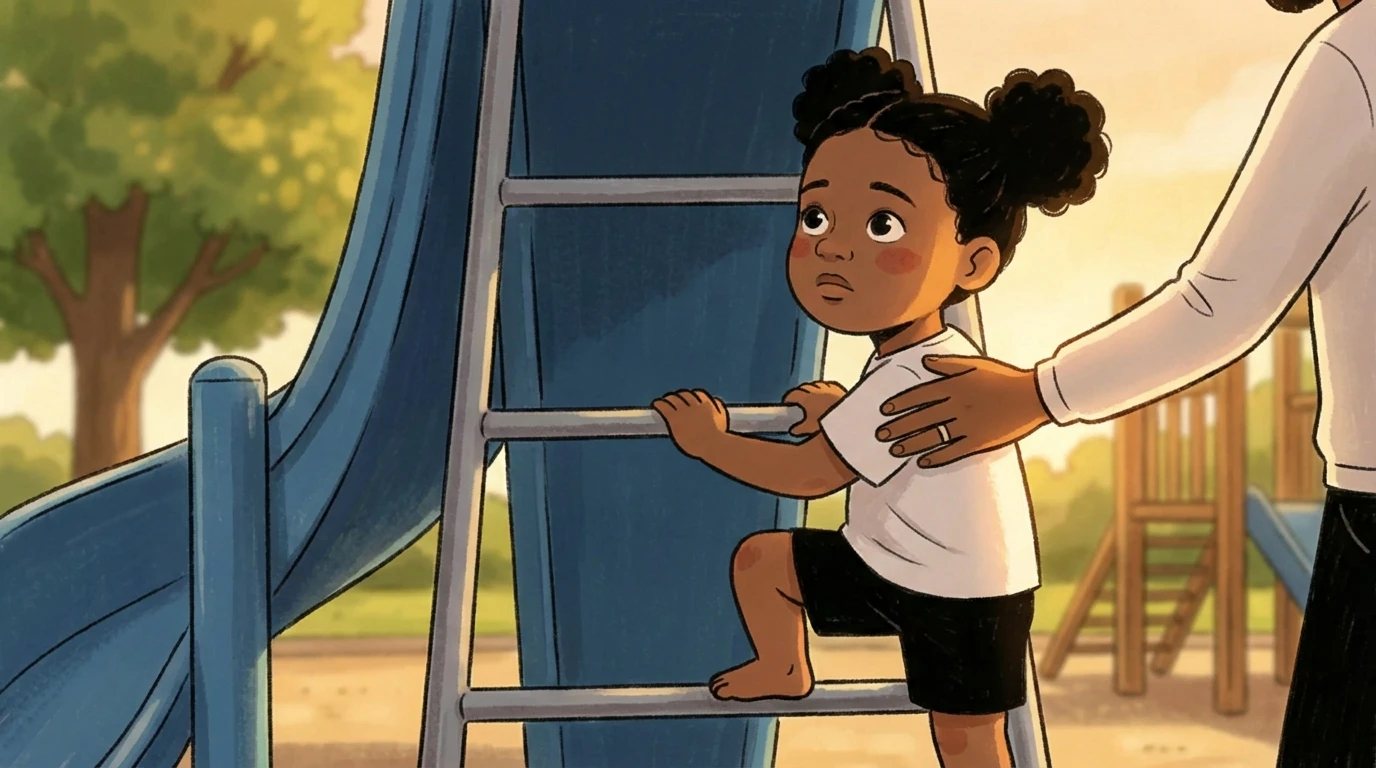
TLDR
- Small steps beat big pushes. A child who is forced past a fear learns to dread it more. A child who inches toward it on their own terms learns they can handle it.
- Play and laughter dissolve fear faster than logic. When you make the scary thing silly, you break the association between the situation and the threat response.
- Your job is support, not pressure. There is a hard line between helping a child through a fear and shoving them past it. One builds confidence. The other builds avoidance.
- Bravery is a skill, not a personality trait. Kids who practice facing small fears get better at facing bigger ones. The practice itself is what matters.
- Respect the no. If your child hits a wall after real effort, backing off gives you data. Try a smaller step next time.

The problem with "just be brave"
Your kid freezes at the sight of a dog. Or melts down before swim class. Or turns to stone in the dentist's lobby. And someone (maybe you, maybe a well-meaning grandparent) says the thing: "There's nothing to be scared of."
Here is what that sentence does inside your child's brain: absolutely nothing useful. Their amygdala has already fired. The threat response is running. Telling a child there is nothing to fear when their body is screaming otherwise teaches them that their feelings are wrong and adults cannot be trusted to understand.
The opposite of avoidance is supported approach. You want your child to move toward the thing that scares them, on their own feet, at a pace that keeps their nervous system in the "stretched but not overwhelmed" zone.
That is what gradual exposure does. And it works on everything from fears like dogs, loud noises, or water to stage fright to the dark.
Afraid to push too hard
The Childhood Anxiety course will show you how far to nudge
You'll know the exact distance between helpful challenge and retraumatizing — and stay on the right side of it.
What gradual exposure looks like in practice
The idea is dead simple: break the scary thing into a ladder of steps, starting with the one that barely registers as uncomfortable and ending with the thing your child currently cannot do.
Building the fear ladder
Say your kid is terrified of dogs. The ladder might look like this:
- Look at pictures of dogs in a book
- Watch a short video of a puppy
- Stand across the street from a neighbor's dog on a leash
- Stand ten feet away from a calm, small dog
- Stand five feet away
- Let the dog sniff their hand with you holding their other hand
- Pet the dog briefly
Each rung gets its own session, its own day, sometimes its own week. You never skip a rung. Your child decides when they are ready to move up. If they freeze, you go back down one step and stay there.
The golden rule of pacing
The sweet spot is what psychologists call "manageable distress." Your child should feel a little nervous but not panicked. A bit of butterflies is the engine. Full-blown terror is the emergency brake.
Watch for the signals. A child in manageable distress might grip your hand tighter or talk faster. A child who has tipped into overwhelm will shut down, cry, or bolt. If you see the second set, you have gone too far. Back up.

Why laughter works better than lectures
Here is where it gets interesting. You can build a perfectly reasonable fear ladder and still watch your kid refuse the first rung. Logic has limits when a five-year-old's fight-or-flight system is calling the shots.
Play and humor bypass the fear circuit entirely. When a child is laughing, their body physically cannot maintain a full threat response. Laughter releases the same tension that fear creates, but routes it through a completely different channel.
The ridiculous role-play technique
This sounds too goofy to work, and works almost every time.
Say your child has a school presentation and they are terrified. Here is what you do:
Announce that you are going to give the speech. Gather an audience (the child, siblings, stuffed animals propped on the couch). Then get up and be spectacularly terrible at it. Forget your words. Freeze mid-sentence. Trip over nothing. Ham it up so hard your kid cannot stop laughing.
Then, after your magnificent disaster, say out loud: "Well, I messed that up completely. And you know what? I'm glad I did it. Nobody needs me to be perfect. They just need me to try."
The combination of visible failure plus visible pride rewires the equation. Your child just watched the scariest possible outcome happen to someone they love, and that person was fine. More than fine. Laughing about it.
Nine times out of ten, your kid will say something like "No, that's all wrong, let me show you." They have gone from terrified to eager without you pushing them a single inch.

How to use gradual exposure with your child
- Name the fear togetherSit with your child and name exactly what scares them. Not 'dogs' but 'the neighbor's big barking dog.' Specific fears get specific ladders. Vague fears stay vague and unbeatable.
- Build the ladder in small rungsBreak the fear into 5-8 steps from barely uncomfortable to the goal. Write them down or draw them. Let your child help rank what feels scariest. Their input matters more than yours here.
- Start at the easiest rungBegin with the step your child says they can handle. Stay there until they are bored by it, not just tolerating it. Boredom is the signal to move up.
- Add play and humor at every stepMake each rung into a game. Use role-play, exaggeration, or silly voices. The laughter is doing real neurological work even though it looks like goofing around.
- Let your child say stopIf they freeze or want to go back down, do it without disappointment. Say 'We can try this step again another day. You were brave to get this far.' Mean it.
- Celebrate the trying, not the resultPraise the act of approaching the fear, not the outcome. 'You walked into that room even though you were scared' beats 'See, there was nothing to be afraid of.'
What to say (and what to stop saying)
The scripts matter. Your child is listening to how you frame their fear, and they will borrow your language to talk to themselves about it later.
Scripts that help:
- "That does look scary. I'm right here with you."
- "You don't have to do the whole thing. Can you do just this one small part?"
- "Your body is telling you to be careful. Let's figure out if the danger is real or if your brain is being extra cautious today."
- "Last week you couldn't even look at it. Today you stood three feet away. That is what building real resilience looks like."
Scripts that backfire:
- "There's nothing to be scared of" (tells them their feelings are wrong)
- "Just do it, you'll be fine" (dismisses the fear and applies pressure)
- "Your sister isn't scared, why are you?" (comparison plus shame)
- "If you don't do this now, you never will" (catastrophizing teaches catastrophizing)
Every time you validate the fear before asking them to approach it, you strengthen their sense of self. Every time you dismiss the fear, you teach them to hide it from you.
The line between support and pressure
Every parent hits this question: am I helping or am I pushing too hard?
The answer lives in your child's body language, not their words. A child who says "I don't want to" but inches closer is working through it. A child who says "Okay" but has gone rigid, glassy-eyed, or silent has checked out. Trust the body over the words.
And here is the part nobody wants to hear: sometimes the right call is to walk away from the rung entirely. If your kid tried, genuinely tried, and hit a wall, backing off just means respecting their nervous system's speed limit.
Children who feel supported through fear develop a growth mindset around courage. They learn that bravery is something you practice, not something you either have or you don't. That belief turns out to be the single best predictor of whether they will face hard things later.
When gradual exposure is not enough
Some fears are proportional. Your kid is scared of dogs because a dog knocked them over once. Clear path forward.
Other fears are disproportional, persistent, and spreading. If your child's fear is shrinking their world (they won't go to school, won't leave the house, won't sleep alone despite months of work), you may be looking at an anxiety disorder.
Normal fears respond to gradual exposure over weeks. Anxiety disorders resist it. If you have been working a fear ladder for a month with no movement, talk to your pediatrician. Cognitive behavioral therapy for kids uses these same principles, just with professional calibration.
There is zero shame in getting help. You would not set your own broken bone.

FAQ
It depends on the fear and the child. Some kids move through a fear ladder in two weeks. Others need two months on the same rung. The pace is your child's to set. Rushing it creates setbacks. Consistency matters more than speed.
Start smaller. If the first rung is too much, invent a rung below it. If looking at pictures of dogs is too scary, start by talking about a cartoon dog. You can always make the entry point easier. There is no step too small to count.
Verbal praise for effort works well. Sticker charts or small rewards can help younger kids stay motivated. Avoid big material rewards because they shift the focus from internal pride to external payoff. You want your child to feel brave, not bribed.
Yes, and it follows the same principle. Start with very short separations in safe settings and slowly increase duration. Practice leaving for two minutes, then five, then fifteen. Always come back when you said you would. Predictability builds trust.
Forcing a child past a fear they are not ready for backfires almost every time. It increases avoidance and teaches the child that their feelings do not matter. Share the research: gradual, supported exposure works. Forcing does not.