TLDR
- Your calm body is the first intervention. Children co-regulate off your nervous system. If you're tense, their brain reads 'danger confirmed.' Regulating yourself before responding to your child changes the entire interaction.
- The PAUSE method gives anxiety a predictable structure. Five steps: Pause yourself, Acknowledge the feeling, Understand the trigger, Support with a plan, Encourage small steps. Repeatable, concrete, and it works because anxious brains need predictability.
- Reassurance alone makes anxiety worse over time. Saying 'you'll be fine' feels helpful. But it teaches your child that the only way to feel better is to hear it from you. The goal is internal coping, not external soothing on repeat.
- Avoidance is the engine that keeps anxiety running. Every time your child avoids the scary thing and feels relief, their brain logs 'avoidance = safety.' The relief is real. The lesson is wrong.
- Small exposures with support build genuine confidence. Confidence doesn't come from being told you're brave. It comes from doing something hard and surviving. Your job is to make the hard thing small enough to attempt.

Why your child's brain is lying to them
Anxiety is a smoke detector with a broken sensitivity dial. The system works (it's supposed to detect danger), but it fires for burnt toast, steam from the shower, and someone lighting a birthday candle three rooms away.
The feelings are genuine. The threat assessment is wrong. And that gap between what the body feels and what's happening in reality is where all the parenting difficulty lives.
You can't reason a child out of a body response. Telling an anxious child "there's nothing to worry about" is like telling someone having a panic attack to just relax. The information is correct. The delivery method doesn't reach the part of the brain running the show.
So what does reach it? Our complete anxiety series covers this in depth, but the short version: their nervous system needs to borrow yours.
Frozen mid-spiral
The Childhood Anxiety course will teach you a response that lands
You'll walk into the next spiral with a sequence that brings your child back down in minutes, not hours.
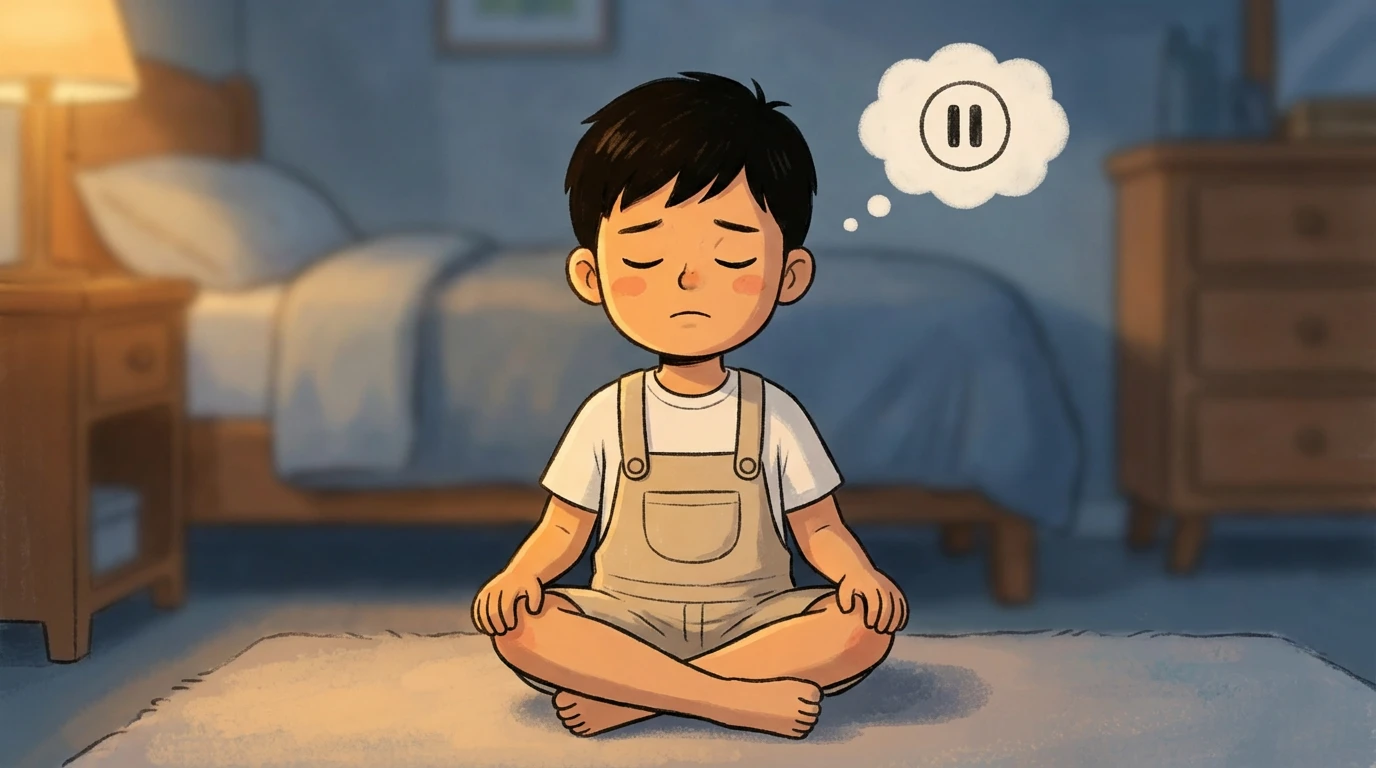
The PAUSE method
PAUSE is an acronym, and I know acronyms feel cheesy. But anxious moments scramble your thinking, and having five letters to follow beats staring at your panicking child while your own brain goes blank.
P: Pause yourself first
Before you say a single word to your child, stop. Take one slow breath. Unclench your jaw.
Your child's mirror neurons are reading your body language faster than they process your words. If your body says "emergency," their brain escalates. If your body says "I've got this," their brain starts to downshift.
Your own anxiety management is the foundation everything else sits on. You can't PAUSE your child if you haven't paused yourself. Breathing techniques that work for you are worth practicing before you need them, not during.
A: Acknowledge the feeling
"I can see this feels really scary for you right now."
No fixing, no minimizing, no silver linings. Labeling a feeling activates the prefrontal cortex, which puts the brakes on the amygdala's alarm response. The sentence "you're fine" does the opposite. It tells your child that what they're experiencing is invisible to you.

U: Understand the trigger
Ask, don't assume. "What part feels the scariest?" gets you further than "Are you worried about the test?" because the second question hands your child the answer instead of letting them locate it.
The presenting anxiety and the actual trigger are often two different things. Your child seems anxious about the birthday party, but it's the car ride because they get carsick and they're terrified of throwing up in front of other kids. The earlier articles cover how fears change at each age, which helps you narrow down what's developmentally likely.
S: Support with a plan
Anxious brains catastrophize because they can't see a path through the scary thing. Give them one.
"So the loud part is what worries you. Here's what we'll do: we'll sit near the exit. If it gets too loud, you squeeze my hand twice and we step outside."
The plan doesn't need to be perfect. It needs to exist. A child with a plan has some control, and control is the antidote to the helplessness that fuels anxiety.
E: Encourage small steps
The goal is never "get over it." The goal is "do one small thing slightly outside the comfort zone." Terrified of dogs? The small step might be looking at a picture of one. Scared of swimming? Sitting on the pool deck with feet in the water.
Every small step that doesn't end in disaster rewires the prediction. The brain expected catastrophe. Catastrophe didn't come. Over dozens of repetitions, the smoke detector recalibrates. This is the principle behind gradual exposure approaches, and it works because it's how learning happens in the nervous system.
How to use the PAUSE method with your child
- Pause yourself before respondingTake one breath. Drop your shoulders. Unclench your hands. Your child's nervous system is reading yours, and what it reads determines whether the next sixty seconds escalate or settle.
- Acknowledge what they feelSay 'I can see this is scary for you' or 'your body is telling you something feels wrong.' Name it without fixing it. Labeling the emotion activates the part of the brain that calms the alarm.
- Understand the real triggerAsk 'what part feels the scariest?' Open questions reveal the actual fear, which is often different from the obvious one. A child scared of school might be scared of the bus, the cafeteria, or a specific kid.
- Support them with a concrete planBuild an if-then plan together: 'If X happens, we'll do Y.' The plan gives them a sense of control and a mental path through the scary thing instead of a wall.
- Encourage the smallest possible stepPick one tiny action at the edge of the comfort zone. Not the whole thing. One step. Success rewires the brain's threat prediction. Stack enough small wins and the big fear shrinks.

The reassurance trap
Here's where well-meaning parents accidentally make anxiety worse. Your child asks "Will the plane crash?" and you say "No, planes are very safe." They feel better. For about ninety seconds.
Then they ask again. And you answer again. And by the fourteenth time, you've accidentally created a reassurance loop. Your child learned that the way to manage the feeling is to get you to say the magic words, not to manage the feeling themselves.
Instead of answering directly, reflect it back: "You're worried about the plane. What do you think?" or "We talked about this one. What did we decide?" You're training them to access their own answer instead of yours. They might get upset. That discomfort is the learning happening.
When to build a calm-down toolkit
The PAUSE method is for the moment of anxiety. Between episodes, you can build tools your child uses independently.
A physical toolkit works better than abstract strategies for kids under 10: a box with putty to squeeze, a card with breathing options drawn on it, a picture of their safe place, and a written copy of their plan.
The toolkit has to be built when your child is calm, not during a spiral. An anxious brain can't learn new skills. It can only execute ones it already practiced.
The worried parent quiz can help you figure out if your response patterns are supporting independence or reinforcing the anxiety cycle.
What doesn't work (and why parents keep trying it)
Logic. "There are only three sharks in this entire ocean." Your child nods. Their body stays terrified. Logic arrives at the wrong brain address during anxiety.
Forced exposure. Throwing a kid in the deep end works in movies. In real life, it creates trauma responses. Gradual exposure is the evidence-based version, and the "gradual" part is doing all the work.
Avoidance. Rearranging your family's life around your child's fears feels protective. Every avoided situation confirms the brain's belief that the threat was real. The anxiety's territory expands.
Comparison. "Your sister isn't scared." Now your child has anxiety AND shame. Two problems instead of one.

The long game
Anxiety management is a skill, and like all skills, it develops unevenly. Your child will PAUSE beautifully at the dentist and fall apart at a sleepover.
Progress looks like shorter recovery times, not zero anxiety. If your child used to spiral for two hours and now recovers in twenty minutes, that's a win, even if the initial panic looks identical.
The next article in this series covers what happens when the anxiety is specifically about being away from you.
Your child doesn't need to be fearless. They need to know that fear is survivable, that they have a plan, and that you'll be standing there (looking bored, checking your phone, pretending this is all very normal) while they figure it out.
FAQ
You can use it with children as young as 3, but you'll be doing most of the work at that age. By 6 or 7, kids can start running through the steps with prompting. By 9 or 10, many can initiate it independently. The method grows with them.
'Calm down' tells a child what to feel without showing them how. PAUSE gives a sequence of concrete actions: regulate yourself first, name the feeling, find the trigger, make a plan, take one step. It's a process, not a command.
Don't push. Say 'you don't have to tell me right now. I'll be here when you're ready.' Some kids process anxiety physically before verbally. Offer drawing, writing, or just sitting together. The conversation often comes later, sometimes at bedtime.
In small doses, yes. Saying 'I get nervous before big presentations too, and here's what I do' normalizes the experience and models coping. Keep it brief and focused on the strategy, not a detailed account of your own struggles.
When anxiety persists for several months, intensifies over time, spreads to multiple situations, or prevents daily activities like school, friendships, or sleep. A pediatrician can assess whether therapy or other support would help. Early intervention tends to produce better outcomes.