TLDR
- Repetitive behaviors in kids aren't always OCD. Toddlers and preschoolers naturally repeat things to master them. The distinction is whether the behavior is driven by curiosity or by anxiety the child can't control.
- Compulsive spitting, repeating words, and rituals are common OCD presentations in children. Kids with OCD often don't have the classic hand-washing image. Their compulsions can look bizarre, random, or even defiant to parents who don't know what they're seeing.
- The child doesn't want to do the ritual either. This is the part parents miss. A child with OCD feels trapped by their own brain. Punishing the behavior makes the underlying anxiety worse, which makes the compulsions worse.
- Accommodation feels kind but feeds the cycle. When you rearrange the household around a child's rituals, you're teaching their brain that the ritual was necessary. The anxiety gets louder, not quieter.
- OCD in kids almost always needs professional treatment. Unlike general anxiety, OCD responds specifically to Exposure and Response Prevention therapy. Parenting strategies help, but they're not a substitute for ERP.

What OCD looks like in a six-year-old
Forget the hand-washing stereotype. In kids, OCD shows up as behaviors that make no sense to anyone watching, including the child doing them.
Your kid touches every doorknob twice before walking through. They spit on the ground four times after someone says a specific word. They repeat a phrase under their breath until it "feels right." They need you to say goodnight in an exact sequence, and if you get one word wrong, the whole thing starts over.
The behaviors look voluntary. And that misread is where most parents go wrong, because the instinct is to treat it like defiance when the engine underneath is pure anxiety.
The difference between habits and compulsions
Toddlers love repetition. They want the same book fourteen nights running. They line up cars by color. That's developmental. The child is calm during these routines, and if you interrupt them, you get mild irritation, not panic.
OCD-driven rituals look different. The child is visibly distressed before, during, or after the behavior. They may cry while doing it. They may tell you they don't want to but can't stop.
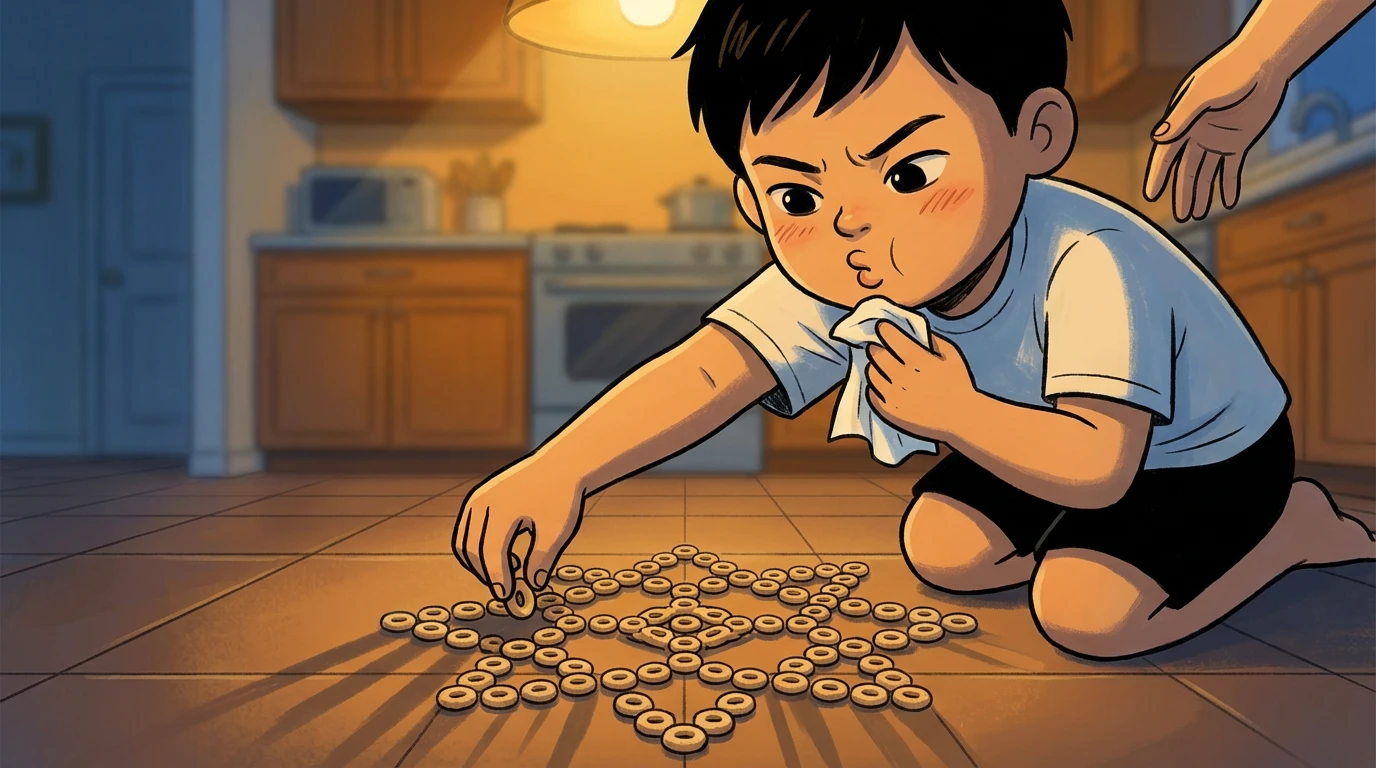
Tapping the doorframe again
The Childhood Anxiety course will help you respond to rituals correctly
You'll know when a ritual needs gentle disruption and when pushing back will only entrench it deeper.
The anxiety loop parents can't see
Here's what's happening inside your child's head. An intrusive thought fires: Something bad will happen if I don't spit right now. The thought produces a wave of anxiety that is physically unbearable. The child performs the ritual (spitting, touching, repeating), and the anxiety drops. The brain logs this: ritual worked, anxiety went away, do it again next time.
Every completed ritual strengthens the loop. The relief is real but temporary, and the next time the intrusive thought fires, it's louder. The child needs more repetitions, more elaborate sequences, more reassurance that they did it right.
This is why telling a child to "just stop" is like telling someone having a panic attack to relax. The instruction is technically correct and completely useless.

Common OCD behaviors parents mistake for something else
Compulsive spitting
Your child spits on the floor, on their hands, on food. It looks like a behavior problem. But a child with compulsive spitting typically hates doing it. They feel contaminated or "wrong" inside, and spitting is the brain's attempt to expel the wrongness. The shame compounds the anxiety, which compounds the spitting.
Repeating words or phrases
Some kids repeat what they just said until it sounds "right." Others repeat what you said. Others whisper corrections to themselves. This can look like a quirk associated with ASD or sensory processing, and sometimes it is. The OCD version comes with distress and an inability to move on until the repetition satisfies an internal standard the child can't articulate.
Bedtime and morning rituals
The goodnight sequence that has to be perfect. The morning routine that takes 45 minutes because shoes have to be tied, untied, and retied until they're "even." Clothes that have to be put on in a specific order. When the ritual gets interrupted, the child melts down not from stubbornness, but from genuine terror that something will go wrong.
Confession and reassurance seeking
"Did I do something bad?" "Are you sure?" "But are you SURE?" Repeated ten times. Twenty. The child is trying to neutralize an intrusive thought, and your reassurance is the ritual. Every time you say "no, you didn't do anything bad," you complete the loop.
What helps at home
Professional treatment (specifically ERP, or Exposure and Response Prevention) is the gold standard for childhood OCD, and you should talk to a specialist sooner rather than later. But your behavior at home matters enormously while you're getting that support in place.
How to respond to OCD rituals at home
- Label what you see without judgmentSay 'I notice you feel like you need to touch that again. That sounds like the worry talking.' You're separating the child from the OCD. They are not the behavior.
- Externalize the OCD togetherGive it a name. Some families call it 'the bully brain' or 'the worry monster.' When you say 'the bully is being loud today, huh?' you and your child become a team against the OCD instead of opponents.
- Resist completing the ritual for themWhen your child asks you to repeat the goodnight phrase or confirm they didn't do something bad, pause. Say 'I already answered that one. What does your brain want me to say?' Help them notice the loop.
- Reduce accommodation graduallyIf your household revolves around the child's rituals, start small. Pick one accommodation to drop per week. Tell your child in advance: 'We're going to practice not checking the lock together tonight.'
- Praise the resistance, not the outcomeWhen your child fights the urge, even unsuccessfully, say 'I saw you try to walk past without touching it. That took guts.' The effort matters more than whether they managed to stop.

What makes it worse (the accommodation trap)
Your child can't leave the house until they've checked that the stove is off. So you let them check. Then they need to check twice. Then five times. Then they need you to check while they watch.
Every accommodation expands. The thing that feels compassionate (letting them complete the ritual, answering the reassurance question) is the thing that makes the condition stronger. It's the same principle behind every evidence-based anxiety strategy: you have to let the anxiety exist without rushing to extinguish it.
The reassurance trap
Your child asks if everything is okay. You say yes. That's just being responsive, right?
With OCD, your "yes" is a compulsion performed by proxy. The child is using your answer to complete a ritual their brain demands. The fix is to acknowledge the worry without providing the specific reassurance: "I can see the worry is really loud right now. What do you think the answer is?"
When to get professional help
For general childhood anxiety, there's a lot you can handle with the strategies in this anxiety series. OCD is different. The research is clear: ERP therapy is the most effective treatment for pediatric OCD, and earlier intervention leads to better outcomes.
Signs it's time to call a professional:
- The rituals take more than 30 minutes per day
- Your child is avoiding school, friends, or activities because of the behaviors
- You've restructured parts of family life around the rituals
- Your child expresses distress about not being able to stop
- The behaviors are escalating in frequency or complexity
A therapist trained in ERP will help your child gradually face situations that trigger obsessions without performing the compulsion. Kids are remarkably good at this when the therapist knows what they're doing.
Challenges like social anxiety involve similar exposure principles, but OCD specifically requires the response prevention component. General talk therapy alone won't cut it.

The thing about OCD that changes everything
Once you understand that the rituals are anxiety-driven, your entire frame shifts. The spitting, the repeating, the elaborate bedtime sequences, the endless questions. They stop looking like your child being difficult and start looking like your child being trapped.
You can't discipline OCD out of a child. But you can stop accidentally feeding it, name it as something separate from who your child is, and get them in front of someone who knows how to treat it. That's the job.
FAQ
Look for distress. A child going through a phase is calm during their routine and mildly annoyed if interrupted. A child with OCD is anxious before the ritual, briefly relieved after, and panicked if prevented from completing it. Duration matters too. Phases fade in weeks. OCD escalates.
Yes. OCD can appear in preschoolers, though it's more commonly diagnosed around age 6-10. In very young children, it's often mistaken for quirky toddler behavior. If the rituals cause visible distress and resist redirection, mention it to your pediatrician regardless of age.
Some children experience periods where symptoms decrease, but OCD rarely resolves completely on its own. Without treatment, it tends to shift forms over time rather than disappear. Early ERP therapy gives the best chance of long-term management.
No. OCD has strong genetic and neurobiological roots. Parenting didn't cause it. However, how you respond to the rituals can either reduce or reinforce the cycle, which is why learning about accommodation is so valuable.
Yes. Teachers who understand OCD won't mistake rituals for defiance or attention-seeking. Share specific behaviors to watch for and let the teacher know that forcing the child to stop mid-ritual increases anxiety. A brief conversation prevents a lot of misunderstanding.