TLDR
- Separation anxiety is biology, not bad behavior. Children are wired to stay close to their survival system. When that system walks out the door, their brain registers it as a threat. This is healthy attachment doing its job.
- Sneaking out makes everything worse. When you vanish without warning, your child learns they can't trust the moment. Now they have to monitor you constantly instead of just dealing with a predictable goodbye.
- Short goodbyes beat long ones. Lingering signals to your child that you're not sure they'll be safe. Keep it brief, confident, and always with a clear statement about when you'll return.
- Reunion matters as much as departure. How you greet your child at pickup shapes whether they trust the next goodbye. Show up on time, greet them warmly, and narrate the story of how you came back.
- Gradual exposure builds real confidence. Start with five-minute separations and work up. Each successful reunion is a data point that rewires your child's expectations about being apart from you.

What separation anxiety is (and what it isn't)
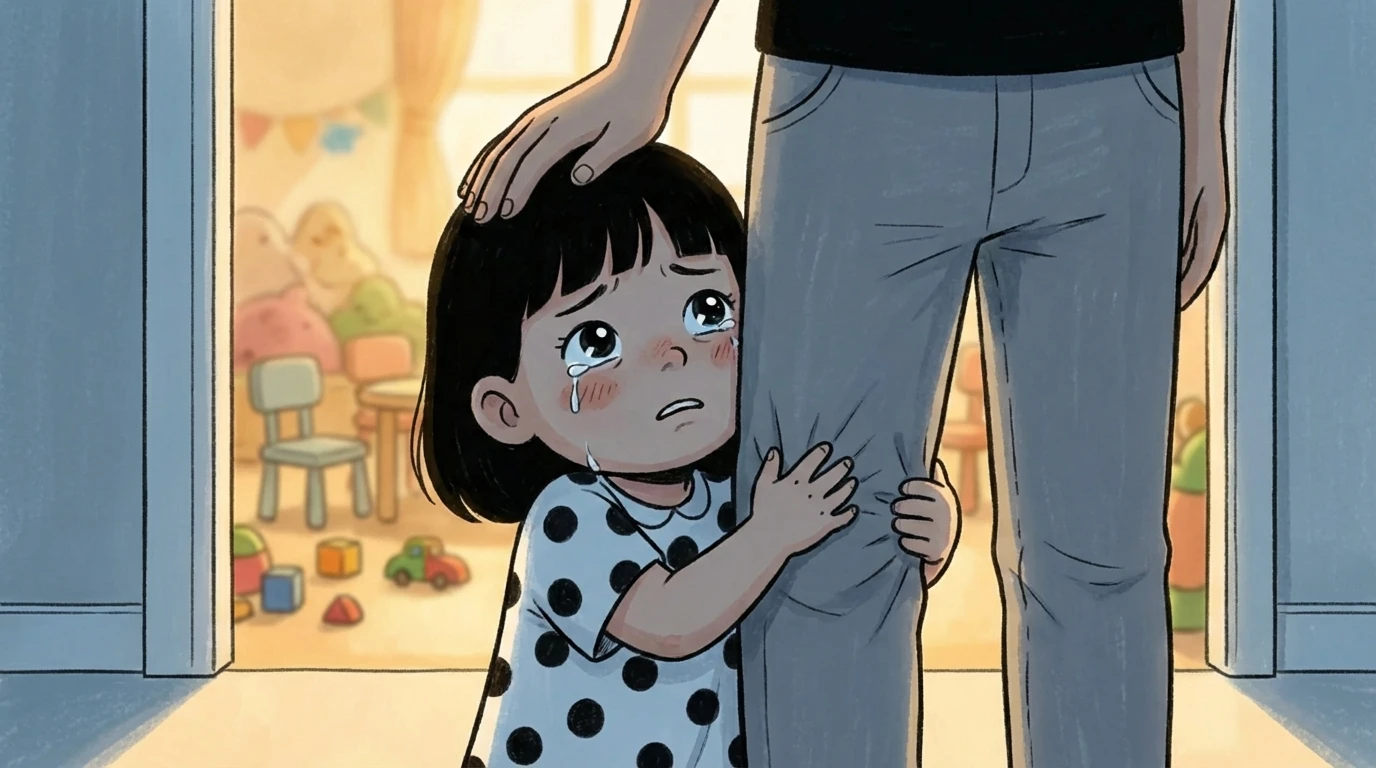
Your toddler wraps both arms around your leg at daycare drop-off and screams like you're abandoning them on a mountainside. You feel terrible. The other parents are staring. You start wondering if something is wrong with your kid.
Nothing is wrong with your kid. Children are biologically programmed to keep their primary caregiver close because that caregiver is their survival system. Food, shelter, warmth, love: it all flows through you. When you head for the door, their brain doesn't register "mom's going to work." It registers that the supply line just got cut.
This reaction is most common between 9 months and age 4 or 5, though it can show up at any age. Some kids breeze through drop-off. Others cling and wail for months. Research shows that highly sensitive children struggle more with separation from birth, feeling everything more intensely, including the moment you say goodbye.
Separation anxiety means your child is securely attached to you. That's the part nobody tells you while you're peeling a sobbing three-year-old off your shin at 8:15 AM.
Peeling them off your leg
The Childhood Anxiety course will make drop-off survivable
You'll have a goodbye routine that shortens the crying and stops the clinging before you reach the door.
Why your child's brain can't "just deal with it"
The one-track mind problem
Toddlers and preschoolers get stuck on a single thought. They cannot hold "my parent is leaving" and "I am safe" at the same time. Their brains physically lack the wiring for that kind of flexibility until around age 5 to 7. So when you walk toward the door, the only thought available is: you're leaving and I might never see you again.
The hardware arrives first. The software takes years of practice.
The contrast problem
During the day, your child has near-constant access to you. At bedtime or daycare, they're suddenly expected to go hours without their person. That shift feels enormous. Separation anxiety at bedtime hits especially hard because darkness amplifies the feeling of being alone.
When your child melts down at the moment of separation, their nervous system has flipped into fight-or-flight. You'll see it as screaming (fight), running away and hiding (flight), or going limp on the floor (freeze). These are stress responses, not personality flaws.

The goodbye that works
Here's what most parents get wrong: they either linger (which signals "I'm not sure you'll be safe") or they sneak out (which signals "I can't be trusted to warn you"). Both backfire.
The best goodbyes are short, confident, and honest. Short does not mean rushed. You're delivering a clear message and following through.
What to say
Tell your child two things: that you are leaving, and when you will be back. Clarity reduces anxiety. Confusion increases it.
A script that works: "I'm going to work now. After lunch, I'll come get you and we'll walk home together." Give them a concrete event to anchor to, not a clock time.
What not to do
Never slip away without saying something. Children who discover their parent vanished without warning become hyper-vigilant. Instead of one predictable goodbye, they now spend all day monitoring whether you're about to disappear again.
If your child cries when you leave, walk out anyway. If you rush back every time they cry, they learn that crying reverses the separation, which makes the next goodbye harder.
How to build your child's separation confidence
- Start with tiny separationsBefore a big transition like daycare, practice at home. Take a bathroom break in a separate room. Leave your child with a grandparent for thirty minutes. Each micro-separation builds evidence that you come back.
- Introduce caregivers graduallySpend time at the new environment with your child before leaving them alone. Let them bond with the caregiver while you're present. Your child absorbs your sense of safety and transfers it to the new person.
- Create a predictable goodbye ritualSame sequence every time: a hug, your parting phrase, a wave from the window. Predictability lets your child mentally prepare for each step.
- Give them a connection objectA photo of you, a stuffed animal, a t-shirt that smells like you. Transitional objects buffer the intensity of the goodbye. Draw a heart on their hand and one on yours so you match.
- Be on time at pickupIf you say 'after lunch,' be there after lunch. Every kept promise is a data point that rewires your child's expectation about whether you can be trusted to return. Broken promises compound anxiety.
What to do when you come back
Most parents focus on the goodbye and forget about the reunion. But how you show up at pickup shapes whether your child trusts the next goodbye.
Greet your child with warmth. Walk in, make eye contact, tell them you're happy to see them.
Then try the "tell the story" technique: narrate what happened. "I took you to school, you were a little nervous, you played with your friends, and I came back just like I said I would." Your child starts to internalize the pattern: they leave, good things happen, they come back.

If your child ignores you at pickup or acts out by throwing things, they're probably not indifferent. They're angry. The message underneath is I missed you and I was sad, but I don't know how to say that, so I'm showing you I'm mad instead. Name it for them: "You seem upset. I think you missed me. I missed you too."
When separation anxiety shows up at bedtime
Secure attachment is the foundation your child uses to tolerate being apart from you. At bedtime, that foundation gets tested.
If bedtime has become a nightly battle, build a "connection bridge." For younger kids: draw matching hearts on your hands, tell them a story about an invisible string between you, or whisper a secret to their stuffed animal about keeping them safe. For older kids: spray your perfume on their pillow, or put a photo of the two of you on their nightstand.
When the anxiety lingers (and what that means)
Gradual exposure is how children build tolerance for being apart from you. Most kids move through separation anxiety within weeks or months if they're getting consistent, predictable goodbyes and reliable reunions.
But some situations make the anxiety stick around. A parent returning to work after months at home. A week-long trip that left the child with grandparents. A hospitalization. The child's fear is no longer theoretical. They need more time and more evidence to trust that it won't happen again.
If your child's anxiety is preventing them from functioning at school, with friends, or at home, that's when professional help makes sense. A child who needs coaxing but eventually participates is in the normal range. A child who cannot participate at all may need support beyond what you can provide at home.
For school-age kids wondering about the next big step, a kindergarten readiness assessment can help you figure out where they stand.

The hardest part is your own feelings
Your child screaming at drop-off wrecks you too. Your heart lurches, your eyes sting, and you spend the next two hours refreshing the daycare app for proof they stopped crying.
Children read your emotional state to decide whether a situation is safe. If you're trembling at goodbye, your child picks up the signal that something might be genuinely wrong. The parenting term for what you need here is "sturdiness": the ability to tolerate your child's distress without getting pulled into it.
Sturdiness doesn't mean you feel nothing. It means you feel the hard thing and do the hard thing anyway. You empathize ("I know you don't want me to go"), state the plan ("I'll be back after lunch"), and walk out even though every cell in your body wants to turn around.
That, more than any script, is what teaches your child that separation is survivable.
FAQ
Peak separation anxiety typically runs from 9 months to age 3, gradually fading by 4 or 5. Highly sensitive children may take longer. The timeline depends on temperament, consistency of routines, and how caregivers handle goodbyes and reunions.
Yes, as long as a trusted caregiver comforts them after you leave. Brief crying followed by accepting comfort is normal. If your child cries hard for more than fifteen minutes after you leave, they may need more time bonding with the caregiver before regular separations.
No. Transitional objects like a stuffed animal or a parent's t-shirt help children bridge the gap between your presence and your absence. Most kids naturally outgrow the need for them. The object is a tool for building confidence, not a crutch.
Avoiding separation altogether can reinforce the fear. The goal is gradual, predictable separations that build your child's evidence base: you leave, good things happen, you come back. Start small, stay consistent, and always follow through on your return time.