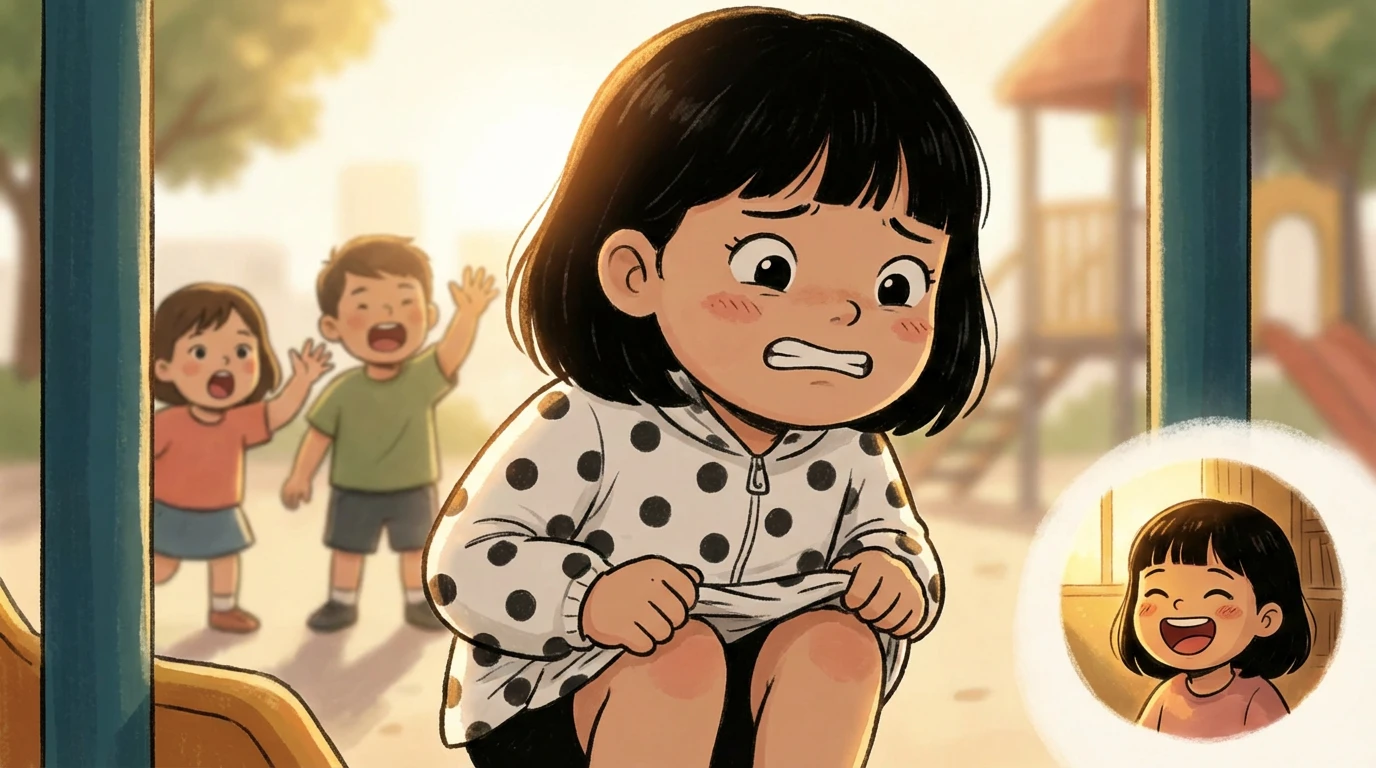
TLDR
- Shyness and social anxiety are different animals. Shy kids warm up slowly but get there. Socially anxious kids avoid situations entirely, and the avoidance gets worse over time without intervention.
- Selective mutism is anxiety, not defiance. A child who talks nonstop at home but won't speak at school is experiencing a freeze response. They aren't choosing silence. Their nervous system is choosing it for them.
- Speaking for your child feels helpful but backfires. Every time you answer on their behalf, you confirm the brain's theory that speaking is too dangerous to attempt.
- Gradual exposure works, but the steps need to be tiny. Whispering to a parent in the presence of another person counts as progress. Waving instead of speaking counts. The goal is any communication, not perfect conversation.
- Selective mutism needs professional help early. Unlike general shyness, selective mutism rarely resolves on its own. Early intervention with a therapist trained in this specific condition makes a measurable difference.

The difference between shy and stuck
Every parent has watched their kid hide behind their leg at a birthday party. That's shyness, and it's a temperament trait, not a disorder. Shy children warm up given time and a low-pressure environment. They might hang back for twenty minutes, then join the game.
Social anxiety is different. The child doesn't warm up. They spend the entire party pressed against the wall or begging to leave. And the next time a party invitation arrives, they refuse to go. The hallmark of social anxiety is avoidance that grows over time. Each avoided situation teaches the brain that socializing is dangerous, which makes the next situation feel even more threatening.
Here's the tricky part. From the outside, both kids look the same at minute one. The difference shows up at minute thirty, and at the next event, and the one after that. Shy kids expand. Anxious kids contract.
What selective mutism looks like (and doesn't)
You have a child who narrates their entire day to the family dog, performs elaborate puppet shows in the living room, and argues with their sibling at full volume about whose turn it is on the tablet.
Then the school calls. Your child hasn't spoken a word in class since September.
Silent at school, loud at home
The Childhood Anxiety course will help your child find their voice outside
You'll build a bridge between the chatty kid you know and the one their teacher has never heard speak.
The freeze response in action
Selective mutism is an anxiety disorder. The child's brain tags specific environments or people as threats. When the threat system activates, the vocal cords physically tighten. Speech becomes as difficult as trying to talk while someone squeezes your throat.
This is a freeze response, the same system that makes adults go blank during a job interview. In children, it gets locked to specific contexts. Home is safe, so speech flows. School is tagged as threatening, so speech stops.
What it's not
Selective mutism is not oppositional behavior. The child is not giving you the silent treatment. If your kid could talk, they would. Telling them to "just say hi" is like telling someone having a panic attack to just calm down. Technically correct and completely useless.
It's also not autism spectrum disorder, though they can co-occur. A child with selective mutism has typical communication at home. The silence is context-dependent, not global.

Why "just talk" makes everything worse
The most common adult response to a silent child is to increase pressure. Teachers call on them in class. Relatives get in their face at holidays. Parents bribe. If you don't say thank you to grandma, we're leaving.
Every pressure tactic confirms the brain's threat assessment. The intensity of the adult reaction becomes evidence that this situation is, in fact, dangerous.
The accommodation trap
The opposite extreme causes problems too. When parents permanently speak for their child, order their food, answer every question directed at them, the child never gets data that contradicts the anxiety.
You're caught between two bad options: pushing too hard (which triggers a shutdown) and accommodating too much (which prevents growth). The path through the middle is narrow.
The gradual exposure approach that works
The clinical term is "stimulus fading" or "sliding in," and it looks nothing like the dramatic exposure therapy you might picture. Nobody is going to put your child on a stage. The steps are so small they barely register as progress, which is exactly the point.
How to build speech in low-pressure steps
- Start where speech already happensRecord your child talking at home, or have them whisper to you in a quiet corner of a familiar place. The goal is to prove to the brain that their voice exists outside the house.
- Add one person to the safe zoneInvite one calm, patient friend or relative to your home. Let your child talk to you normally while this person is in the next room, then the same room, then part of the conversation. Weeks, not days.
- Bridge to new environmentsVisit the classroom when it's empty. Let your child talk to you there. Then with one classmate present. Then two. The environment becomes safe before the social demand increases.
- Use nonverbal stepping stonesPointing, nodding, thumbs up, showing a drawing, whispering to a parent who relays the message. Every act of communication that isn't full speech still rewires the threat circuit. Accept all of it.
- Celebrate any sound at allA laugh, a cough, a whispered word to a stuffed animal in someone's presence. Any vocalization in a previously silent context is the brain updating its threat map. Notice it quietly, don't throw a parade.

What happens at school
School is where selective mutism causes the most visible damage. A child who can't speak can't participate or ask for help. The social consequences pile up fast. Other kids stop trying to include someone who never responds.
Working with teachers
Most teachers have never encountered selective mutism. They need three things from you: an explanation (this is anxiety, not defiance), specific strategies (don't call on them in front of the class, allow nonverbal responses, pair them with one patient buddy), and realistic expectations (progress is measured in whispers, not speeches).
Ask the school to stop requiring verbal participation for grades. A child who can write the answer but not say it out loud is demonstrating knowledge. Penalizing the delivery method punishes the disability.
The social confidence question
If you're wondering how socially confident your child is underneath the anxiety, a social confidence assessment can help separate what's temperament from what's the anxiety talking. Some kids with selective mutism are natural extroverts trapped behind a freeze response. Others are introverted and the mutism layers on top.
When to call in a professional
Here's where this article gets direct. If your child has been consistently silent in a specific setting for more than four weeks, get professional help. Selective mutism responds well to early intervention and responds poorly to waiting it out.
Look for a therapist who specifically treats selective mutism, not general childhood anxiety. The treatment approach (behavioral, exposure-based, sometimes called "brave talking") differs from standard talk therapy. A therapist who asks your nonverbal child to sit on a couch and describe their feelings has missed the point.
The anxiety series overview covers when worry crosses into clinical territory across all anxiety types. For selective mutism specifically, the threshold for seeking help is lower and the timeline is shorter than for other childhood anxiety presentations.
Gradual exposure techniques form the backbone of treatment, whether you're doing them at home or a professional is guiding the process. The next article in this series covers that approach in detail.
Previous patterns like OCD-type rituals can coexist with selective mutism. If your child has both, mention it to the therapist because treatment sequence matters.
The long game
Most children with selective mutism who receive appropriate treatment begin speaking in previously silent settings within months. The anxiety may linger underneath, but the functional impairment responds to consistent low-pressure work.
Your job in the meantime is to be the translator, not the fixer. Relay their whispers without embarrassment. Explain to confused relatives without making it a spectacle. Protect them from well-meaning adults who think a little pressure will crack it open.
The silence doesn't need cracking. It needs melting. And melting takes warmth applied steadily over time.

FAQ
Shy children warm up over time in new situations and eventually participate. Children with selective mutism consistently cannot speak in specific settings regardless of how much time passes. The silence is involuntary, driven by a freeze response in the nervous system, and it doesn't resolve with simple encouragement.
Some children do, but many don't, and waiting carries risks. Untreated selective mutism can solidify into broader social anxiety that persists into adolescence. Early intervention is more effective than hoping it resolves naturally. Four weeks of consistent silence in a setting is enough to warrant professional evaluation.
Gradually, yes. Start by giving your child a few extra seconds before jumping in. If they don't speak, relay what they whispered to you rather than inventing an answer. The goal is reducing accommodation without increasing pressure, which means small shifts over weeks.
Keep it brief and factual: 'They have an anxiety condition that makes speaking in certain situations very difficult. They're working on it with professional support. The best thing you can do is talk to them normally without requiring a response.' Most people adjust once they understand.
Not necessarily. Children who receive treatment for selective mutism often develop typical social functioning. The anxiety itself may persist at a low level, but the ability to speak and participate in social situations is a skill that, once unlocked, tends to hold. Early treatment gives the best odds.