TLDR
- Catastrophic thinking is a pattern, not a personality. Children who worry about everything aren't dramatic. Their brains are running threat-detection software with the sensitivity dial cranked to maximum.
- Empathize before you reassure. Jumping straight to 'it'll be fine' feels dismissive. Let your child voice the worry fully, reflect it back, then offer comfort.
- Avoidance feeds the spiral. When kids avoid the thing they fear, the relief teaches their brain the fear was justified. Gentle exposure, with support, breaks the loop.
- Your own anxiety is contagious. Parental worry about a child's worry creates a feedback loop. Getting your own nervous system regulated is half the intervention.
- Bedtime is ground zero. A quiet, dark room with no distractions gives the worry brain exactly what it wants: uninterrupted airtime. Structure the wind-down deliberately.

The brain that won't stop asking "what if"
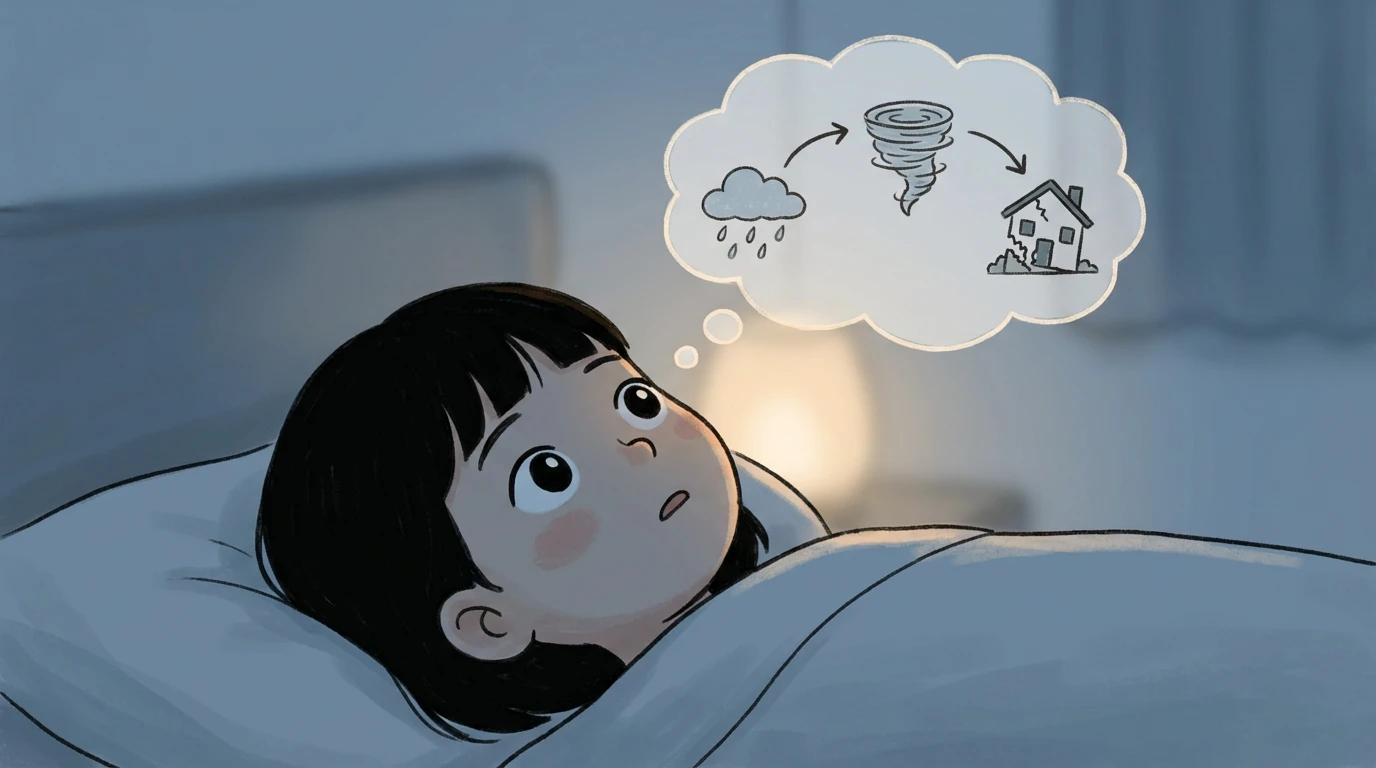
Your kid said goodnight twelve minutes ago. Now they're at your door, worried the house might catch fire. Last night it was burglars. The night before, a tornado (you live in Portugal).
One worry triggers a bigger worry, which triggers a worse one, which triggers the worst possible outcome. The child's brain doesn't stop at "what if there's a noise downstairs." It races through to "what if someone breaks in and everyone dies."
Kids who spiral like this aren't choosing drama. Their threat-detection system is genuinely firing. Mirror neurons, the same brain cells that let toddlers feel a storybook character's embarrassment so intensely they slam the book shut, are working overtime. Every hypothetical scenario feels real in the body: heart rate climbs, stomach tightens, and the worry becomes its own evidence. "I feel scared, so there must be something to be scared of."
You can't logic a child out of a worry spiral while it's spinning. But you can learn to interrupt it, redirect it, and over time, shrink it.
Why some kids are wired for worry
Not every child catastrophizes. The ones who do tend to share a few traits.
Sensory sensitivity
Highly sensitive children process stimulation more deeply, including emotional stimulation. A passing comment from a teacher or a news headline overheard from the next room lands harder and lingers longer.
The tween hormone surge
Around age ten, pubertal hormones make it harder for kids to fall asleep. Screens suppress melatonin on top of that. A tired, hormonally destabilized brain defaults to threat scanning, and as academic pressure increases and social hierarchies reshuffle, the world feels less predictable. For tweens and teens, the spiral often looks different: instead of crying at bedtime, they snap at you, withdraw, or refuse activities they used to love.
Listing every worst case
The Childhood Anxiety course will break the bedtime worry loop
You'll interrupt catastrophic thinking before it snowballs and your child will fall asleep without the nightly interrogation.
Parental anxiety (yes, yours)
When you're anxious about your child's anxiety, they feel it. Your tension at bedtime, your worried face when they mention a fear, the slight edge in your voice when you say "there's nothing to worry about" while clearly worrying: all of it registers.
Research on this feedback loop is clear. When parents received reassurance that their child's anxiety was within the normal range, the parents relaxed, and the children improved. Sometimes the biggest intervention was calming the parent's own worry pattern rather than directly treating the child.

How to interrupt a worry spiral in the moment
When your child comes to you mid-spiral, your instinct is to fix it. "The house isn't going to catch fire. We have smoke detectors. Go back to bed." That's reassurance without empathy, and it bounces right off.
Step one: name the worry out loud
Reflect what the child is telling you, with specifics. "You're worried that if there's a fire, we won't wake up in time." This takes the swirling dread in their head and turns it into a sentence. A sentence is smaller than a feeling. A sentence can be examined.
For younger kids, you often have to supply the words entirely. A toddler who slams a book shut before the character makes a mistake is experiencing empathic distress they can't articulate. Saying "You don't like that part? That feels bad" gives them a container for the feeling.
Step two: empathize before anything else
"That sounds really scary. I get why that would keep you up." Full stop. No "but." The child needs to feel that their worry has been received, not batted away.
Step three: offer one concrete anchor
After the empathy has landed (you'll feel the child's body soften), offer one grounding fact. Not a lecture. One thing.
"We have smoke detectors in every room, and they're loud enough to wake the whole street."
Then redirect: "What are you looking forward to this weekend?" Shifting to a positive topic gives the brain somewhere else to go.
How to respond when your child spirals at bedtime
- Reflect the specific worrySay back exactly what they told you. 'You're scared the earthquake will happen while we're sleeping.' Precision shrinks the fear from a fog into a sentence.
- Empathize without fixingAcknowledge the feeling is real. 'That's a scary thought. I understand why your brain keeps going back to it.' No 'but' for at least thirty seconds.
- Offer one grounding factGive a single concrete reassurance tied to the specific worry. Not a list of reasons they're safe. One fact they can hold onto.
- Redirect to something positiveShift the conversation to what they're looking forward to. Weekend plans, a favorite meal, a friend coming over. Give the brain a different track to run on.
- Use a consistent wind-down ritualSame music, same sequence, same words every night. Predictability is the opposite of anxiety. Over time the ritual itself signals safety.

Building long-term worry tolerance
Interrupting individual spirals matters, but the real goal is helping your child's brain learn that uncertainty is survivable.
Gradual exposure to the feared thing
Avoidance is the worry spiral's best friend. Every time a child avoids what scares them and feels relief, their brain logs: "The fear was real, and avoidance saved me." The next encounter triggers an even bigger response.
The antidote is gentle, supported exposure. A child afraid of the dark doesn't need a pitch-black room. They need a graduated approach to managing their anxiety: lights dimmed a little more each week, a parent present but gradually moving further away. Push too fast and the child panics, reinforcing the fear. Move steadily and they accumulate evidence that they survived.
Give them something to control
A huge part of worry is helplessness. Giving a child control over small variables reduces that feeling dramatically. Let them choose the nightlight brightness. Let them pick their wind-down music. Tell them they can call for you at any time and you will come. Then keep that promise every single time. Their willingness to tolerate your absence depends entirely on their confidence that you'll show up when called.
Name the pattern, not just the worry
With older kids, you can name the pattern itself. "Your brain is doing that thing again where it takes one worry and stacks ten more on top. Let's just look at the first one." This teaches metacognition: the ability to observe their own thinking rather than being swept along by it.
When worry crosses the line
A child who worries but still participates in daily life is likely within the normal range. They might need coaxing to go to dance class, but they go and enjoy it once there.
Watch for when anxiety prevents functioning. A child who can't attend school, won't leave the house, or whose sleep is so disrupted they can't concentrate during the day. That's when professional evaluation makes sense. All kids worry. The benchmark is whether the worry is running their life.

The overnight version
Bedtime is where worry spirals thrive: dark, quiet, alone, nothing to distract the brain.
End the day with connection, not correction. Thirty minutes of reading together before lights out fills the child's emotional tank. After the light goes off, tell them one specific thing you noticed about them that day. "I saw you help your sister find her shoe this morning without anyone asking." Specificity matters. Generic praise doesn't anchor the way a concrete observation does.
Turn on the same music every single night. After a few weeks, the music itself will trigger drowsiness through conditioned association.
Remove screens at least an hour before bed. This is especially relevant for tweens whose melatonin production is already suppressed by hormonal changes.
And some of this will take weeks or months, not days. A child learning to tolerate bedtime alone is building a skill, the same way they learned to ride a bike. There will be backsliding. There will be nights you sit in their doorway reading your own book by flashlight. That's scaffolding.
FAQ
Check whether your child is still functioning at school, with peers, and at home. A child who worries but still participates in daily life is likely within the normal range. A child whose anxiety prevents them from attending school, maintaining friendships, or sleeping consistently may benefit from professional evaluation.
Occasionally, yes, and it won't create a permanent habit. But if it becomes nightly, work on graduated independence instead. Start by sitting in their room while they fall asleep, then gradually move further away over days or weeks. The goal is building their confidence, not cutting them off.
Don't argue with the probability. Their brain has already decided the threat is real. Instead, name the specific worry, empathize with how scary it feels, offer one concrete grounding fact, and redirect to something positive. Over time, this teaches their brain to interrupt the spiral on its own.
Often, yes. Children are remarkably tuned in to parental stress. When parents manage their own anxiety and communicate genuine confidence, children absorb that calm. Working on your own worry patterns is one of the most effective things you can do for your child.
Catastrophic thinking can appear as early as toddlerhood, when children first develop empathy and begin imagining negative outcomes. It often intensifies around ages seven to ten as cognitive abilities grow and again during puberty when hormones, sleep disruption, and social changes converge.