TLDR
- Calm yourself before anything else. You cannot de-escalate a child while your own nervous system is in fight-or-flight. Breathe first.
- Feelings intensify before they resolve. When your child cries harder after you validate, the process is working. Safety unlocks the release.
- Stop labeling older kids' emotions. Repeating 'you are very sad' makes school-age kids feel analyzed. Match their tone instead.
- Problem-solving comes last. If your child isn't calm, they aren't ready for solutions. Go back to validating.
- Empathy is not a technique to stop tantrums. It helps your child process feelings. Sometimes the crying gets louder before it stops.

Your kid is melting down and you have six seconds
Your daughter just threw a handful of Legos at the wall because the tower collapsed again. Your son is yelling that you never listen. Your toddler is lying face-down on the sidewalk, screaming about a dog they saw two blocks ago.
Every fiber of your being wants to fix it, stop it, or leave the room. That instinct is normal. And it will make things worse about 90% of the time.
Emotion coaching is helping your child move through big feelings instead of around them. Children who learn to feel emotions (rather than stuff them) develop better self-regulation and fewer behavior problems.
Here is the process in six steps.
Freezing mid-meltdown
The Big Feelings course will give you the six steps in order
You'll know exactly what to say and when to stay quiet, so the meltdown moves through instead of escalating.
Step 1: calm yourself first
Before you say a single word, deal with your own nervous system.
An escalated parent cannot de-escalate a child. That is the brain science behind co-regulation, not a bumper sticker. Your child's nervous system attunes to yours. If your heart rate is spiking, theirs will too.
Stop, drop your agenda (just for now), and breathe. The "just for now" matters because bedtime still exists. The homework still needs doing. But this moment requires presence before productivity.
Try a mantra: This is not an emergency. Even if your kid just told you he hates you in front of your mother-in-law.
Notice what your body is doing
Are your fists clenched? Jaw tight? The urge to make this stop right now? Good. Notice that. The gap between impulse and response is where all of parenting lives.
Step 2: connect to create safety
Your child needs to feel big emotions instead of stuffing them. Stuffed emotions do not vanish. They bubble up later as hitting, defiance, or that inexplicable meltdown at 5:47 p.m. every day.
Your job is to make it safe enough for feelings to come out. Get close. Touch their shoulder if they will let you. Use a warm tone, not the one you use when pretending to be calm but obviously furious.

If you breathe slowly and deeply, your child will usually start to breathe more slowly too. Co-regulation works even when your child looks like they want nothing to do with you.
Give them the message: I am here. You are safe. You can handle this.
Step 3: validate without fixing
This is where most parents trip up. Your child is upset, and you want to solve the problem or explain why their feelings are unreasonable. Both are mistakes.
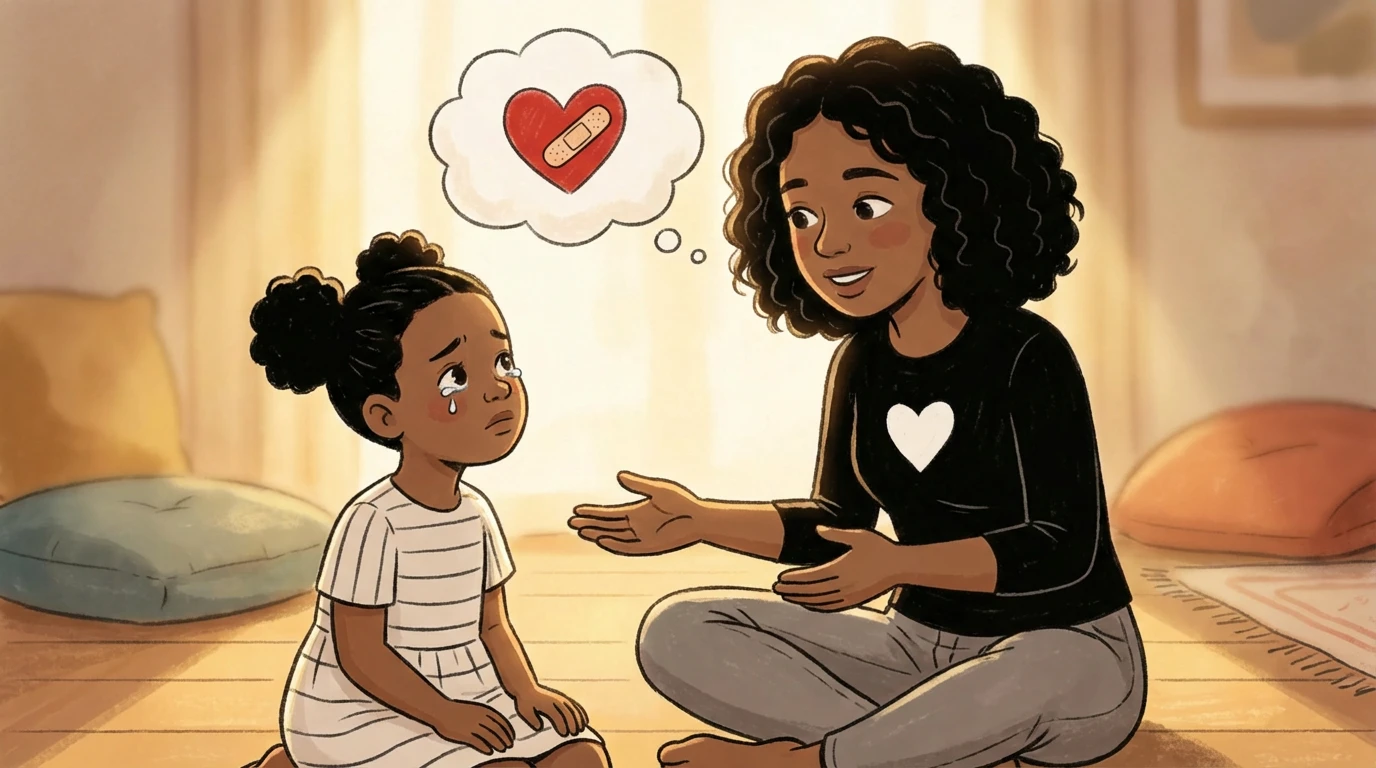
Validation does not mean you agree. It means you understand why they feel this way. "You're so mad that your brother took your turn" acknowledges the feeling without picking sides.
Match their intensity
A mellow "you seem upset" aimed at a child vibrating with rage will feel dismissive. If they are furious, your voice should carry weight: "You are so angry about this."
With older kids, skip the labels
With toddlers, naming emotions works well. "You're so mad!" gives them a word for the tidal wave. But with older children, repeating "you are very sad and frustrated" makes them feel managed. Imagine your partner doing that to you.
Instead, try: "That's so disappointing" or just sounds of understanding: Mmm. Oh no. The child does not need a therapist narrating their inner life. They need a person who gets it.
Step 4: double-check your understanding
You do not have to be a mind reader. Just ask: "Did I get that right?"
If they snap "I'm NOT mad!", that is a signal they feel analyzed. Back up and describe what happened instead: "You wanted to keep playing and I said stop. Is that what's bugging you?"
Do not fight about what your child is feeling. Their awareness shifts in real time. What matters is that they feel you are on their side.
How to emotion coach your child in 6 steps
- Calm yourself firstPause, breathe, drop your agenda for 90 seconds. You cannot regulate a child while escalated. Try the mantra: 'This is not an emergency.'
- Connect to create safetyGet close, use a warm tone, breathe slowly. Your child's nervous system attunes to yours. Physical touch helps if they accept it.
- Validate without fixingAcknowledge what your child feels without trying to solve the problem yet. Match their intensity so they feel genuinely heard, not managed or analyzed.
- Double-check understandingAsk 'Did I get that right?' If they correct you, use their words. Do not argue about what they feel.
- Deepen the conversationAsk 'Is there anything else?' The presenting problem is often not the real one. Let them talk.
- Support problem-solving lastOnly when calm, ask 'What could you do about this?' Resist giving answers. Still upset? Go back to step 3.
Step 5: deepen the conversation
Here is the move that separates emotion coaching from generic "I hear you" parenting. Ask: "Is there anything else?"
This question opens floodgates. Your child might start with complaints about oatmeal and end up telling you they think you love their sibling more. Children who react intensely to minor setbacks are often carrying something bigger underneath.

Let yourself feel some of what your child is feeling while staying centered. If their heartbreak is real, your eyes might sting. That is connection, not weakness.
You can narrate what happened without judging: "You wanted the red cup. Dad gave you the blue one. You got really upset." Telling the story back helps a child's brain integrate the experience, moving it from raw emotion into something they can begin to let go of.
When empathy seems to make things worse
Sometimes after you validate your child's feelings, the crying gets louder. Way louder.
You did not break your child. Your empathy created enough safety for locked-up emotions to surface. Think about it: when you have been holding it together all day and someone you trust hugs you, what happens? You fall apart. Same mechanism.
Emotions intensify before they resolve. The alternative is those feelings staying stuffed down and driving the hitting, the defiance, and the 4 a.m. wake-ups. After the big cry, most children become visibly calmer and more affectionate.
This is why what happens after a meltdown matters so much. The reconnection phase is where real learning lands.
Step 6: support problem-solving (last)
Wait until your child is calm. If they are still wound up, they cannot think logically.
Then try: "This is a tough problem. What do you think you could do?" Resist giving the answer. If they suggest something that would create more problems, use curiosity: "What do you think would happen if you did that?"
When there is no solution
Sometimes the playdate is cancelled. The toy is broken. The baby is staying. Your child may need to mourn. Children build resilience by feeling disappointment fully and discovering they come out okay.
For siblings, coaching each child through their feelings before frustration escalates can prevent a lot of the screaming.
The part where you mess it up
You will skip straight to problem-solving because you are late for work. You will snap "just stop crying!" on four hours of sleep. You will label your eight-year-old's feelings and watch their face shut down like a gate slamming.

That is okay. Emotion coaching is a practice, not a performance. Coming back and trying again teaches your child more about resilience than any single perfect interaction.
If you want to figure out which style of emotional connection clicks best with your child, a quick quiz on parenting love languages can help you tailor your approach.
The goal is a child who knows that feelings are safe to feel, that someone is on their side, and that even the worst moments pass.
FAQ
Step back but stay nearby. Say 'I hear you want space. I will be right here when you are ready.' They run because your warmth brings up feelings they do not want to face yet. Let them regulate the distance.
Yes. You will not get a conversation, but you can still validate by naming what you see: 'You wanted that toy and she took it. You are so mad.' The tone matters more than the words. Stay close, stay calm.
Talk alone will not stop hitting. Kids who hit have big fear locked inside. Validate the emotion, set a firm limit on the action, and create safety for the feelings underneath to surface. Over time, the hitting decreases.
You do not have to turn every spilled juice box into a therapy session. Use it when emotions are big enough to interfere with functioning or your relationship. For small frustrations, a simple 'That is annoying, huh?' is enough.
Most parents notice their child opens up more within a few weeks. Meltdowns do not disappear, but they get shorter and recovery gets faster. You will also notice your own stress response changing.