TLDR
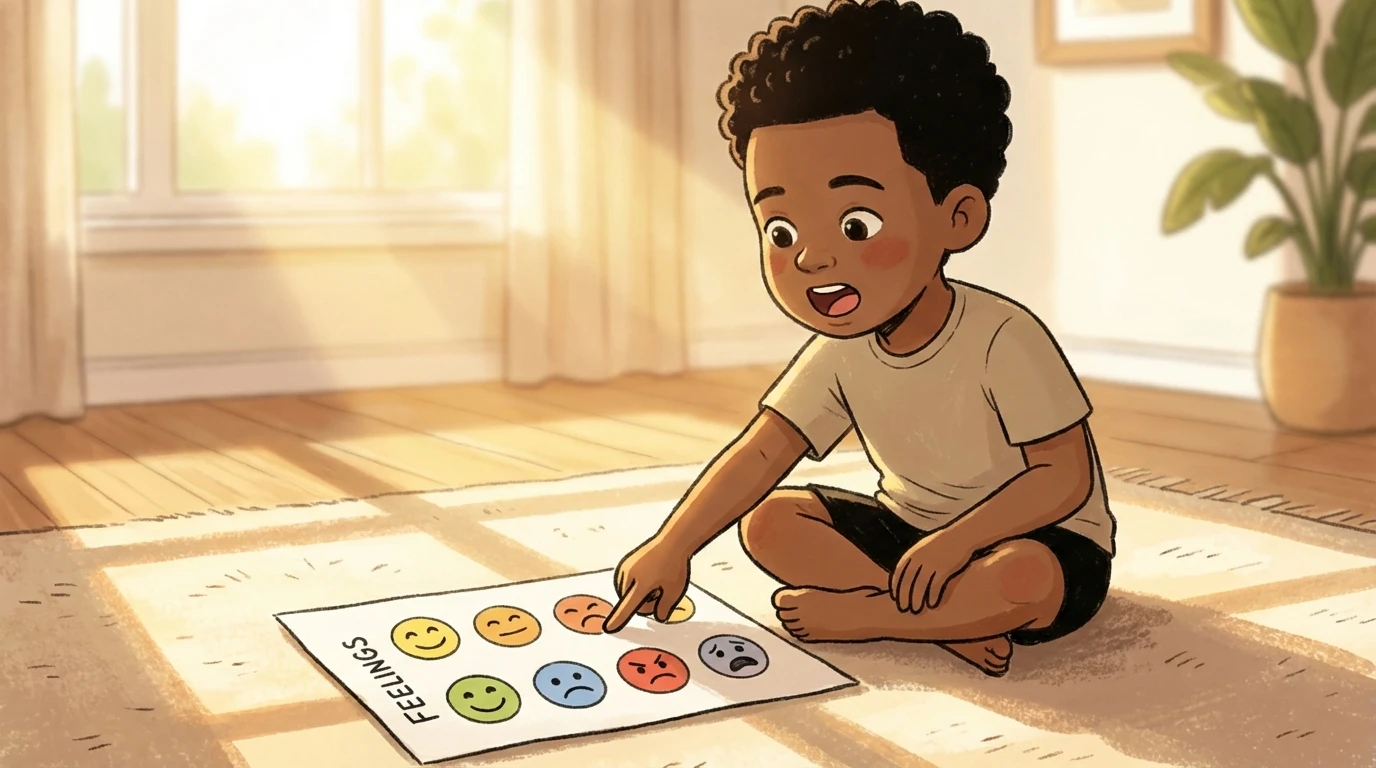
- Naming a feeling is the first step to managing it. The brain calms down when an emotion gets a label. Kids who can say 'I'm frustrated' are already further along than kids who can only scream.
- Children need six months of hearing a word before they use it. Start labeling emotions long before you expect your child to say them back. The absorption period is real and invisible.
- Anger is often a disguise for fear or sadness. When your child seems furious, check what might be underneath. Teaching them words for the deeper feeling changes how they cope.
- Daily life is the best classroom. You do not need flashcards or curricula. Grocery stores, playgrounds, and bedtime offer constant chances to name what everyone is feeling.
- Wondering about others builds empathy. When you and your child speculate about why someone else looks upset, you are training perspective-taking that translates into kinder behavior.

The word before the storm
Your kid is losing it in the cereal aisle. Face red, fists balled, volume at eleven. And somewhere in the back of your mind you think: if only they could tell me what is wrong instead of screaming about it.
That thought is the entire thesis of thirty years of developmental research. When children can name what they feel, they handle it better. The word itself does something. Brain imaging shows that labeling an emotion reduces activity in the amygdala, the alarm system that fires during big feelings. Adults who say "I'm anxious" out loud show measurably less physiological stress than adults who just sit with the sensation silently.
Kids work the same way, except they start with approximately zero words for their inner experience and have to build the entire dictionary from scratch.
Why words come before regulation
Here is the order that matters: feel it, name it, manage it. You cannot skip step two. A child who experiences rage but has no word for it can only act it out (hitting, throwing, screaming). A child who can say "I'm so mad" has created a tiny gap between the feeling and the action. That gap is where self-regulation lives.
Dr. Laura Markham puts it plainly: children need to hear emotional vocabulary for about six months before they can use it themselves. Six months. So if you want your three-year-old to say "I'm frustrated" during a meltdown, you needed to start labeling frustration around age two and a half. The clock is always running earlier than you think.
Beyond mad and sad
The Big Feelings course will build your child's emotion vocabulary
You'll hear words like frustrated, disappointed, and nervous come out of their mouth instead of screaming.
This is also why the toddler who can only say "NO" to everything is not being defiant. They have one word for a dozen different internal states. Hungry, tired, overwhelmed, scared, and angry all come out as the same furious syllable. Your job is to give them more words so they can be more specific.

The four feelings underneath everything
If the idea of teaching your child dozens of emotions feels like a graduate seminar, start with four. Every complex feeling maps back to one of these.
Happiness
Love, joy, peace, silliness. This is the baseline state, the feeling of things going the way they should. You do not need to teach this one hard. Kids arrive knowing happiness. Your job is just to name the subtypes: "You look so proud of that tower" is more useful than "you're happy."
Fear
Terror, anxiety, worry, and the feeling of being powerless. Here is the part that trips parents up: when mammals feel fear, they often shift into anger as a defense. So the kid who seems furious about going to a new school may be terrified underneath. If you address the anger, you miss the real problem. If you name the anxiety underneath, you give them a word for what is happening inside.
Sadness
Grief, disappointment, loneliness. Same pattern as fear: many kids defend against sadness by getting angry. The child who rages when they lose a board game may be devastated, not competitive. Name the sadness and watch the anger lose steam.
Anger
Irritation, frustration, rage. When anger goes unheard, kids sometimes turn it inward, which can look like withdrawal or numbness. A child who has shut down emotionally may have learned that nobody listens when they are angry, so they stopped showing it.
How to teach feeling words without a curriculum
You do not need flashcards. You need a mouth and some willingness to narrate out loud what would otherwise stay invisible.
Narrate your child's experience
Start from infancy. "You're startled. That was a loud noise." "You are so frustrated. That lid will not go on." You are not quizzing them. You are just providing the subtitles to their internal movie.
Speak on their behalf when they cannot. If a sibling grabs a toy and your toddler screams, say to the sibling: "Look at his face. He is telling you he does not like that." You have just labeled the feeling for the toddler, taught the sibling to read emotional cues, and modeled verbal expression. Three lessons in one sentence.
Model it with your own feelings
When you narrate your own emotional states out loud, you teach vocabulary through context. "I'm feeling really irritated because I've been on hold for twenty minutes" does more for your kid's emotional education than any worksheet. They see a real person feeling a real thing and using words instead of throwing the phone.
How to build your child's emotional vocabulary
- Label emotions from infancyNarrate what your baby or toddler seems to be feeling. 'You're excited, look at those kicking legs.' They absorb the words for months before they can use them.
- Go beyond mad, sad, and happyReplace 'you're upset' with more specific labels. Frustrated, disappointed, embarrassed, jealous, overwhelmed. The more precise the word, the more useful it becomes.
- Use play as a safe laboratoryStuffed animals can be angry, scared, and lonely. A three-year-old who cannot say 'I'm furious' can make a stuffed bear say it. The distance makes it safe.
- Tell stories about their past feelingsNarrate events back to them: 'Remember when Jack played with your truck and you got worried he would take it home?' Stories create order out of emotional chaos.
- Wonder about other people's feelingsWhen you see someone upset, say 'I wonder why that boy is crying' and let your child speculate. This builds empathy through curiosity rather than lectures.

Wonder about strangers together
"That kid looks so upset. Oh, I see, their ice cream fell. They must be so disappointed." This is not just small talk. Research shows that when parents wonder aloud with toddlers about what other people are feeling, the child treats others more kindly a full year later. You are building the empathy circuits in real time.
Skip the lectures
When your kid is mid-meltdown, resist the urge to explain why they should not feel that way. Instead, try questions during calm moments: "If you felt angry at a friend, what could you do?" or "Do you make better choices when you feel angry or when you feel calm?" These questions build metacognition, the ability to think about their own thinking. That skill pays dividends for decades.
The age-by-age reality
Babies absorb. Toddlers echo. Preschoolers experiment. School-age kids refine.
A two-year-old hearing "you're frustrated" is doing invisible work even if they respond by throwing a block at your head. A four-year-old might surprise you by saying "I'm disappointed" at exactly the right moment. A six-year-old can start wondering why their friend seems nervous about the school play.
The developmental arc is long, and the early investment is invisible. You will label emotions hundreds of times before your child uses a single feeling word independently. That is the timeline. There is no hack and no app that replaces a parent saying "you look worried" at the right moment. You can check where your child's emotional vocabulary stands right now and adjust from there.
Books, songs, and other unfair advantages
Picture books about emotions work the same way puppet play does. Your child gets to observe feelings at a safe distance, without being the vulnerable one. Research backs this up: when adults read books about emotions to toddlers and preschoolers and talk about how the characters feel, the kids show more kind behavior and less aggression toward peers afterward.
Songs work too. Adapting "If You're Happy and You Know It" to include mad (stomp your foot), sad (wipe a tear), and shy (peek through your hands) connects feeling words to body sensations and sneaks in coping strategies. "If you're mad and you know it, dance it out" gives kids a pre-practiced tool for the next time anger shows up.
You are not running a feelings seminar. You are weaving emotional language into stuff you already do.

FAQ
Most children begin using basic feeling words between two and three, but they need to hear those words in context for about six months before they can produce them. Start labeling emotions from infancy so the vocabulary is available when their language catches up.
They may not have the right word yet, or they may have learned that expressing feelings gets dismissed. Try offering options: 'You seem frustrated or maybe disappointed. Does either of those fit?' Giving choices is easier than generating words from scratch.
Mislabeling is a bigger risk than over-labeling. If you consistently say 'you're angry' when your child is scared, you teach them the wrong word for their experience. Stay curious and check: 'Are you mad, or does something feel scary?'
Gently expand rather than correct. If they say 'I'm mad' but seem sad, try 'It sounds like you might also be disappointed that your friend could not come over.' You are adding vocabulary, not replacing what they offered.
Research shows small differences in early language development broadly, but emotional vocabulary depends far more on how much feeling-talk happens at home than on gender. Boys who hear rich emotional language develop it just as well as girls who hear the same.