TLDR
- Euphemisms teach shame without saying a word. When you call it a 'woo-hoo' or 'down there,' your child learns that something about that body part is too weird or too wrong to name out loud.
- Correct names are a safety tool. A child who can say 'he touched my vulva' gives adults clear, actionable information. A child who says 'he touched my cookie' does not.
- Girls get shortchanged on vocabulary. 95% of three-year-old boys know the word penis. Only 52% of girls the same age have been given any specific name for their genitals.
- Vulva and vagina are not the same thing. The vulva is the external anatomy. The vagina is the internal canal. Teaching the difference matters the same way teaching arm versus hand matters.
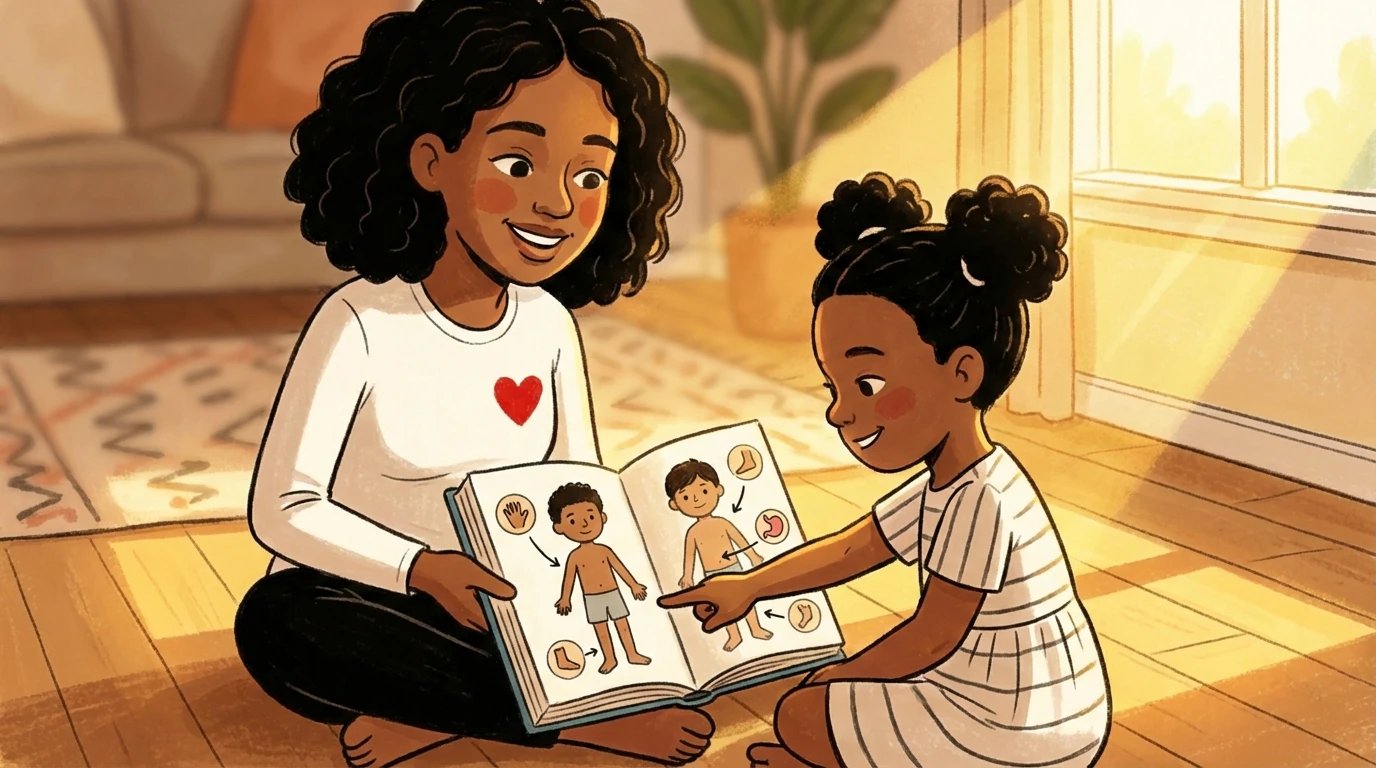
- Bath time is the easiest classroom. Point to elbows, knees, toes, vulva, penis. When genitals show up in the same list as shoulders, they stop being a big deal.

The word you keep avoiding
Somewhere around age two, your kid is going to point at their body in the bathtub and ask what that is. And you are going to feel a strange urge to say anything other than the real word.
"That's your… special area." "That's your private part." "That's your hoo-ha."
You would never do this with a knee. Nobody has ever said, "That's your bendy leg middle." But the second genitals enter the conversation, otherwise rational adults start speaking in code.
The code is the problem. When you dodge the real word, your child doesn't hear "this is private." They hear "this is shameful." And they file that away, quietly, alongside everything else they're learning about which parts of themselves are acceptable to talk about and which parts are not.
Shame around body parts doesn't stay contained. It leaks into how kids feel about their bodies, their boundaries, and their willingness to speak up when something is wrong.
Cutesy words, real risks
The Body Safety Conversations course will teach you why real names protect kids
Your child will use correct anatomical terms confidently, which makes disclosure possible if something ever happens.
Why the real words matter for safety
This is the part that moves it from philosophy to practicality.
Medical clarity
A two-year-old who says "my tummy hurts" gives a doctor something to work with. A two-year-old who says "my down there hurts" does not. Pediatricians, nurses, and urgent care doctors need specifics. "My vulva is itchy" or "my penis hurts when I pee" gives them a starting point. "My cookie feels funny" sends everyone on a guessing game while your kid sits there in pain.
Abuse prevention and disclosure
This is where it gets serious. Correct anatomical vocabulary is one of the most concrete prevention strategies against abuse. A child who can say "he touched my penis" gives investigators, teachers, and mandated reporters clear, unambiguous information. A child who says "he touched my flower" might not be understood at all.
Predators specifically target children who don't have the words. Kids who use baby talk for their body parts signal that no adult has had direct conversations with them about their bodies. That silence is what predators rely on.

The gender gap nobody talks about
Here is a number that should bother you: 95% of three-year-old boys know the word penis. Only 52% of girls the same age have a specific word for their genitals.
Not the correct word. Any word at all.
Boys get "penis" early and without much fuss. It's right there, visible, and parents seem to find it less awkward to name. Girls get silence, or a catch-all like "privates," or (and this is common) nothing.
This gap tracks directly onto cultural discomfort with female anatomy. And it has consequences. Women who grew up with shame around their bodies and sexuality are less equipped to set boundaries, recognize violations, and advocate for themselves. That pattern starts in the bathtub at age two.
Vulva is not vagina
Most adults get this wrong, so let's fix it now.
- Vulva: the external anatomy. What you can see.
- Vagina: the internal canal. Not visible from the outside.
- Clitoris: part of the vulva. Often the first part girls discover during self-exploration because it feels good.
You wouldn't teach a boy that "penis" covers the penis, scrotum, and testicles. The same specificity matters for girls. Three parts, three names, three locations.
How to teach it (without making it weird)
The trick is that there is no trick. You already taught your kid "elbow" and "shoulder" and "nostril" without breaking a sweat. Genitals get the same treatment.
How to teach anatomical names naturally
- Start during diaper changes and bathsName body parts as you go. 'I'm washing your vulva now, and now your legs, and now your toes.' Embedding genitals in a list of ordinary body parts strips away the specialness.
- Play the body part gamePoint to different parts and have your child name them. Shoulders, elbows, knees, penis, ears. When genitals appear between knees and ears, they become just another answer in the game.
- Use the words yourself, out loudSay 'vulva' and 'penis' in normal conversation the way you say 'arm' and 'foot.' Your child calibrates their comfort level to yours. If you whisper it, they learn it is something to whisper about.
- Correct euphemisms without shamingIf your child says 'wee-wee,' respond with 'that's called your penis.' Same tone you'd use if they called a horse a doggy. Gentle correction, no drama, move on.
- Add detail as they get olderA two-year-old needs 'penis' and 'vulva.' A four-year-old can learn 'testicles,' 'scrotum,' 'vagina,' and 'clitoris.' Layer vocabulary the same way you layer any other knowledge, gradually and in context.

Your discomfort is the real obstacle
Let's be honest about what's happening when you can't say "vulva" to your three-year-old. It's not that the word is complicated. "Stegosaurus" is complicated, and kids say that one just fine.
It's that somewhere in your own childhood, someone taught you (probably without words) that these body parts were different. Embarrassing. Not for polite conversation. And that training is so deep it can make a grown adult fumble over a five-letter word while looking at a toddler.
Your child has zero shame about their body until you install it. They will say "penis" at the dinner table with the same energy they say "excavator." They will point at their vulva in the bathtub the same way they point at their belly button. The awkwardness is entirely yours.
And it's worth pushing through. Because every time you say the word naturally, you're telling your child: this part of you is normal, it has a name, and you can talk about it. That message, repeated over years, builds the kind of body confidence that makes later conversations about sex and relationships possible instead of excruciating.
What about potty training?
Potty training is a natural on-ramp for anatomical vocabulary. You're already talking about body functions constantly. "Did you pee?" "Do you need to poop?" The plumbing is front and center.
This is the moment to layer in the correct words. "Pee comes out of your penis." "You wipe your vulva from front to back." Practical, matter-of-fact, useful. The vocabulary has a job to do, and your child can feel that it's functional, not weird.
If you missed the window during diaper changes, potty training gives you a second chance to normalize the words while your kid is already focused on that part of their body.
When your child uses the words in public
This will happen. Your child will say "penis" in the grocery store at full volume. They will tell grandma about their vulva. They will inform their preschool teacher that boys have testicles.
Take a breath. This is a sign you did it right.
The social awkwardness belongs to the adults in the room, not your child. A four-year-old using anatomical terms correctly is demonstrating exactly the kind of body literacy you want them to have. The fact that it makes other adults squirm is a reflection of their discomfort, not a problem with your parenting.
If someone comments, a simple "we use the correct names in our family" is enough. You don't owe anyone an explanation for teaching your child the names of their own body.

FAQ
Just start using the correct terms. Say something like 'remember when we called it your woo-hoo? The real name is vulva.' Kids adapt fast. They will not be confused or traumatized by a vocabulary upgrade. The sooner you switch, the less unlearning they need to do.
As soon as your child starts learning words for other body parts. If they know 'nose' and 'elbow,' they can learn 'penis' and 'vulva.' Most children are ready between twelve and eighteen months. There is no such thing as too early for correct vocabulary.
Use the correct terms yourself, consistently. Children hear both approaches and will gravitate toward whichever parent models more comfort. Share the safety research with your partner. Often the abuse prevention angle shifts the conversation from awkward to urgent.
Briefly, maybe. The novelty wears off the same way it does with any new word. Children who learn 'excavator' say it constantly for a week and then move on. Anatomical words follow the same pattern. Normalizing them reduces fixation faster than avoiding them does.