TLDR
- Your kid can hear you just fine. Call them for ice cream and they sprint to the kitchen. Call them to put on shoes and they're suddenly deaf. The issue is cooperation, not auditory processing.
- Yelling works once and costs you twice. It triggers a startle response that looks like compliance. But it drains the relationship account that makes future cooperation possible, so you end up yelling louder next week.
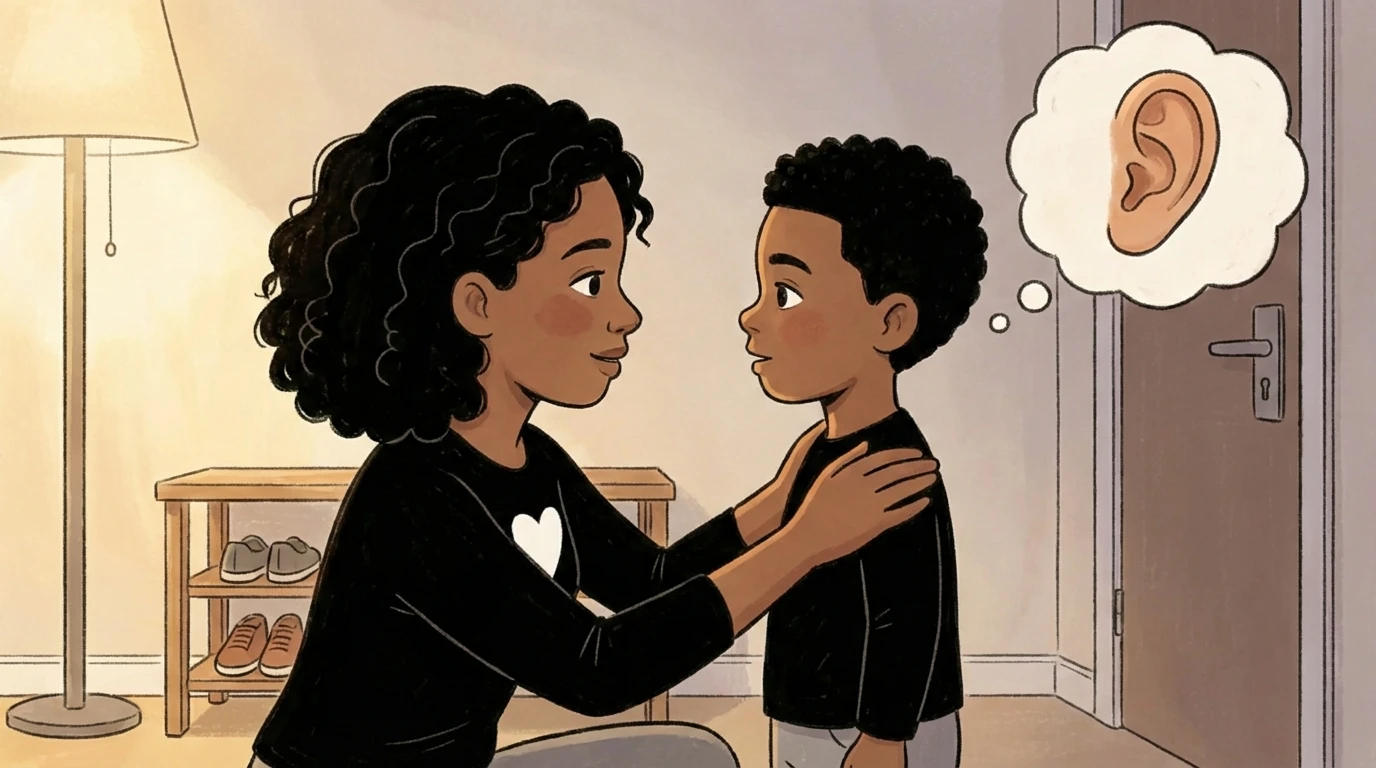
- Connection before direction is the whole strategy. Get close, touch their shoulder, comment on what they're doing, wait for eye contact. Then talk. Barking orders from the hallway teaches them to tune you out.
- Choices turn resistance into cooperation. Bath now or in five minutes? Shoes first or jacket first? When kids pick from options you're fine with, the power struggle evaporates.
- Routines replace nagging with autopilot. A kid who follows the same morning sequence every day doesn't need you hovering over each step. The routine becomes the boss, not you.

The ice cream test
Here's a quick diagnostic. Yell "Who wants ice cream?" from the kitchen. Your kid will materialize before you open the freezer.
Now yell "Time to brush your teeth!" from the same kitchen. Nothing. Not even a twitch.
Their hearing is identical in both scenarios. What changed is their motivation to cooperate with a request that conflicts with what they'd rather be doing. That distinction matters because it shifts the question from "Why won't my kid listen?" to "Why would my kid cooperate right now?"
And that second question has an answer you can work with.
A child's prefrontal cortex, the part of the brain that overrides short-term desires for longer-term goals, doesn't finish developing until the mid-twenties. Asking a four-year-old to stop playing and put on socks is asking them to override their entire neurological wiring. They can build that skill over time. They can't just will it into existence because you said so.
Why repeating yourself makes it worse
You've asked three times. Your voice is climbing. By the fifth time, you're practically vibrating. And then they finally move.
You just trained them that you're not serious until you yell. Kids are efficient. They learn that the first four requests carry no real weight, so why respond to them? The yelling is the actual signal. Everything before it is background noise.
Repeating yourself also floods the interaction with words, and kids stop processing after the first few. A study on auditory processing found children under ten struggle to filter speech from background noise, and your repeated instructions become that background noise.

The one-warning rule
Give one warning. Make it count. Move close, touch their arm, wait for eye contact, and say what you need. "We're leaving in five minutes. Deal?" Then shake on it. When five minutes pass, follow through.
If they don't respond to your first attempt, don't increase volume. Go back to step one: you didn't have connection. Walk over, comment on what they're doing ("Wow, that tower is getting tall"), wait for them to look at you, and try again.
Fewer words, warmer tone
Most parents bury the instruction inside a paragraph. "Honey, you know we talked about this, and I really need you to come over here because we have to leave soon and if we're late again your teacher is going to..." Your kid checked out after "Honey."
Use the minimum words that carry the message. "Shoes, please." Said warmly. While standing right next to them. While smiling. That lands better than a lecture from the next room.
Yelling from the doorway
The Discipline Without Punishment course will help you get heard without raising your voice
You'll walk over, speak once at their level, and see them move. No threats required.
The connect-first method
Think about how you'd react if your partner walked in and said "Stop what you're doing and take out the trash" without making eye contact. You'd feel irritated and ordered around. Kids feel the same way, except they have less ability to articulate why they're resisting.
Connection is the currency of cooperation. You build it through eye contact, physical proximity, acknowledging their world, and spending time that isn't about getting them to do something. You spend it every time you make a request. If the account is overdrawn, every request meets resistance.
Enter their world first
Before you ask anything, comment on what your kid is doing. "That drawing has a lot of purple in it." This takes four seconds and it changes the dynamic from "person who wants something from me" to "person who sees me."
Then: "I need to tell you something. Can you look at me?" Wait. Don't talk until you have their eyes.
The structure for any request:
- Move close (across the room doesn't count)
- Get on their level
- Touch lightly
- Acknowledge what they're doing
- Wait for eye contact
- Make the request in as few words as possible
This is how adults communicate with other adults they respect. Kids deserve the same.
Give choices that aren't really choices
"We need to leave. Do you want to put your shoes on yourself or should I do it?" Both options end with shoes on feet. But the kid picked one, so it feels like their idea.
Choices work because they convert a demand into a decision. Nobody likes being forced. When a child chooses from options you set, they cooperate because the decision feels like it belongs to them. This approach functions all the way up through the teen years, just with more complex options.
The trick: never offer a choice you can't live with. "Do you want to take a bath or not?" gives them an out you didn't intend.

Routines do the nagging for you
If every interaction with your kid is an order, they'll tune you out the way you tune out commercials. The whining and resistance you're getting is a direct response to feeling bossed around all day.
Routines cut the number of orders in half. A kid who follows the same morning sequence (teeth, toilet, backpack, shoes) doesn't need you at each step. Take photos of them doing each task and stick them on the wall. Over time, they internalize the sequence. Your role shrinks from drill sergeant to "What's next on your list?"
The payoff is bigger than saving your voice. Kids who manage their own routines develop self-discipline, the internal kind that works when nobody is watching. That matters more than obedience, which only works when someone is standing over them.
When you lose it anyway
You will yell. Every parent does. What matters is what happens after.
Repair is a fifteen-second intervention that changes everything. Wait until you're calm, then say: "I was frustrated earlier. It wasn't okay that I yelled. I'm working on it. I love you."
That's it. You just modeled accountability, emotional awareness, and the idea that your regulation affects theirs. Relationships survive ruptures. What matters is whether repair follows.
If the guilt after yelling is something you recognize, know that the impulse to shout comes from your own dysregulated state, not from your kid's behavior. Once you're calm, you can think of something better.
Wondering whether your overall approach is working? That question alone means you're paying attention.
How to get your kid to listen the first time
- Move close and get lowWalk to your child. Crouch to their eye level. Touch their shoulder. Do not start talking until you are within arm's reach and they can see your face.
- Acknowledge before you askComment on what they're doing: 'That track layout looks complicated.' This takes five seconds and tells them you see them as a person, not just an obstacle to your schedule.
- Wait for eye contactSay 'I need to tell you something' and pause. Do not deliver your request until they look at you. If they don't look up, ask 'Can you look at me for a second?'
- Use five words or fewerState the request clearly and briefly. 'Shoes, please.' 'Bath in five minutes.' 'Teeth time.' Long explanations lose them. Save the reasoning for later.
- Offer a choiceGive two options you're fine with. 'Jacket first or backpack first?' The non-negotiable part (leaving) stays fixed. The child picks how, which makes the whole thing feel voluntary.
- Follow through onceIf they agreed to five minutes, come back in five minutes. Don't re-negotiate. Don't give three more warnings. Help them with the transition: 'Time's up. Let's zoom those trains to the bathroom.'

The long game
Kids raised with connection-first communication don't become doormats. They become people who cooperate because they want to, not because they're afraid of what happens if they don't. And that cooperation follows them into classrooms, friendships, and eventually their own families.
The effort is front-loaded. Connecting before every request feels exhausting when you're running late and your kid has one shoe on. But a child who trusts that you'll listen is a child who listens to you. A child who gets choices learns to make good ones. A child who follows routines develops self-discipline that outlasts your supervision.
The fundamental truth: children are humans, and humans don't cooperate with people who bark orders at them. Start with connection. The listening follows.
FAQ
Check whether you had real eye contact before you spoke. If yes, help them physically start the transition instead of repeating the request. Walk over, pick up the shoes, hand them over. Some kids need that bridge between 'I heard you' and 'I'm moving.' Stay warm while you do it.
You set the options. Both choices lead where you need them to go. 'Bath now or in five minutes' still ends in a bath. The child picks the path, not the destination. You keep full control over what's non-negotiable.
You've trained each other. They wait for the yell because that's when consequences start. Reset by moving close, making eye contact, and following through after one calm request. It takes a few weeks of consistency before they stop waiting for the escalation.
The connect-first approach works from toddlerhood through the teen years. For toddlers, keep requests shorter and transitions more physical. For older kids, the choices become more complex and the reasoning more collaborative. The principle (connection before direction) stays the same at every age.