TLDR
- Natural consequences are life's teachers. Let them work. When the stakes are low and your child is safe, step back. Forgetting a jacket and being cold teaches more than a lecture.
- Most 'logical consequences' are punishments with better branding. If the consequence isn't directly related to the behavior, you're just making your kid feel bad and calling it education.
- The 3 Rs test: related, reasonable, respectful. Any consequence that fails one of these is a punishment, regardless of what you call it.
- Consequences don't teach skills. They only stop behavior. After the consequence, you still need to teach your child what to do instead. That's where the real change happens.
- Your child's brain isn't finished yet. Adjust accordingly. The prefrontal cortex that handles impulse control won't be fully online until age 25. Expecting adult-level self-regulation from a four-year-old is setting everyone up to fail.

The word "consequence" is doing a lot of heavy lifting
Parents love this word. It sounds measured, like you read a book. "We use consequences in our house" lands very differently at a dinner party than "we punish our kids."
But in most homes, the parent decides the child did something wrong, the parent invents a consequence, and the child experiences it as punishment. Calling it a "consequence" doesn't change what the child registers.
There are two genuinely different types of consequences, and most parents are using the wrong one while calling it the right one. The distinction matters, and getting it wrong means your discipline strategy is punishment wearing a better outfit.
Punishments in disguise
The Discipline Without Punishment course will teach you responses that aren't just rebranded penalties
You'll stop engineering fake consequences and start using approaches that build real accountability.
Natural consequences: the ones you don't create
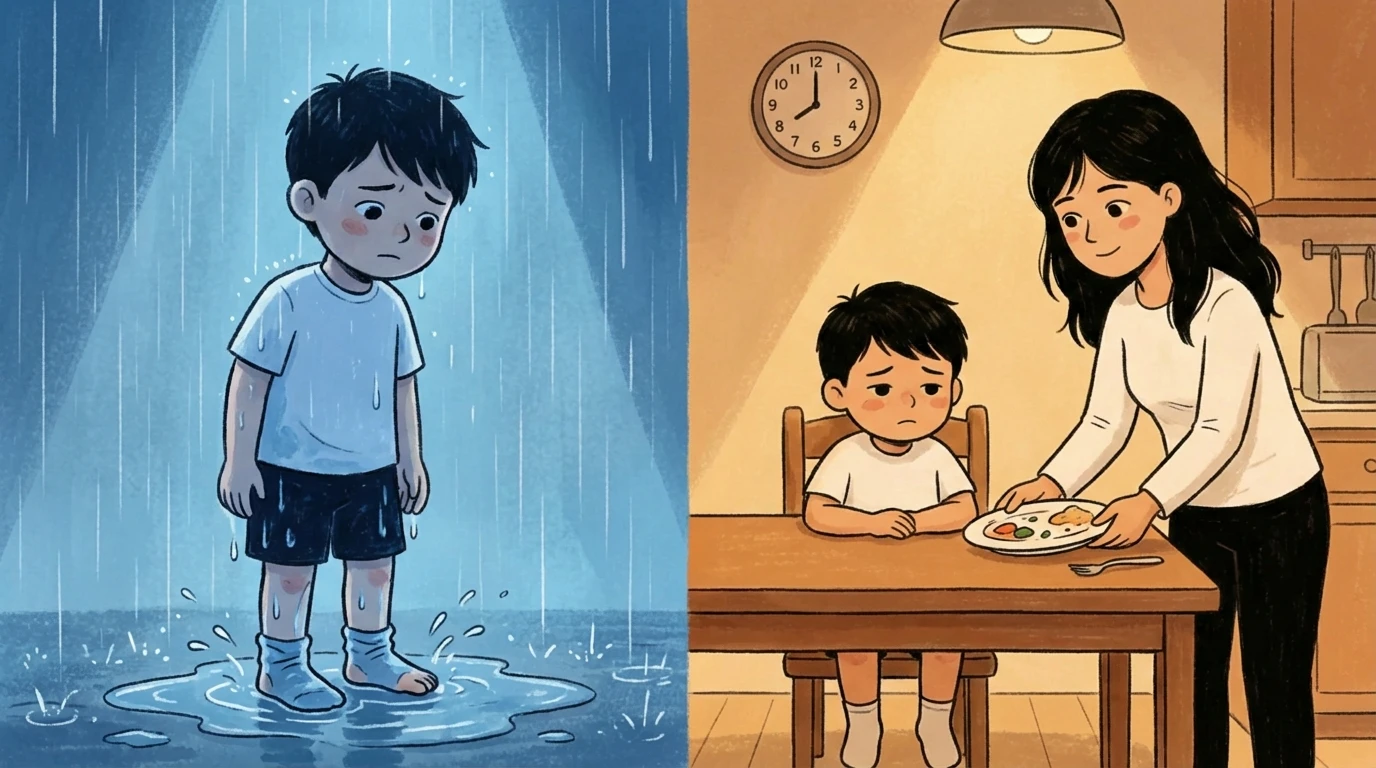
A natural consequence is what happens when you do nothing. Your child refuses to wear a coat. They get cold. Your child is mean to a friend. The friend doesn't want to play anymore.
You didn't engineer any of this. Life did. And life is a remarkably effective teacher when the stakes are low.
When to step back
Natural consequences work best when three conditions are met:
- The outcome isn't dangerous. Being cold at recess is uncomfortable. Running into a parking lot is not a learning opportunity.
- The lesson is immediate. A toddler who won't wear shoes feels the hot pavement right now. That connection is concrete enough for their brain to encode.
- You can stay genuinely on their side. If you're standing there thinking good, now you'll learn, your child will pick up on that. The consequence stops being natural and starts feeling orchestrated. Your kid isn't dumb.
When natural consequences backfire
The "let them learn the hard way" crowd goes too far when they refuse to help with something easy. Your child forgot their lunch. You're home. The school is five minutes away.
Refusing to bring the lunch doesn't teach responsibility. It teaches your child that you won't help when helping costs you almost nothing. A teenager who learned that lesson at age eight is a teenager who won't call you when the party gets scary. The relationship cost of withholding easy help is always higher than the lesson you think you're teaching.

Logical consequences: where parents get creative (and get it wrong)
A logical consequence is one you impose, but it connects directly to the behavior. Your child throws a toy at the wall. The toy goes away for the rest of the day. Your child dumps water out of the bathtub. Bath time ends.
The connection between action and outcome separates a logical consequence from a punishment. And that connection is where most parents fumble.
The 3 Rs test
Jane Nelson's framework from 1985 still holds: a consequence must be related, reasonable, and respectful. Fail any one, and you're punishing.
- Related: Your child hits their sibling. Taking away screen time is not related. Having them take space from the sibling, then helping repair the relationship when they're calm, is related.
- Reasonable: A two-year-old who spills milk during a tantrum cannot mop the entire kitchen. They can help you wipe the table with a cloth. Match the response to what the child can do.
- Respectful: "I told you this would happen" turns any consequence into humiliation. The consequence itself might be perfect, but your delivery poisons it.
The Sally problem: Sally hits her sister. Her parents take away TV for a week. A week later, Sally remembers being furious about the TV. She does not remember the hitting. The consequence had no connection to the behavior, so her brain filed it under "unfair things my parents do" instead of "reasons not to hit." The behavior morphs. The anger stays.
Why "consequences" often don't produce the learning you expect
Brain science tells us something parents don't want to hear: children under seven have limited cause-and-effect reasoning for delayed consequences. A five-year-old who loses tomorrow's playdate because of today's behavior at dinner will not connect those two events in any meaningful way.
The impulse control gap
Your child's prefrontal cortex, the part responsible for impulse control and planning, won't be fully developed until their mid-twenties. The entire premise of consequences ("they'll think twice next time") requires brain hardware that doesn't exist yet.
This doesn't mean consequences are useless. It means they work only when they're immediate, related, and delivered while the child can still draw the connection. "You threw the block, so blocks are done for now" works at age three. "You threw the block this morning, so no park this afternoon" is just revenge on a delay.
What punished kids learn instead
Research consistently shows that children who are punished (even with "consequences") don't become more moral. They become better at:
- Avoiding getting caught
- Lying to dodge the consequence
- Focusing on the unfairness of the punishment instead of the impact of their behavior
- Behaving only when authority is present
Are you raising a child who does the right thing because someone is watching, or because they want to? Those come from very different approaches. Different parenting methods handle this differently, and it's worth examining where yours falls.

How to design a consequence that teaches instead of punishes
- Check the connection to the behaviorThe consequence must relate directly to what happened. Hitting a sibling means taking space from that sibling. Throwing food means mealtime ends. If you can't draw a straight line from behavior to consequence, it's a punishment.
- Make sure it's developmentally reasonableA two-year-old cannot clean up an entire spill alone. A four-year-old can help you wipe the table. Match the consequence to what your child can do at their age and emotional state.
- Deliver it without anger or shameYour tone is the difference between a lesson and a punishment. 'We need to leave the playground because the sand-throwing isn't stopping' is a consequence. Saying it through gritted teeth with 'I told you so' energy turns it into retaliation.
- Follow through every timeA consequence you enforce once and abandon twice teaches your child that boundaries are negotiable. Consistency matters more than severity. The calmest, smallest consequence applied every time beats a dramatic one applied randomly.
- Teach the missing skill afterwardThe consequence stops the behavior. It doesn't teach the replacement. After everyone is calm, show your child what to do instead. 'Next time you're mad at your brother, you can say I need space.' The skill-building is where the real learning happens.
The alternative: limits without punishment
There's a third option that gets lost in the natural-vs-logical debate. Setting a limit, enforcing it, and skipping the consequence entirely.
Your child bounces a ball inside. You say: "Balls are for outside." You open the door. They go outside. No consequence. No lecture. A boundary, delivered with warmth, and followed through.
Why limits alone are often enough
When a child feels connected to you, they care about what you want. The relationship itself is the motivator. You don't need to manufacture a consequence to make the lesson land because the child already wants to cooperate. They just needed a clear boundary and a nudge in the right direction.
If your child regularly ignores limits, that's information, but the information is about connection, not about needing harsher consequences. It might be time to take the parenting era quiz and examine whether your approach has drifted into territory that's creating more resistance than cooperation.
When something goes wrong, teach repair
If the ball scuffed the wall, you clean it up together. Because that's what you do when you make a mess. "We always clean up our own messes" delivered cheerfully from the time they're small creates a child who takes responsibility without anyone making them feel terrible about it first.
The repair is the real lesson. The child who experiences repairing damage and feels good about making it right is learning accountability from the inside. The child who is punished for making the damage is learning to hide their mistakes.

So do consequences work?
Sometimes. When they're genuinely natural, or when they pass the 3 Rs test and are delivered by a regulated parent to a child who's calm enough to process them.
But consequences can never teach a missing skill. A child who hits doesn't need to lose screen time. They need to learn what to do with anger instead of hitting. A child who forgets their homework doesn't need to go hungry at lunch. They need a system: pack the bag the night before, put a sticky note on the backpack, leave everything by the door.
Consequences stop behavior. Teaching changes it. If your discipline plan is heavy on consequences and light on skill-building, you'll keep consequence-ing the same behaviors over and over. And you'll call it a discipline problem when it's a teaching gap.
FAQ
A natural consequence happens without your involvement. Your child forgets their jacket, they get cold. A logical consequence is parent-imposed but directly related to the behavior. Your child throws sand, you leave the sandbox. The key test: if you had to create it, it's logical. If it happened on its own, it's natural.
Yes. You won't let a toddler run into traffic to 'learn' about cars. Natural consequences only work as teaching tools when the stakes are low enough that your child can safely experience the outcome. Forgot lunch and goes a bit hungry? Fine. Forgot a bike helmet? You step in.
Ask yourself: is the consequence related to the behavior, or am I just trying to make my child feel bad enough to stop? If your child hits a sibling and you take away screen time, that's punishment. If your child hits and you separate them from the sibling until they're calm, that's a related consequence.
If bringing it to school is easy for you, bring it. Refusing a small favor to 'teach a lesson' mostly teaches your child that you won't help when they need you. If forgetting is chronic, the fix is building systems together (packing the night before, sticky notes, a launch pad by the door), not withholding help.
Children under three lack the cause-and-effect reasoning to connect a consequence to their behavior in any lasting way. Around age four, related consequences start making sense if they're immediate and concrete. For toddlers, redirection and limit-setting are more effective than any consequence, natural or otherwise.