TLDR
- Your toddler's brain cannot do what you're asking. The prefrontal cortex needed for voluntary generosity is years away from being functional. You're requesting a skill that doesn't exist yet.
- Forced sharing teaches grabbing, not giving. When you snatch a toy away to give to another child, you've just modeled the exact behavior you're trying to stop.
- Turn-taking puts the child in control. The child with the toy decides when they're done. The waiting child learns patience. Both kids walk away feeling respected.
- The crying is the point, not the problem. When a waiting child cries because they can't have the toy right now, they're building the emotional muscle to tolerate frustration.
- You're working yourself out of a job. With consistent turn-taking, kids start negotiating turns on their own. You go from referee to spectator.
The guilt trip that starts at the sandbox
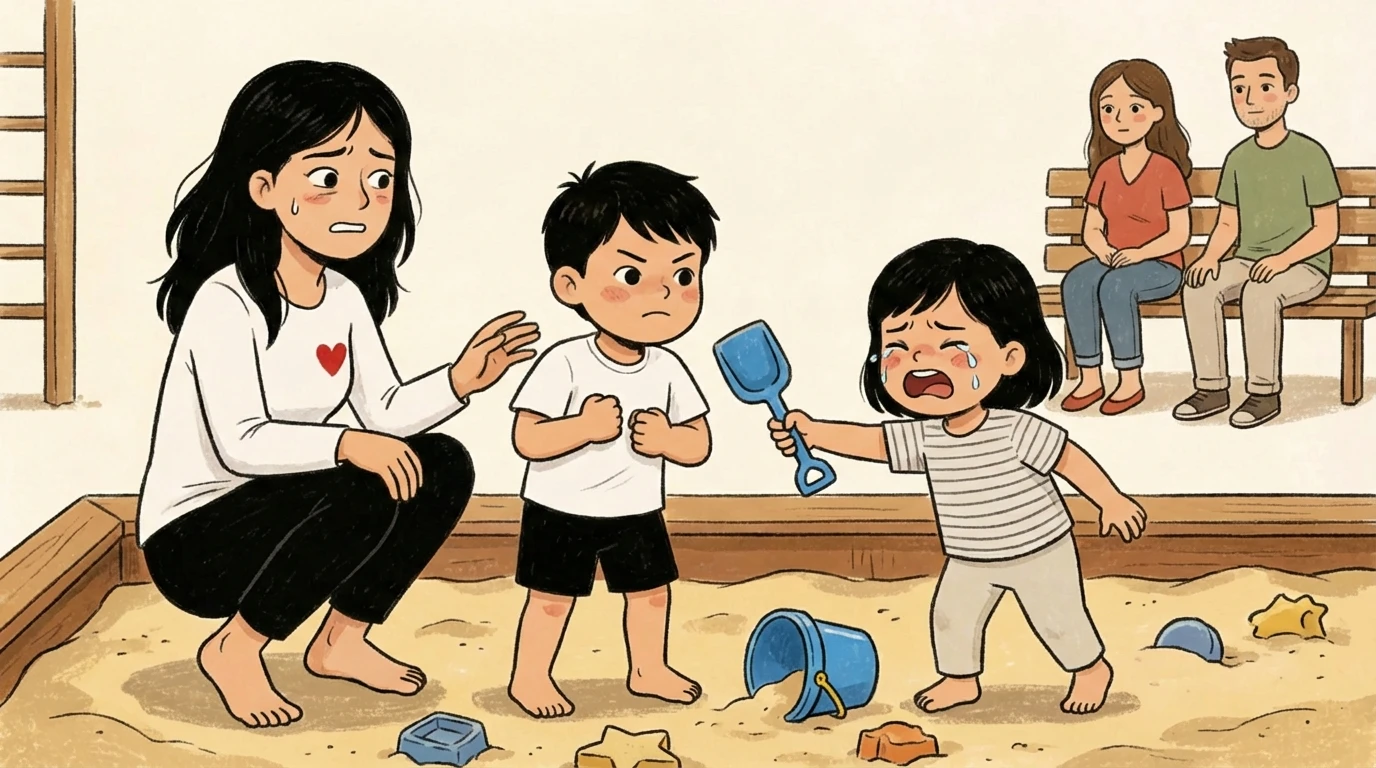
You're at a playdate. Your two-year-old has a shovel. Another kid wants the shovel. You feel twelve adult eyes on the back of your head and hear yourself say: "We share, sweetie. Give your friend the shovel."
Your kid does one of two things. Screams and clamps down harder. Or surrenders the shovel with a look of bewildered betrayal.
Neither outcome teaches your child a single thing about generosity. What just happened was an adult, under social pressure, forcing a tiny person to hand over their property to avoid an awkward silence. We've all done it.
Your toddler is being two. That's all.
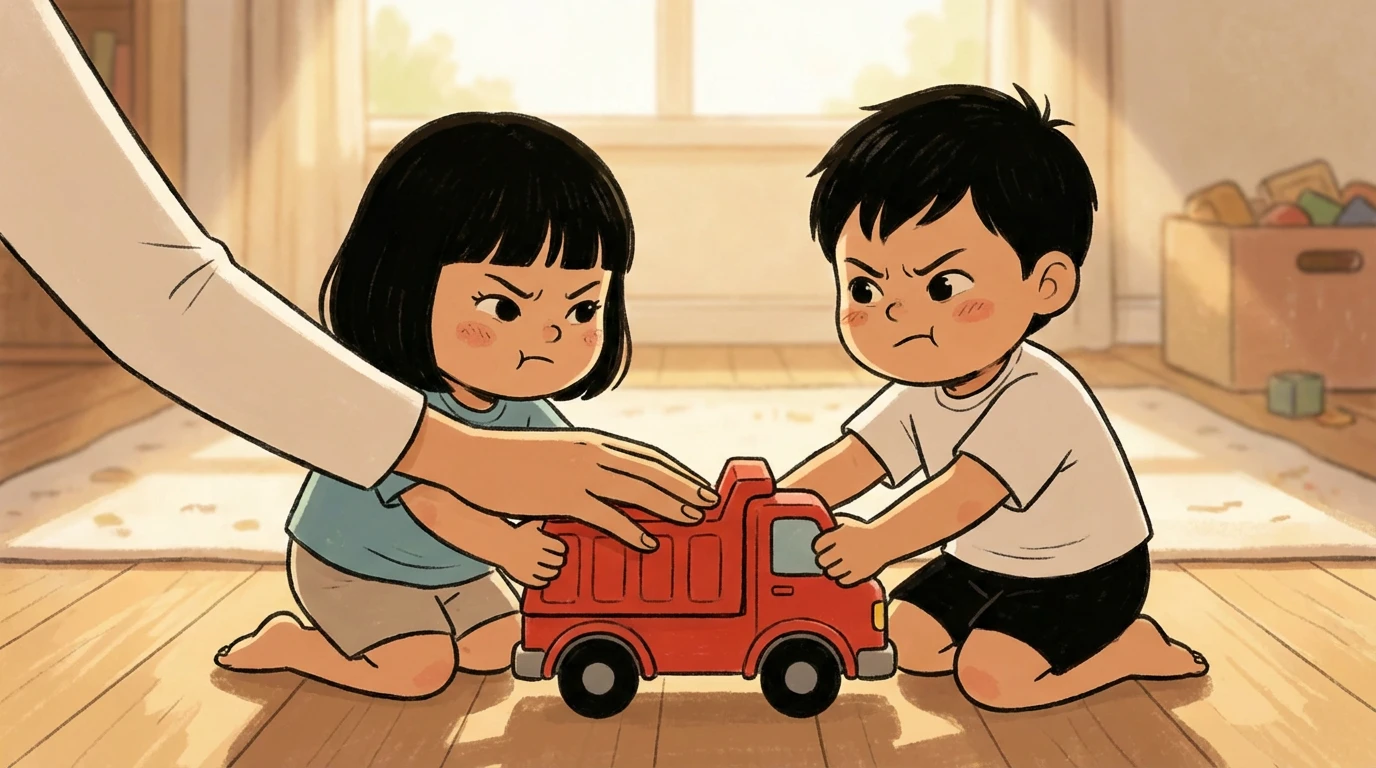
Two hands on one truck
The Social Skills course will replace forced sharing with turn-taking that works
You'll stop bracing for the grab-and-scream cycle and start narrating turns they follow.
Why toddlers genuinely cannot share
The part of the brain that handles perspective-taking, impulse control, and voluntary generosity is the prefrontal cortex. In a toddler, that region is still under heavy construction. Asking a two-year-old to share is like asking them to do long division. The hardware isn't there yet.
What "mine" means at this age
When your toddler screams "MINE," they're not being greedy. They're practicing a concept they just discovered: ownership. Understanding what belongs to you is a prerequisite for voluntarily giving it to someone else. You have to know you have something before you can choose to let it go.
If someone walked up to you and said "Give me your phone for a while because that person wants to look at it," you'd think they were unhinged. That's roughly how forced sharing feels to a toddler.
The research on forced sharing
Nancy Eisenberg, one of the leading researchers on children's social development, found that children become more generous through the experience of giving to others and feeling how good that is. But here's the catch: the giving has to be the child's choice. When we force kids to share, they walk away resentful. They become less likely to share in the future, not more.
So every time you pry a toy out of your toddler's hands and give it to another child, you're undermining the exact generosity you're trying to build.
Turn-taking: the method that works
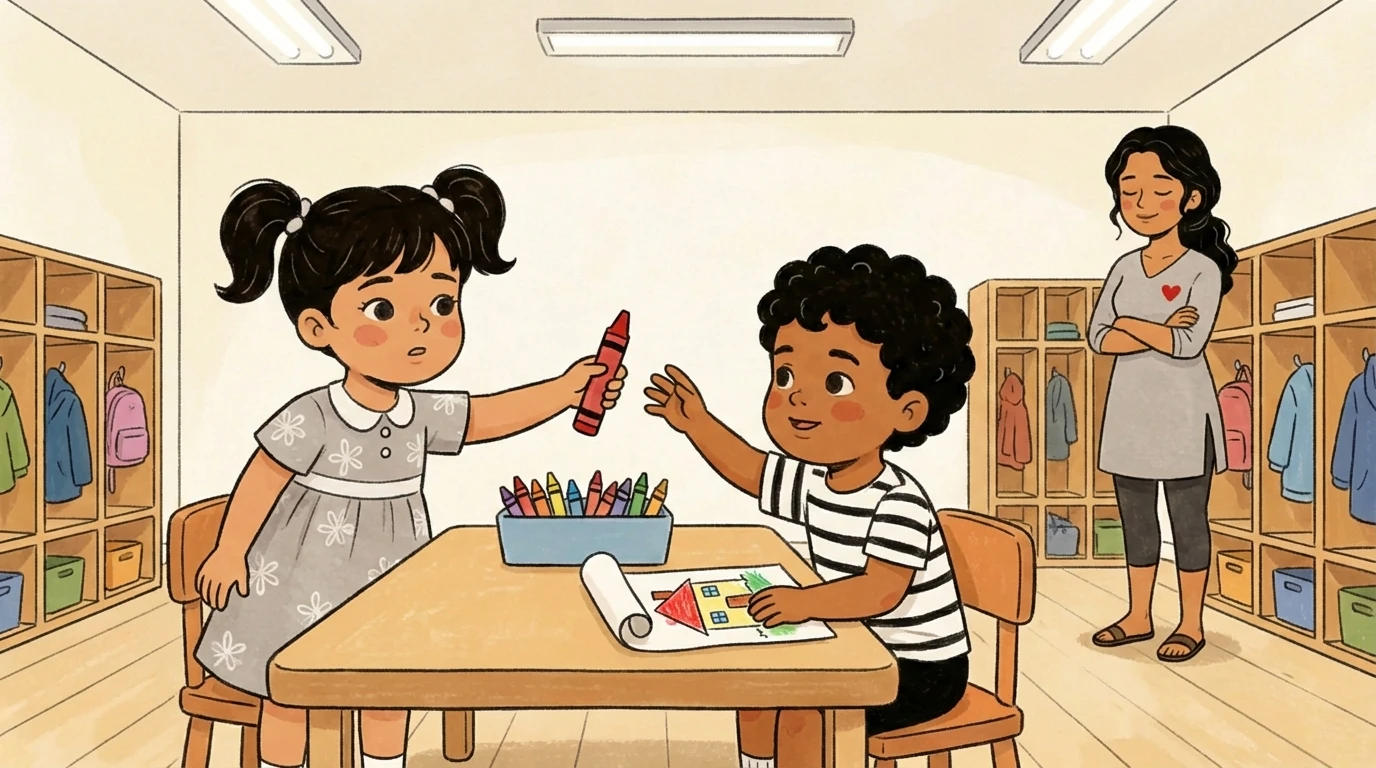
Instead of demanding your child share, try this: the child with the toy decides when they're done. When they're finished, they hand it to the child who asked for it. No timer. No parent deciding "you've had it long enough." The child holds the power.
This sounds like a recipe for one kid hoarding every toy until bedtime. The opposite happens.
Why kids give up toys faster when nobody forces them
When a child knows their toy won't be snatched away, something unexpected happens. The anxiety about losing it disappears. Without that anxiety, they lose interest faster and pass the toy along voluntarily. Kids raised with turn-taking consistently share more easily than kids raised with forced sharing, because there's no scarcity panic driving them to clutch tighter.
The script you'll use a hundred times
When Child B wants what Child A has, you say to Child B: "You can ask them for a turn. When they're done, they'll give it to you."
Then to Child A: "When you're finished with that, will you give it to Jamie? Great, thanks."
That's it. No countdown. No negotiation. The first child finishes on their own terms and hands it over. The handoff feels good to the giver because it was their decision. Over weeks, you'll start hearing your kids say "You can have it when I'm done" to each other without your involvement.
Coaching the child who has to wait
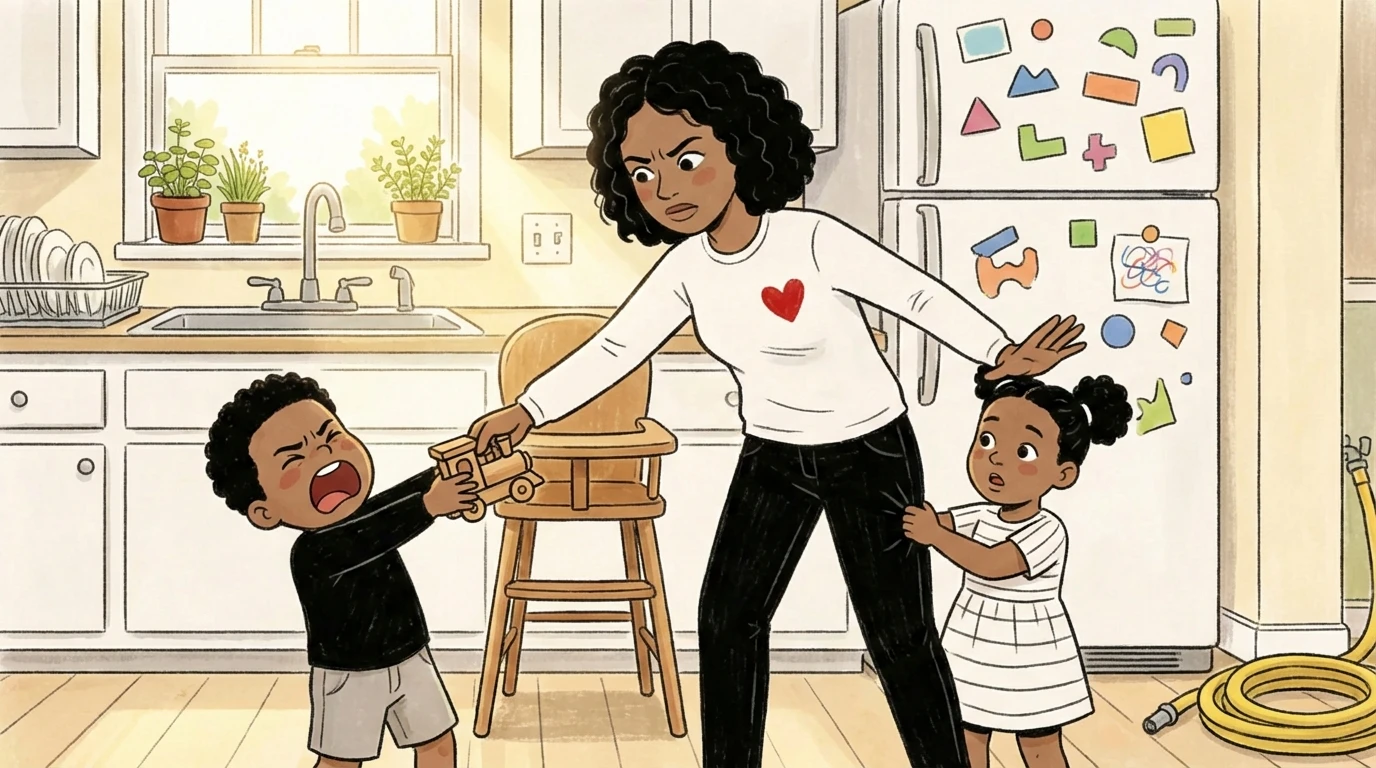
The waiting is the hard part. Your child wants that toy and they want it now. They will cry, whine, or do that full-body vibrating thing toddlers do when the injustice of the universe becomes too much.
Your job is to sit with them in that discomfort, not rescue them from it.
What to say while they wait
"You really want that truck. It's hard to wait. I'll help you wait." Repeat some version of this. Narrate what they're feeling without trying to fix it.
Something interesting happens when you do this consistently. The child cries, feels the full weight of wanting something they can't have right now, and then... moves on. Often to a completely different toy. The intensity was never about that specific truck. It was about the bigger feelings underneath, and crying helped them process.
Redirection as a tool, not a trick
While the waiting child is upset, you can offer alternatives. "The truck isn't available right now. Want to use the digger, or should we build something with blocks?" Some kids take the redirect. Others need to sit in the feeling for a while first. Both responses are fine.
How to introduce turn-taking at home
How to teach turn-taking instead of forced sharing
- Name the new system out loudTell your kids: 'We do turns in this house. When you have something, you keep it until you're done. Then you pass it along.' Keep it simple and repeat it often.
- Model it yourselfHand your kid your phone and say 'You can use it until you're done.' When they give it back, say 'Thanks for giving me a turn.' They learn faster from what you do than what you say.
- Coach the askWhen your child wants what another child has, help them say 'Can I have a turn when you're done?' For pre-verbal kids, narrate the request on their behalf.
- Support the waitStay with the waiting child. Say 'I know it's hard. I'll help you wait.' Don't minimize their frustration and don't rush the other child to finish.
- Celebrate the handoffWhen a child voluntarily passes a toy, notice it out loud. 'You noticed Jamie wanted the car and you gave it to him. Look at his face.' Skip generic praise. Describe what happened and its effect.
The sibling version
Turn-taking is especially powerful with siblings because the same two kids are navigating toy conflicts all day, every day. When sibling jealousy flares up over toys, the turn-taking framework gives both children a predictable process. The child with the toy knows their right to it is protected. The waiting child knows their turn will come.
A practical tip: buy two of the most fought-over items when you can. Before playdates, let your child put their most treasured toys away. You're reducing the emotional stakes so they can practice with toys they care about less.
What about daycare and school?
Most group settings use timer-based sharing. Your child might need to follow those rules at school while practicing turn-taking at home. That's fine. Kids are remarkably good at understanding that different places have different rules.
The skills they build at home (impulse control, patience, voluntary giving) transfer to school even when the system is different. A child who regularly experiences the satisfaction of choosing to hand over a toy handles classroom sharing rules with less distress than one who only knows forced compliance.
If your child is struggling with the emotional skills that underlie sharing, that's useful information. It usually means they have big feelings underneath the grabbing behavior that need an outlet at home.
When grabbing gets physical
Some toddlers don't just want the toy. They hit, push, or bite to get it. This doesn't mean your child is aggressive. Their frustration has outpaced their communication skills, which is standard at this age.
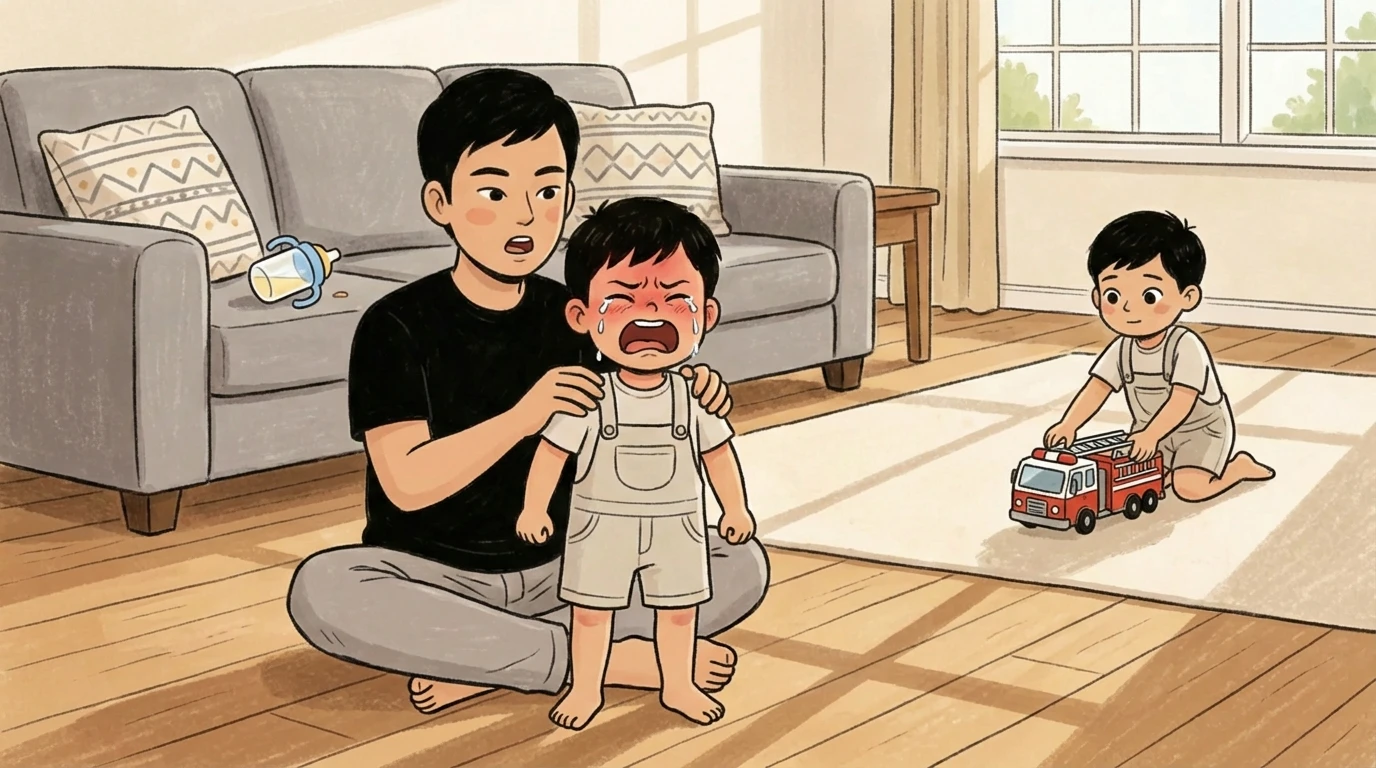
When it gets physical, get down to their level. Put one hand on the contested toy (so nobody runs off with it) and one arm around your child. Say: "You wanted that. You can't hit to get it. I'll help you wait for a turn."
The goal is tears, not compliance. When the big feeling driving the grab gets released through crying, your child will likely let go of the toy on their own. And here's the strange part: they often won't even want that toy anymore. The urgency was never about the object. It was about the feelings stuck inside them.
FAQ
It happens, especially early on. If the toy hasn't been returned by a natural transition point (mealtime, bedtime), you can say 'Jamie's been waiting a long time. Are you almost done?' Most kids, given enough security that the toy won't be snatched, finish within minutes. If it goes to bedtime, the waiting child gets first pick of that toy the next morning.
Yes, but it's harder to enforce at playdates because the other family may use different rules. Focus on coaching your child through the process: help them ask for a turn, support them while they wait, celebrate when the other child passes the toy. You can't control the other household, but you can model the approach with your own kid.
Most children begin showing genuine voluntary sharing between ages 3.5 and 5, when perspective-taking and impulse control start coming online. Before that, any sharing you see is either imitation or compliance, not generosity. Turn-taking bridges the gap by giving younger kids a structured way to practice the mechanics of giving before the motivation develops.
Turn-taking does teach them to stand up for their toys. The rule is clear: you keep it until you're done. If another child grabs it, you help your child say 'I'm not done yet.' This is assertiveness training, not passivity. They learn to hold a boundary and to respect other people's boundaries in return.