TLDR
- Toddlers do not understand finality. They will ask where the person went, repeatedly, for weeks. This is normal processing, not a sign you explained it wrong.
- The real danger is abandonment, not death. Young children cannot grasp death as a concept. What they can feel is that someone important disappeared. Frame it so they know the person did not choose to leave.
- Keep the relationship alive on purpose. Photos on the wall, stories at dinner, a small object that belonged to the person. Children who maintain connection to the deceased adjust better than those expected to move on.
- Your grief is their biggest variable. A child who lost a parent before age two has no traumatic memory to process. What shapes them is whether the surviving parent can be present.
- Rituals matter more than explanations. Planting a tree on a birthday, lighting a candle together, drawing pictures. These give a child something to do with feelings they cannot yet name.

The question you have been dreading
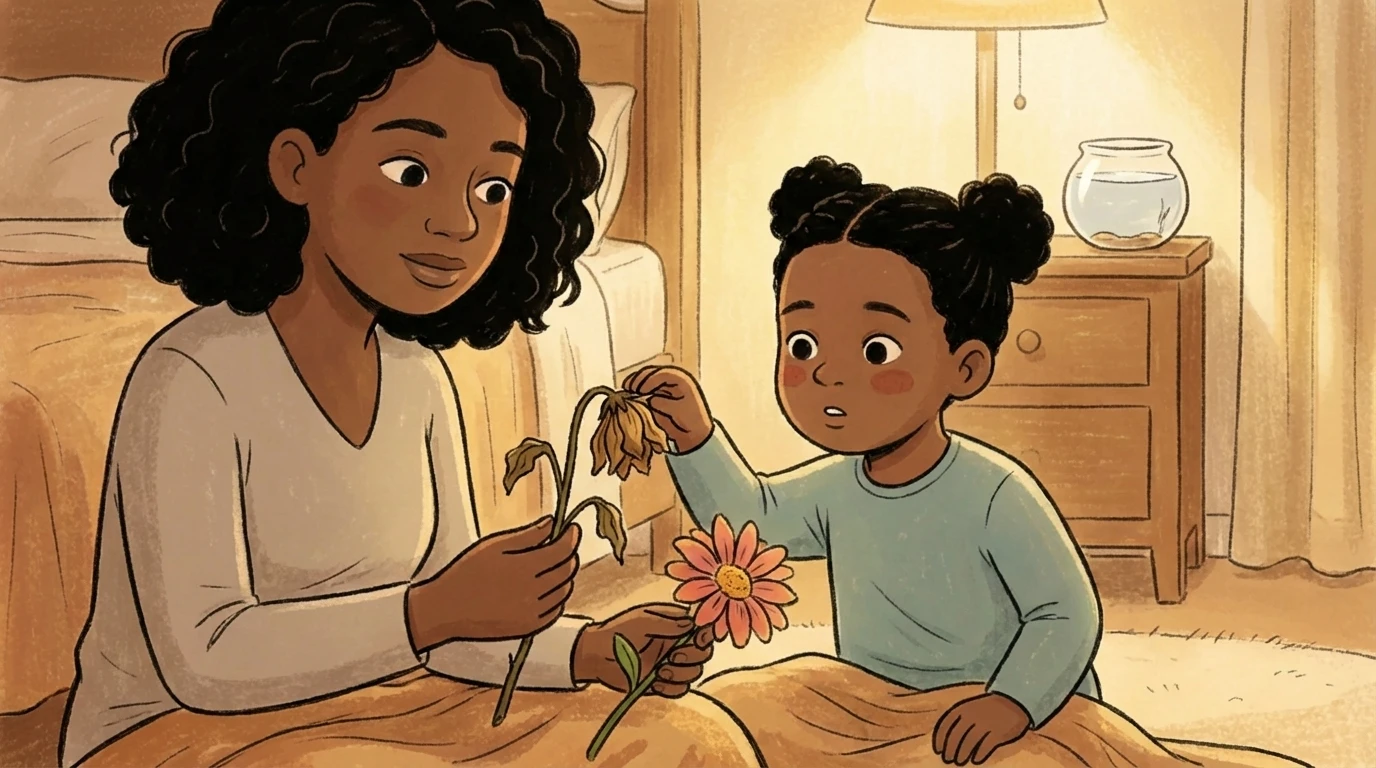
Your kid found a dead bird in the backyard. Or the goldfish is floating sideways. Or grandma is in the hospital and everyone keeps whispering after bedtime.
However it starts, the moment arrives: your child asks a question about death. And everything in your body wants to change the subject, offer a cookie, or say something vague enough to buy another six months.
Kids need an honest explanation of death, delivered by someone they trust, in words their brain can process. The conversation is dozens of small talks over months and years, each building on the last.
And how you handle your own grief matters more than anything you say.
Is grandpa going to die
The Body Safety Conversations course will show you how much truth fits each age
You'll answer the hard follow-up questions honestly without overwhelming a child who still believes in magic.
What kids understand at each age
Under three: the body is the whole world
Toddlers live in the concrete. They understand bodies. They do not understand permanence, abstractions, or metaphors.
When you say "Grandpa went to sleep forever," a toddler hears that sleep is dangerous. When you say "We lost Grandma," they want to help you look for her. Every euphemism you reach for will backfire with a child this age.
Use body language instead: "Grandpa's body stopped working. When a body stops working, the person cannot eat, or breathe, or talk, or hug us anymore." That is blunt. It is also the only version a two-year-old can work with.
They will ask "When is Grandpa coming back?" repeatedly. For weeks. Answer the same way every time, without irritation. A developing brain runs the same loop because it cannot store the answer yet.
Ages three to five: magical thinking in full swing

This is the age when kids believe their thoughts cause things to happen. A four-year-old who was angry at grandma last Tuesday and then grandma died may genuinely believe their anger killed her. You need to say, out loud, that nothing they thought, said, or did caused this.
Kids in this range also start developing specific fears about death. They may worry you will die too. They may ask if the dead person is cold underground.
Answer honestly: "I plan to be here for a very long time. I eat well, I go to the doctor, and I am healthy." For a four-year-old, that is the right amount of truth.
Ages five to eight: the logic questions arrive
Now they want mechanics. What happens to the body? Where does the person go? Why do people have to die?
You can go further here: "Bodies wear out, the way shoes wear out or a car stops running. When a body wears out completely, the person dies. Everything alive is born, grows up, lives a full life, and eventually dies."
If your family has spiritual beliefs, this is where they provide real comfort. "We believe Grandpa's spirit is in heaven" gives a child a location, which their brain craves. Add the critical framing: "Someday, a very long time from now, you will see him again. But first you get to have a whole big life."
How to have the conversation
How to talk to your child about death
- Use the word 'died'Say it plainly. 'Grandpa died.' Euphemisms like 'passed away' or 'lost' confuse young children. The clarity feels harsh to you, but it gives them something solid to hold onto.
- Explain what the body doesConcrete, physical language: 'His body stopped working. He cannot breathe, eat, move, or feel pain anymore.' This grounds the abstract in something a child can picture.
- Say it was not their faultDirectly: 'Nothing you did or said or thought made this happen.' Children under seven are prone to magical thinking. They need to hear this more than once.
- Answer repeated questions patientlyYoung children ask the same question for days or weeks. Each time, answer simply and consistently. This repetition is how their brain processes what it cannot yet store.
- Let them see you grieveCrying in front of your child is not harmful. Say: 'I am crying because I miss Grandpa. Crying helps when we are sad. You do not need to take care of me. I will be okay.'
- Give them something to holdA small object that belonged to the person (a watch, a scarf, a mug) gives the child a physical anchor. Tangible connection matters when everything else feels invisible.
The one thing that will hurt them more than death
A child who feels abandoned is in more danger than a child who is grieving. Toddlers cannot understand that someone died. What they can understand is that someone who was here is gone. And the story they will write, if nobody gives them a better one, is: that person left because they stopped loving me.
This is why every explanation needs to circle back to love. "Grandpa did not want to leave. His body stopped working. But his love for you is still right here." Touch their chest. "You carry it with you."
Helping a child process grief after a death is a posture you hold for months, repeating the same truths across dozens of small conversations: the person loved you, the person did not choose to leave, the love is still yours.
Keeping the connection alive
Most adults assume the goal is to help a child "move on." Research says the opposite. Children who maintain a relationship with the deceased, who talk about them, look at photos, tell stories, adjust better than children expected to stop mentioning them.

Practical ways to do this:
- Frame a photo for their room. The person's face should be part of daily life, not hidden in a drawer.
- Tell stories at dinner. "Your grandpa used to do the same thing with his fork. He would have laughed so hard at that."
- Plant a tree on the person's birthday (not the date of death). The birthday celebrates a life. The death date centers a tragedy.
- Light a candle together once a year and each share a memory.
- Draw pictures of the child and the person together. Art gives kids a way to process intense emotions they cannot put into words.
Encourage them to talk to the person in their head. If a young child tells you they saw Grandpa or heard him talking, do not correct them. This is a healthy way to stay connected.
When your grief is the biggest risk
Here is the part that stings. If you are the surviving parent and you are still a wreck months or years later, your unresolved grief is a bigger risk to your child than the death itself.
A child who lost a parent at 19 months has no traumatic memory of that event. What shapes them is whether the surviving parent can show up. Your grief is valid. It also cannot run your household indefinitely.
Grief, over time, should take up less of the pie. In the first weeks, it is the entire pie. Months later, maybe a quarter. Eventually, a thin slice you carry always but that does not define every day. If that slice has not gotten smaller, a grief counselor is the single most effective thing you can do for your child.
You cannot protect your kid from the hard parts of life. You can show them, by how you live, that honest answers to big questions are survivable. That the world, despite what happened, is still worth engaging with.

What not to say
"They went to a better place." A child hears: there is somewhere better than here with me. Why would they stay?
"They are watching over you." Some kids find this comforting. Others find it terrifying. An invisible person watching you at all times is a horror movie premise for a five-year-old.
"God needed another angel." This makes God the villain who took their person. Frame death as the natural end of a full life instead.
"Don't be sad." Sadness is the correct response to losing someone you love. Let them feel it.
FAQ
If they want to, yes. Prepare them: 'Grandpa's body will be there, but it will look different because his spirit is not in it anymore.' Give them a small job like placing a flower, and let them leave early if they need to.
Nothing is wrong. Young children process through repetition. Answer the same way each time. They are building a mental framework one pass at a time, and this can go on for weeks.
Yes. Tell them why you are crying and that you will be okay. Add: 'You do not need to take care of me.' This prevents them from taking on a caregiving role and teaches them grief is survivable.
Watch for persistent changes lasting more than a few weeks: sleep problems, regression in toilet training or speech, refusing to separate from you, or complete withdrawal. Short-term changes are expected. Long-term shifts warrant a call to your pediatrician.
Bring them up. Regularly. Kids take cues from adults about what is safe to discuss. If you never mention the person, your child learns that topic is off-limits and will grieve alone.