TLDR
- You don't need a crisis to see a therapist. If you keep hitting the same wall with your kids and self-help hasn't moved the needle, that's enough of a reason.
- The right fit matters more than the right credentials. A therapist who specializes in childhood trauma but makes you feel judged will not help. Trust the gut check from a phone consult.
- Start with three phone calls. Most therapists offer a free 15-minute consultation. Use it to ask about their approach and see if you click.
- Therapy is not forever. Many parents see real shifts in 8-12 sessions. You're not signing a lifetime contract.
- Your kid's therapist and your therapist should be different people. Mixing roles creates conflicts of interest. Get your own person.

The moment you know it's time
You've read the books. You've tried the deep breaths, the validating statements, the getting-down-to-their-level thing. And last Tuesday, you still screamed at your four-year-old over a shoe.
The thing about that moment is this: the fact that you're bothered by it means something is working. Parents who don't care don't google "am I messing up my kid" at midnight. The discomfort you feel is the gap between who you want to be and the patterns you inherited. Therapy is where you close that gap.
But "find a therapist" is one of those pieces of advice that sounds simple and then turns into a research project the size of buying a house. Insurance networks, specialties, waitlists, the creeping feeling that maybe you're not "bad enough" to warrant it. So let's break it down.
If you're not sure whether your level of struggle warrants professional help, a quick self-assessment can clarify things. But if you already know and just need the logistics, keep reading.
Wondering if it's bad enough
The Breaking the Cycle course will help you start before you find a therapist
You'll begin untangling inherited patterns now with guided exercises instead of waiting for the perfect referral.
What kind of therapist to look for
Individual therapy (for you)
You want someone licensed (LCSW, LMFT, PsyD, PhD) who works with adults on parenting stress, family-of-origin issues, or attachment. If you're specifically dealing with how your own childhood trauma shows up in your parenting, look for someone trained in EMDR, IFS (Internal Family Systems), or somatic experiencing.
Ask them directly: "Do you work with parents who are trying to break generational patterns?" If they pause or pivot to talking about your child's behavior, they're probably not the right match.
Couples or co-parenting therapy
If the friction is between you and your partner about how to handle the kids, a couples therapist with a family systems background can help. This is different from individual therapy. Your coordination is off, and that friction leaks into how the kids experience you both. One parent playing good cop while the other tightens the screws is a pattern that confuses kids and exhausts everyone. A good couples therapist helps you build a shared playbook so your kids get consistency instead of mixed signals.
When your child also needs support
Sometimes you realize your kid needs their own person too. If your child is dealing with anxiety that's beyond typical worry, or if you're looking for a specialist for a spirited or neurodivergent child, those are separate searches. Your therapist and your child's therapist should never be the same person. The roles conflict.

How to find one (without losing your mind)
How to find the right therapist
- Start with your insurance portalLog into your insurance company's provider directory. Filter by specialty (family, trauma, anxiety) and distance. This gives you the starting list of people who won't cost you $200 a session.
- Cross-reference on Psychology TodaySearch the same names on Psychology Today's therapist directory. Read their bios. You're looking for someone who mentions parenting, family of origin, or intergenerational patterns in their profile.
- Call three, not oneMost therapists offer a free 15-minute phone consult. Call at least three. Ask: What's your approach with parents? Have you worked with someone trying to break cycles from their own childhood? How long do clients usually work with you?
- Trust the gut checkAfter the call, ask yourself one question: did I feel judged, or did I feel understood? Credentials matter, but the therapeutic relationship predicts outcomes better than any technique or training.
- Book the first session within 48 hoursMomentum matters. If you wait a week to schedule, life will fill the gap and the phone call energy will fade. Book it while the relief of having called is still fresh.
What to do about waitlists
Good therapists often have waitlists. Get on two or three simultaneously. In the meantime, you are not stuck doing nothing. Reading, journaling, and working through structured content can move the needle while you wait. The work you do before therapy makes therapy more effective because you arrive with language for what's happening.
The cost question
If your insurance coverage is thin, look into:
- Sliding-scale therapists (many offer reduced rates based on income)
- Community mental health centers
- Open Path Collective (sessions for $30-$80)
- University training clinics (supervised graduate students, often very good)
- Your employer's EAP (Employee Assistance Program), which typically covers 3-6 free sessions
Don't let cost be the reason you never start. A $40 sliding-scale session with a good-fit therapist will do more than a $250 session with someone who doesn't get you.
What the first session looks like
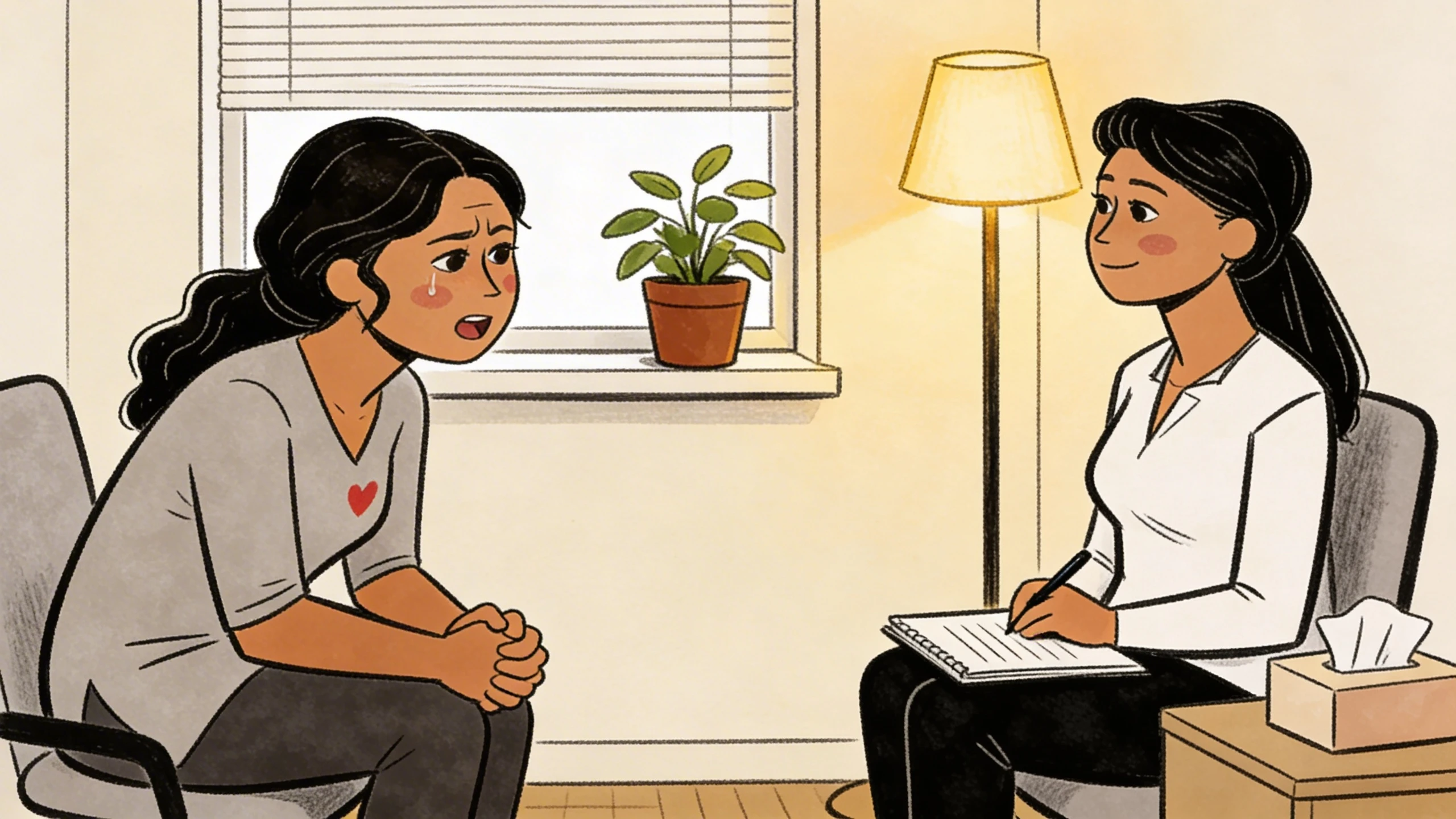
You walk in. You sit down. And then you feel ridiculous because you don't know where to start.
That's normal. A good therapist won't make you perform your pain on command. They'll ask open questions: What brought you here? What's going on at home? What do you wish was different?
You don't need to have a dramatic story. "I keep yelling at my kids and I don't want to" is a perfectly valid reason. So is "I think my childhood is affecting how I parent and I want to figure that out." So is "I'm so burned out I can't feel anything anymore."
If that last one hit close, burnout that's beyond what self-care can fix is one of the clearest signals that therapy will help.
For parents specifically dealing with postpartum mental health struggles, mention that in the first session. It changes the approach and timeline.
What to tell the therapist right away
Three things that help your therapist help you faster:
- What triggered you to call. The specific incident, the pattern, the breaking point. Be as concrete as you can. "Last Wednesday I locked myself in the bathroom for twenty minutes because I was afraid I'd say something I couldn't take back" gives them more to work with than "I've been stressed."
- What you already know about your own history. Even "my parents yelled a lot and I swore I wouldn't" is useful.
- What you're hoping for. Not a perfect answer. Just a direction. "I want to stop repeating what was done to me" is clear enough.
When therapy isn't working
Give it 3-4 sessions before you evaluate. The first session is logistics. The second is still warming up. By the third or fourth, you should feel like you're getting somewhere.
Signs it's time to switch:
- You dread going (and it's not just avoidance of hard stuff)
- The therapist gives generic advice you could find on Instagram
- You feel worse after sessions consistently, not just occasionally
- They dismiss your parenting concerns or minimize your childhood experiences
- You've been going for months and nothing has shifted
Switching therapists is quality control, not failure. The therapeutic relationship is the single biggest predictor of whether therapy works. If the relationship isn't right, the technique doesn't matter.
The part nobody warns you about
Therapy will probably make things temporarily harder before it makes them better. When you start seeing your patterns clearly, you'll catch yourself mid-yell and feel worse because now you know what you're doing. That in-between stage is brutal.
It's also proof it's working. You can't change what you can't see. The awareness comes first. The behavioral shift follows. Most parents report feeling meaningfully different in how they respond to their kids within 8-12 sessions. That's not a lifetime commitment. That's a season.

FAQ
If the issue is mostly skill-based (you don't know what to say during a tantrum), a parenting class or course can help. If the issue is pattern-based (you know what to do but can't do it because something deeper takes over), that's therapy territory. Many parents benefit from both.
Online therapy works well for most talk therapy. The research shows comparable outcomes to in-person for anxiety, depression, and parenting stress. It also eliminates the childcare and commute barriers that stop parents from going.
Go anyway. You don't need permission to take care of your mental health. Many partners come around once they see the changes. Start with your own sessions and let the results speak for themselves.
Weekly is ideal when you're starting out. It keeps momentum and prevents the backslide that happens with longer gaps. After a few months, many people move to biweekly. Your therapist will help you decide when to space it out.