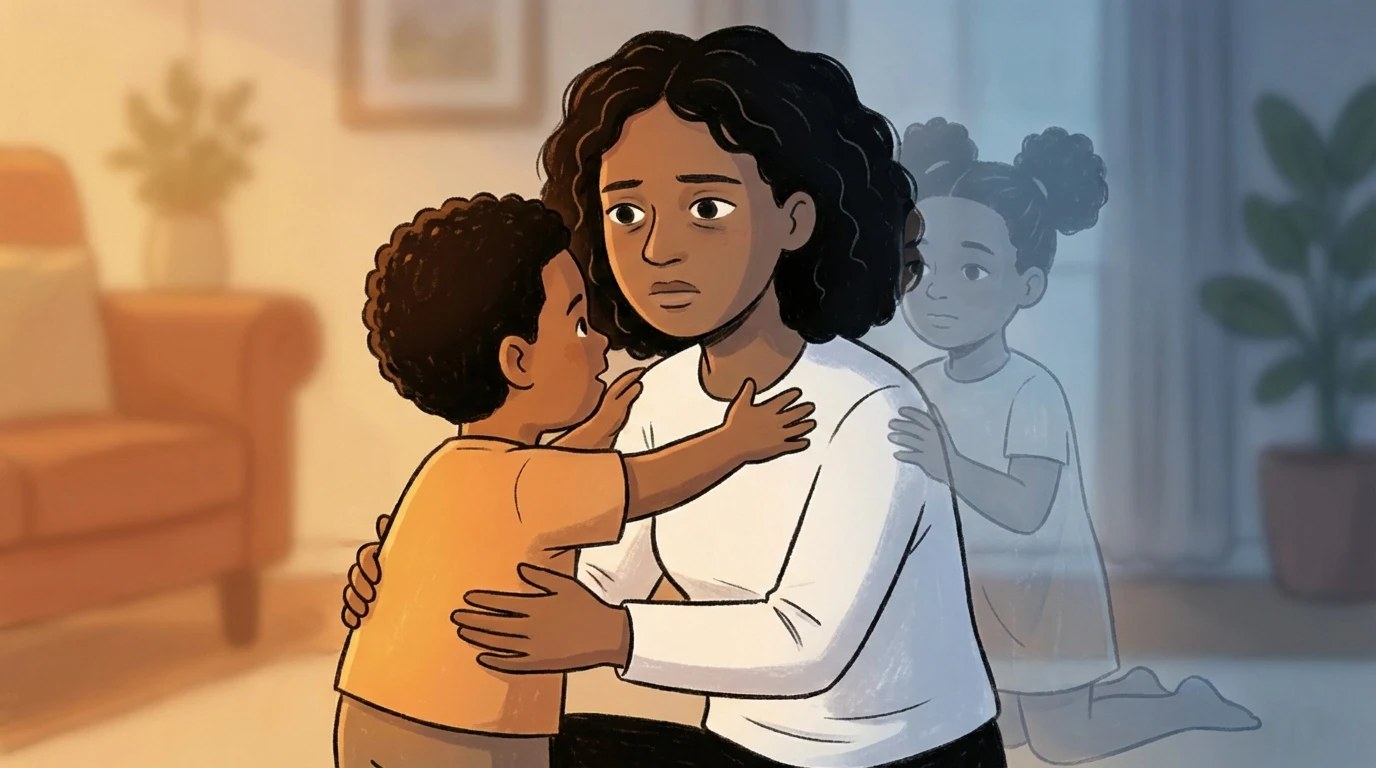
TLDR
- Your body reacts before your brain catches up. Trauma responses live in the nervous system, not in conscious memory. By the time you realize you are overreacting, your body has already flooded with adrenaline and cortisol.
- Your child is not doing this to you. They are doing something developmentally normal that happens to land on an old wound. The intensity of your reaction is the clue that something older is running.
- Knowing your history is not enough. Understanding what happened to you does not stop the nervous system from firing. You need body-level tools, not just insight.
- Flashbacks do not always look like flashbacks. Sometimes trauma shows up as sudden rage, emotional numbness, an overwhelming urge to flee, or the feeling that you cannot breathe. These are all valid trauma responses.
- Small daily practices rewire the pattern. Each time you catch a trauma response and ground yourself in the present, you build new neural pathways. The old wiring does not disappear, but it stops being the default.

Your body remembers what your mind forgot
You are giving your two-year-old a bath. Everything is fine. Then he splashes water in your face and something snaps. Your chest locks up. Your hands go cold. You want to scream or leave or both, and none of that makes sense because he is laughing and you are the one falling apart.
That reaction came from somewhere your conscious mind may not even have access to. Trauma does not store itself in neat, labeled folders you can open and review. It embeds in your body as sensation, reflex, and automatic response patterns that fire long before rational thought can intervene.
This is what makes parenting with a trauma history so disorienting. You can know your childhood was difficult. You can have years of therapy under your belt. And your nervous system can still hijack you in the middle of a Tuesday bath time because the splash, the steam, or the feeling of being trapped triggered a response that was programmed decades ago.
How trauma shows up in parenting
Most parents expect trauma to look like a movie flashback. A clear image, a specific memory, an obvious connection between past and present. For some people it works that way. For most, it does not.
The rage that makes no sense
Your kid talks back and your vision narrows. Your voice drops to a register you barely recognize. The fury coursing through you is so far beyond what a seven-year-old's sass warrants that part of you knows something is wrong even while the rest of you is consumed by it.
That disproportionate rage is your nervous system defending against a threat it learned about in childhood. Maybe defiance meant danger in your house growing up. Maybe talking back led to something you still cannot name. Your body remembers the stakes even when the current situation carries none of them.
The disappearing act
Some trauma responses do not look like anger at all. You go blank. Your child is crying and you are physically present but emotionally gone. You can see them but you feel nothing. You might describe it as checking out, going numb, or just not caring, but what you are experiencing is dissociation. Your system decided that feeling was too dangerous and shut it down.
The need to control everything
Bedtime has to go exactly this way. The routine cannot change. If your partner does it differently, you feel genuine panic. This rigidity often traces back to a childhood where unpredictability meant pain. Control becomes the trauma response that looks like good parenting until it does not.

The trigger is not the problem
Here is where most advice gets it wrong. People will tell you to identify your triggers and avoid them. That is fine for phobias. It is useless for parenting. You cannot avoid your child's crying. You cannot avoid being needed, touched, depended on, or defied. Those are not optional parts of the job.
The trigger is just the messenger. It is telling you that your nervous system detected a pattern match between the present moment and an old threat. The problem is that your body responds to the pattern match as if the old threat is happening right now.
Your kid refuses to eat dinner. Your body interprets this as the same power struggle that ended badly when you were small. Your toddler clings to you while crying and your skin crawls because being needed felt suffocating in your family of origin. Your eight-year-old hits you during a meltdown and suddenly you are not an adult with resources. You are a child with none.
The real work is building a gap between the trigger and your response.
Bathtime surfaced a memory
The Breaking the Cycle course will teach you to separate then from now
You'll stay in the present moment with your child even when your body is reliving something older.
Separating then from now
This is the skill that changes everything, and it is maddeningly simple to describe and genuinely hard to practice. When you feel a trauma response activating, you need to orient yourself to the present moment.
Name what is happening
Say it out loud if you can. "This is a trauma response. I am safe. My child is safe. We are in the kitchen and it is Tuesday." Naming the experience engages your prefrontal cortex, which is the part of your brain that trauma shuts down. The act of labeling pulls you out of survival mode and into observation mode.
Find your feet
Literal grounding. Press your feet into the floor. Feel the texture, the temperature, the weight of your body. Trauma pulls you out of your body and into a timeless soup where past and present blur. Physical sensation anchors you in the now.
Use the five-four-three-two-one
Five things you can see. Four you can hear. Three you can touch. Two you can smell. One you can taste. This sensory orientation technique forces your brain to process current-moment data, which directly competes with the trauma signal.

How to stay present when trauma gets triggered
- Notice the intensity mismatchIf your emotional reaction is a 9 and the situation is a 3, that gap is the signal. Something older than this moment is driving your response. Name it silently: 'this is old stuff.'
- Ground your body firstPress your feet into the floor, grip the counter, or splash cold water on your wrists. Physical sensation pulls your nervous system out of the trauma loop and into the present moment.
- Narrate the current realitySay out loud or to yourself: 'I am in my kitchen. My child is four. I am an adult with choices.' This engages the prefrontal cortex and breaks the pattern match your body is running.
- Breathe on the exhaleMake your exhale twice as long as your inhale. Four counts in, eight counts out. Extended exhales activate the parasympathetic nervous system, which directly counteracts the fight-or-flight response.
- Respond from the presentOnce you can feel the floor under your feet and hear your own voice, you are back. Now you can respond to your actual child in front of you instead of reacting to a ghost.
What professional help looks like
Some trauma responses are manageable with the grounding tools above. Others are not. If you find yourself consistently overwhelmed to the point where daily parenting feels like a minefield, your nervous system is telling you it needs more support than self-help can provide.
Trauma-informed therapy is different from regular talk therapy. Approaches like EMDR (Eye Movement Desensitization and Reprocessing), Somatic Experiencing, and IFS (Internal Family Systems) work directly with the body's stored trauma responses rather than just talking about what happened. Finding a therapist who specializes in this can make the difference between years of coping and actual resolution.
You do not have to wait until things are unbearable. Getting help when you first notice the pattern is faster and less painful than waiting until the pattern has calcified.
Your wiring is old, but you are learning new
The shame spiral after a trauma response is almost worse than the response itself. You yelled. You went cold. You squeezed your child's arm too hard. And now the voice in your head is telling you that you are just like your parent and your kid deserves better and maybe they would be happier with someone else.
That shame voice is part of the trauma pattern. Shame immobilizes you. It keeps you stuck in the old story instead of writing a new one.
Here is what is true: you are a parent whose nervous system was shaped by experiences you did not choose. Those experiences taught your body that certain stimuli are dangerous. Your body is doing what it was trained to do. The fact that you are reading this, that you are trying to understand why you react the way you do, means you are already breaking the cycle that brought you here.
Every time you catch the response. Every time you ground yourself. Every time you repair with your child after the storm passes. That is the new pattern forming. It is slow and it is unglamorous and nobody will give you a trophy for it. But your inner critic will quiet down once the evidence of change starts accumulating.

The long view
Trauma recovery while parenting is not linear. You will have days where you handle a trigger beautifully and days where you react from the old program and feel like you have made zero progress. Both are part of the process.
What matters is the trend, not the individual data point. Over months, the triggers fire less often. The recovery time shortens. The repair conversations with your child get easier because you have had practice. Your child learns that big feelings happen, that adults can lose their footing and find it again, and that relationships survive hard moments.
That is what breaking the cycle looks like in real life. A parent who keeps showing up, keeps catching themselves, and keeps choosing the present over the past.
FAQ
Normal stress matches the situation. You feel frustrated, deal with it, and move on. A trauma response is wildly disproportionate. Your body floods with adrenaline, you feel like you are in danger, and the recovery takes much longer than the incident. That intensity gap is the indicator.
Yes. Body-based therapies like EMDR and Somatic Experiencing work with the nervous system's stored responses rather than requiring conscious memory of the event. Many people resolve trauma patterns without ever accessing a clear account of what happened.
It is both safe and common. Most parents doing this work are parenting at the same time. The key is having a grounding plan for when you get triggered, a repair practice for when you miss, and professional support if the responses feel unmanageable.
Share the basics: your body reacts to certain triggers as if the original threat is happening now, and you need specific support when that happens. Ask for what helps, whether that is taking the child for five minutes or just not questioning your need to step away.