TLDR
- You parent the way you were parented, until you decide not to. Under stress, your brain defaults to whatever your caregivers modeled. Yelling, shaming, and hitting are learned responses passed through families like recipes nobody asked for.
- Shame does not teach. It disables. Children who are shamed do not learn to behave better. They learn they are defective. That belief follows them into adulthood and gets passed to their own kids.
- Your body runs the old program before your brain can intervene. The shift from calm to screaming happens in milliseconds because the pattern is stored in your nervous system, not your rational mind.
- Repair is always available. An isolated incident of yelling will not scar your child for life, provided you go back and reconnect. What causes damage is the repeated pattern without acknowledgment.
- You can stop this. It will cost you discomfort, not perfection. Breaking the cycle means sitting with unbearable feelings instead of offloading them onto your child. It is hard. It works.

The recipe you never asked to learn
You swore you would never yell at your kids the way your parents yelled at you. And then, on a Tuesday evening, after the third request to put on shoes went ignored, you heard it come out of your mouth. The same tone. The same volume. The same hot, pressurized fury that once made you small.
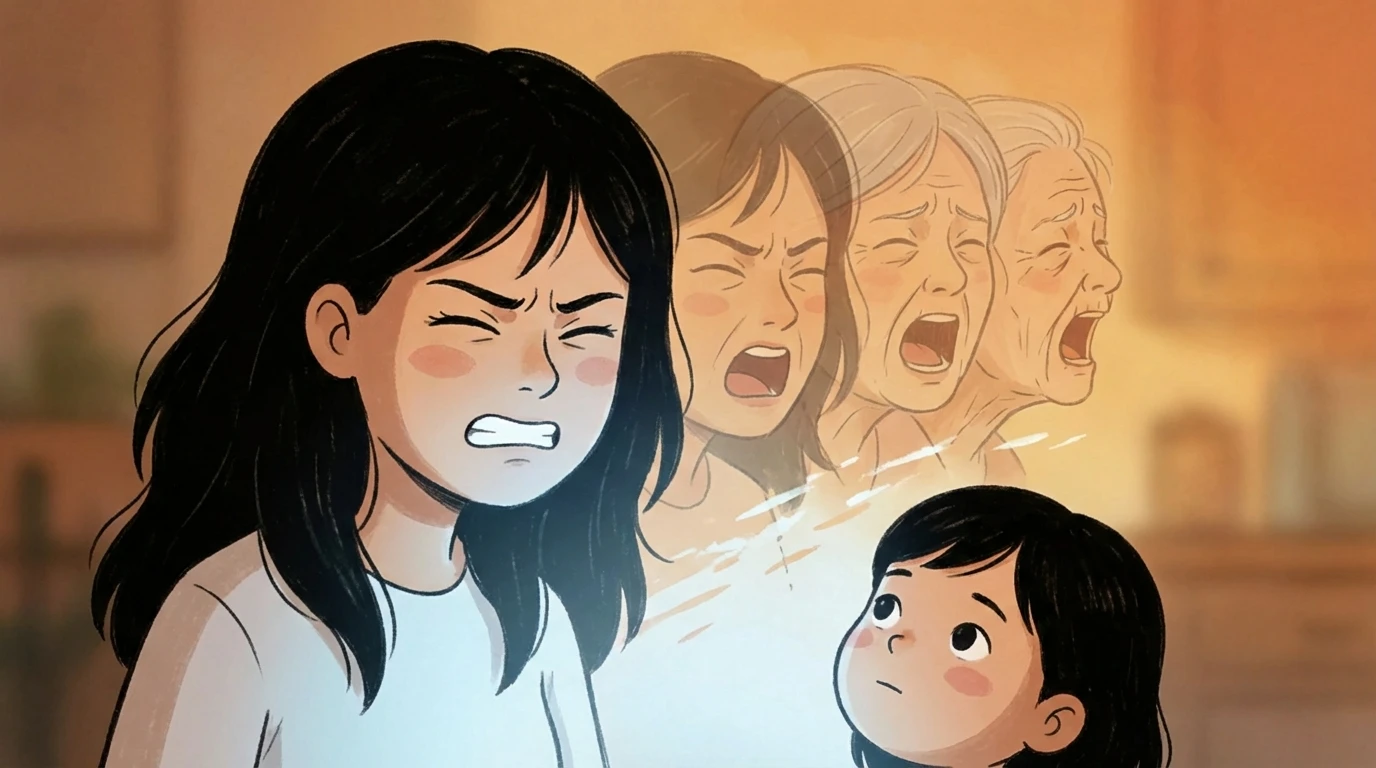
This is the intergenerational cycle, and it does not require your consent to keep running. Your parents learned it from their parents. Their parents learned it from theirs. Nobody sat down and decided that screaming at a six-year-old was good parenting. It got passed along the way eye color does, except this inheritance runs through the nervous system instead of DNA.
The cycle has three components that reinforce each other: yelling (the behavior), shame (the emotional residue), and punishment disguised as discipline (the justification). Pull any one leg out and the whole structure wobbles. But first, you have to see how the structure works, because the wounds your own parents left are still running the show.
How shame jumps from one generation to the next
Here is the mechanism, and it is painfully simple.
The grocery store version
Your child starts melting down at the store. They are tired, overstimulated, and three years old. You feel everyone staring. Your face goes hot. A sinking feeling drops through your chest, and for a split second you feel worthless, exposed, like the whole world just found out you are not good enough.
That feeling is yours, not your child's. It was installed decades ago by a caregiver who made you feel defective when you had big emotions. But instead of sitting with that unbearable sensation, your nervous system does what it learned to do: it deflects. You hiss a threat. You grab an arm too roughly. You say something cutting. And now your child, who was simply tired, feels what you just felt: alone, ashamed, and cut off from the one person who is supposed to make things safe.
That is the transmission. Your unprocessed shame got activated, and you passed it sideways to the person with the least power in the room.
Why punishment makes it worse
Every form of punishment (time-outs used as isolation, yelling, spanking, harsh lectures) intensifies shame because the child cannot separate the behavior from their identity. A three-year-old who gets screamed at for climbing the TV cabinet does not think, "I made a poor choice about furniture." They think, "I am bad. The things I want are bad. I should be different than I am."
Research published in the Journal of Family Psychology links spanking with increased aggression, mental health problems, and cognitive difficulties. But you do not need a study to verify this. You just need to remember how you felt when it happened to you. The lesson was not "don't climb." The lesson was "something is wrong with me."

Your parent's words, your mouth
The Breaking the Cycle course will help you rewrite the family script
You'll catch the inherited phrase mid-sentence and replace it with something your kid will remember well.
What the cycle looks like day to day
The intergenerational cycle does not show up as a single dramatic incident. It shows up as a pattern so ordinary you stop noticing it.
The slow drip
The parent who says "Stop crying or I will give you something to cry about" learned that emotions are dangerous. They are enforcing the same rule that was enforced on them: feelings are a threat, and threats must be shut down, not being cruel on purpose.
The parent who carries old emotional weight into every interaction is repeating patterns, not failing. The difference between failing and repeating is that repeating has a specific cause you can trace and interrupt.
The "I turned out fine" defense
"My parents spanked me and I turned out fine." You will hear this from relatives, friends, and your own internal monologue. Consider the possibility that "fine" means "functional enough to hold a job while quietly struggling with anxiety and a hair-trigger temper that surfaces mostly at home."
Recognizing that your childhood shaped your parenting reflexes is where the real work begins.
Five ways to interrupt the cycle
Breaking this pattern does not require becoming a different person. It requires catching yourself in the act, over and over, until the old wiring starts to weaken.
How to break the intergenerational cycle of harsh discipline
- Trace your triggers to their originWhen you feel that surge of rage or panic, ask yourself: who used to make me feel this way? The answer usually arrives fast. That recognition alone puts a tiny gap between the trigger and your reaction.
- Feel the discomfort instead of offloading itThe urge to yell is the urge to discharge an unbearable sensation. Sit with it instead. Chest tight, jaw locked, hands shaking. Ninety seconds of feeling without acting and the charge begins to fade.
- Replace the script your parents gave youInstead of 'Stop it right now,' try 'You are really upset. I am here.' Instead of 'Because I said so,' try 'I know this feels unfair. Here is why.' Write new scripts before you need them.
- Repair every single time you slipYou will slip. Go back. Get on their level. Say 'I yelled and that was not okay. I am sorry. You did not deserve that.' Repair teaches your child that mistakes do not end relationships.
- Get support you did not have growing upTherapy, parenting groups, a partner who holds you accountable. The cycle thrives in isolation. You cannot break a multigenerational pattern alone any more than you can push a car out of a ditch by yourself.

The part nobody wants to hear
You cannot break this cycle from a place of shame about having the cycle. The voice that says, "A good parent would not feel this rage" is the same voice your parents installed. It is part of the machinery, not the solution.
Reparenting yourself means extending to yourself the compassion you are trying to give your children. When you catch yourself mid-yell, the healing response is not "I am a monster." It is "That came from somewhere old. I can feel it. I am choosing something different right now."
This is uncomfortable in a way that "just try harder" advice does not prepare you for. The discomfort is the old pain surfacing. Your inner critic will tell you the pain proves you are broken. The pain proves you are thawing, and frozen things hurt when they start to warm.
What your kids see when you do this work
Your children do not need a parent who never yells. They need a parent who comes back after yelling and says, "That was wrong. I am working on it. You are safe."
When you model accountability and repair, you are writing a new recipe for your family. Your child watches you struggle with an impulse and choose differently. They watch you apologize without excuses. They watch you sit with hard feelings instead of punishing someone else for them. That is the new inheritance. Not perfection. Honesty. Not calm at all times. Calm enough to come back.
If you find yourself stuck in the same loops despite genuine effort, that is not a sign of weakness. It means the wiring goes deep enough to benefit from professional help. A therapist who specializes in family patterns or intergenerational trauma can reach layers that self-awareness alone cannot.
The cycle took generations to build. You do not have to dismantle it in a weekend. You only have to interrupt it, one moment at a time, until the interruptions become the new pattern.

FAQ
Yes. Intergenerational patterns are strong, but they are not destiny. Every time you recognize the old pattern, feel the discomfort it produces, and choose a different response, you weaken the wiring. The cycle needs unconscious repetition to survive. Awareness and new choices starve it.
You cannot control your partner's process. Focus on your own reactions. Model what repair looks like. Share what you are learning without lecturing. If the gap between your parenting approaches becomes too wide, a family therapist can help you get on the same page.
You can make real progress through self-awareness, journaling, parenting groups, and consistent repair with your kids. Therapy accelerates the process, especially for deeply rooted patterns. If you keep falling into the same reaction despite your best efforts, that is a sign professional support would help.
Watch for statements that judge who your child is rather than what they did. 'You are so selfish' is shame. 'That was not kind to your sister' is correction. If your child regularly seems crushed rather than redirected after you address behavior, shame may be in the mix.