TLDR
- Your overreaction is not about your kid. When a spilled drink makes you furious, that fury belongs to something older. Your child lit the match, but the fuel was loaded decades ago.
- Telling yourself to 'just get over it' does not work. Stuffing emotions down or reasoning your way through them keeps the charge intact. The baggage stays packed until you feel what is inside it.
- Healing happens in the body, not the story. Replaying your childhood story keeps you stuck. Noticing where the tension sits in your body and breathing into it is what releases the charge.
- You do not need to identify the original wound. The current trigger is the doorway. Working with whatever your body feels right now heals the underlying hurt, even if you never pinpoint the exact memory.
- Every pause builds new wiring. Each time you notice a trigger and resist acting on it, you reduce its power. The work accumulates over months and years.

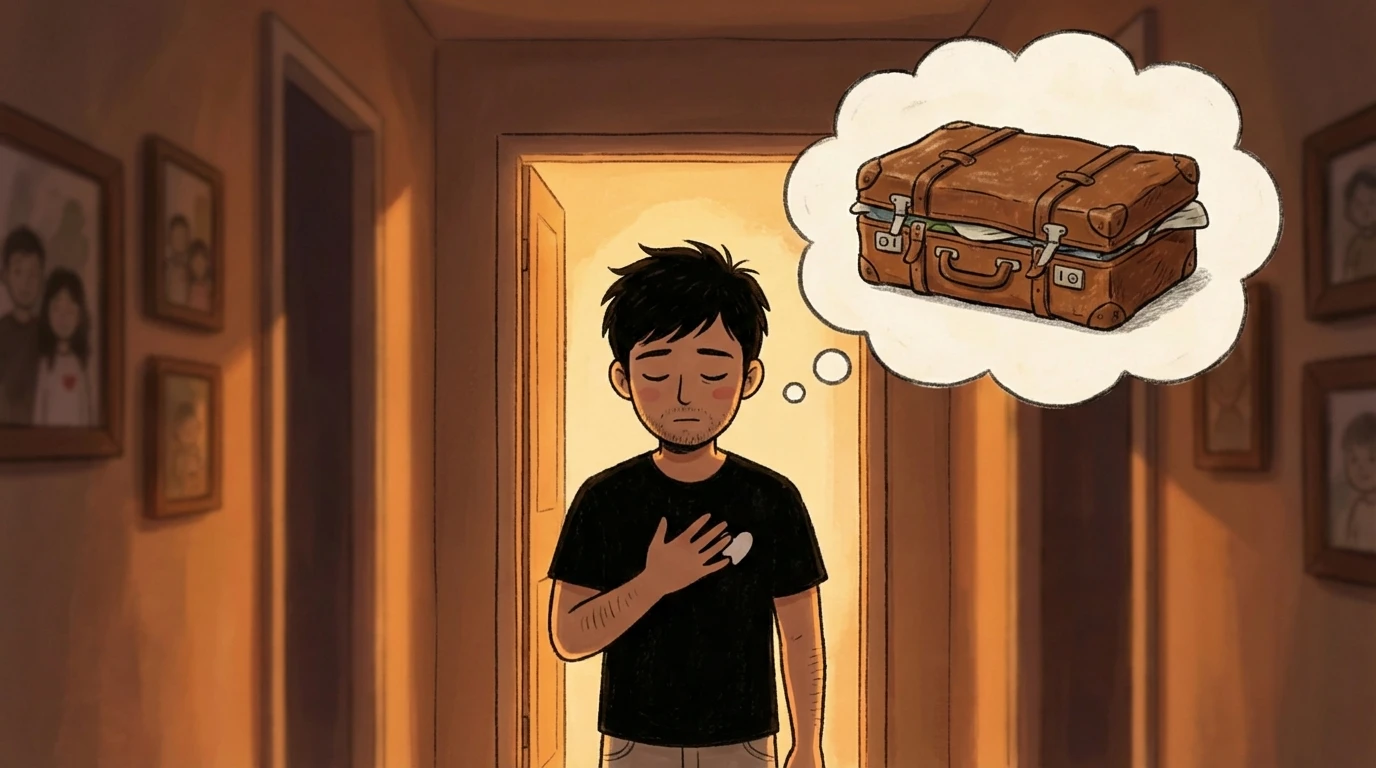
The suitcase you never packed
You did not choose this baggage. Nobody sat you down at age six and said, "Here, carry this resentment and fear for the next thirty years." It just accumulated. A parent who went silent when angry. A household where crying was treated as manipulation. A voice that said you were too much or never enough.
And then you had kids. Your three-year-old started pressing buttons you did not know existed. A whine at the right pitch, a defiant stare, a refusal to eat dinner, and suddenly you are not a competent adult anymore. You are small, furious, and desperate to make it stop.
That is emotional baggage doing what it does. It waits in your nervous system until something in the present resembles something from the past. Then it floods you with feelings that belong to another time entirely. Your child is the trigger, not the cause. The suitcase was packed long before they were born.
You cannot think your way out of this. You cannot read enough books or white-knuckle your way through the activation. The baggage does not care about your intentions. It responds to sensation, not logic.
Yelling over spilled milk again
The Breaking the Cycle course will help you size your reactions to the actual moment
You'll notice when the anger is too big for the mess and trace it back before it lands on your kid.
Why "just let it go" is bad advice
People love to say this. Let it go. Move on. Forgive and forget. It sounds reasonable until you try it and realize that letting go requires you to first pick the thing up and look at it.
Old wounds persist because they were never processed. As a child, you could not handle the full weight of what was happening, so your brain did something adaptive: it walled the pain off. It wrapped the hurt in anger or numbness and stored it somewhere you would not have to feel it. Smart survival for a kid. Terrible strategy for a grown-up who now has a toddler testing every boundary in the house.
The problem is that the wall is still there. Behind it, the pain has not aged. It is as raw as the day it was sealed off. Every time your child's behavior bumps against that wall, the alarm goes off. Your body floods with cortisol as if the original threat is happening right now. You are not overreacting to the present. You are reacting appropriately to a danger that no longer exists.
"Letting go" is the result of a process, not a decision you make once. You have to feel what is behind the wall before it comes down.
The body keeps the score
Emotions live in the body. The lump in your throat when your kid yells "I hate you." The tightness across your chest when they refuse to hug you. The nausea when you hear yourself yelling in a voice that sounds exactly like your mother's.
These are physical sensations, not thoughts. And they are the doorway to healing. When you focus on the sensation instead of the story, the emotional charge starts to dissipate. The story keeps you stuck. The sensation moves through.

The six-second practice that works
You do not need a weekend retreat. You need about six seconds and the willingness to feel uncomfortable.
Notice the physical sensation. Tight jaw. Hot chest. Clenched fists. Name the sensation, not the emotion. Skip the thought ("she always does this") and the judgment ("I am a terrible parent") and go straight to what your body is doing.
Resist taking action. When triggered, every fiber of your being wants to do something: yell, leave the room, check your phone, eat something. All of those are escape routes from the feeling. Stay put.
Hold yourself with compassion. You are being the parent you needed when you were the age your child is now. Just present with the hurt.
Let the sensation move. Sit with it for about ninety seconds without acting. The sensation changes. It loosens, shifts, sometimes dissolves. This is the opposite of the negative patterns that keep most parents stuck.
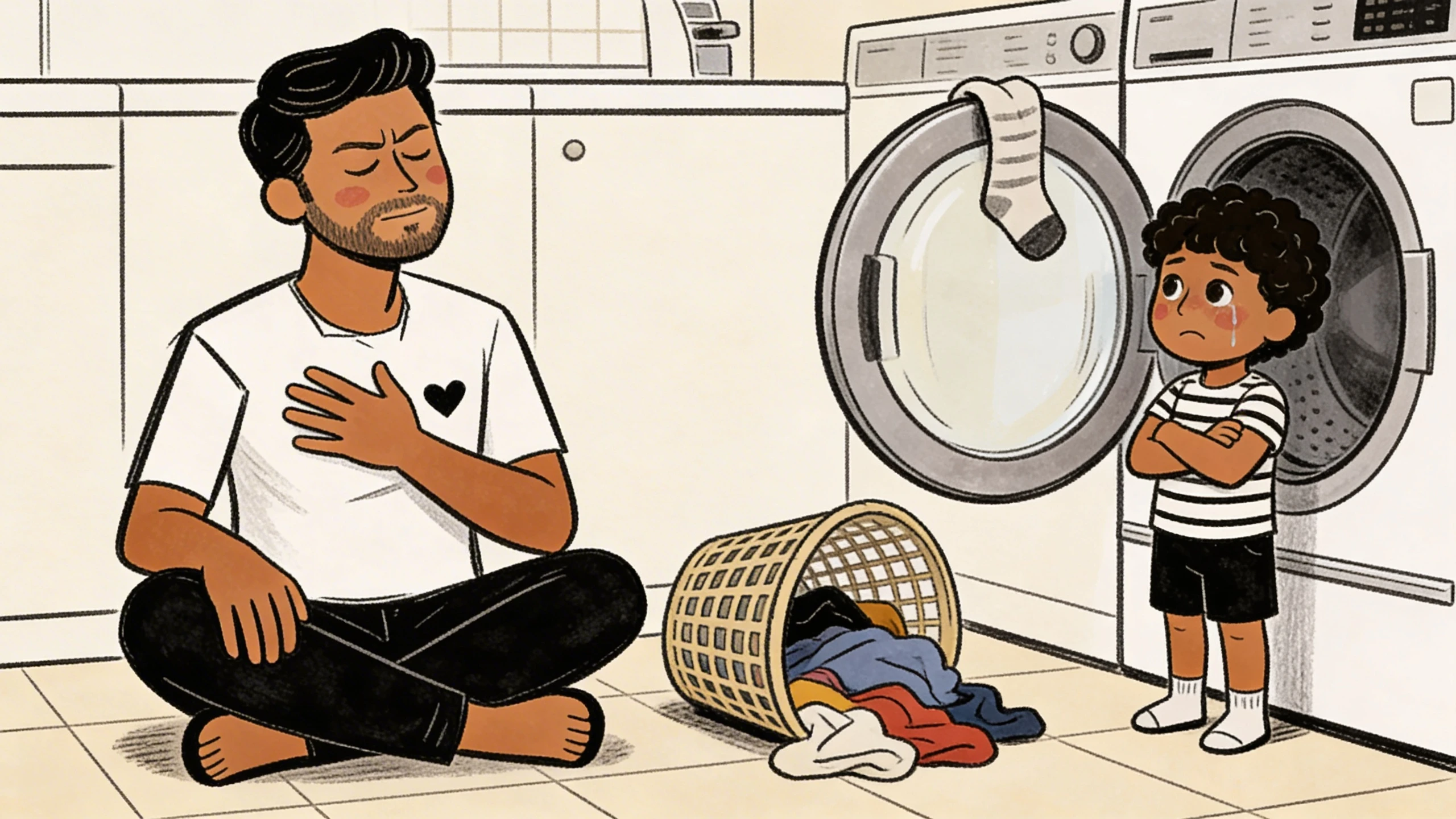
How to unpack emotional baggage when it surfaces
- Find the body signalBefore you can work with a trigger, locate it physically. Scan for tightness, heat, nausea, or clenching. Name the location: 'pressure in my chest' or 'knot in my stomach.'
- Drop the story lineYour brain will start narrating why you feel this way and whose fault it is. That story is a defense mechanism. Return your attention to the physical sensation. The body is where healing happens.
- Breathe into the discomfortDirect your breath toward wherever the sensation lives. Do not try to make it go away. Just breathe and observe. If you feel the urge to jump up and do something, notice that urge and keep breathing.
- Extend compassion to yourselfImagine the version of you who first felt this pain. That child deserved comfort and did not get it. You can offer it now. This is the mechanism that dissolves the defensive wall around the old wound.
- Give yourself a counter-messageAfter the sensation shifts, create a short antidote: 'I can handle this. My child is safe. I am not who hurt me.' This programs your nervous system toward repair instead of repetition.
What happens when you keep doing this
The first time, it will feel like nothing happened. Maybe you paused for ten seconds instead of yelling. Maybe you noticed the chest tightness before you slammed the cabinet. That counts. That is the work.
Every time you feel the trigger and resist acting on it, you reduce its power. By sitting with the activation instead of fleeing, you allow your brain to finally process the old memory. The emotional charge decreases. The trigger that once made you see red starts to register as a dull ache, then a flicker, then barely a blip.
The memory changes shape
You do not forget what happened to you. But the meaning shifts. If your baggage involves a parent who screamed at you, you may still remember the screaming, but your takeaway changes. Instead of "I was unlovable," it becomes "my parent was struggling." You feel understanding for them and compassion for yourself as a child. The memory stays, but the weight it carries in your body drains away. You can think about it without your pulse rising.
Because you are processing your own baggage, you stop dumping it on your kids. The moments that used to trigger you become just moments. Your kid whines. You feel a twinge. You breathe. You respond from the present instead of the past.

This is not a weekend project
Healing emotional baggage takes time. Not because you are broken, but because the baggage accumulated over years and dissolves in layers. Some triggers will fade quickly. Others will circle back when you thought they were done. Expect to feel like you have made no progress right before a big shift. That is how this goes.
Every step makes you lighter. Every time you choose to feel instead of react, you send a different signal to your nervous system. Every time you choose present-moment awareness over autopilot, your children benefit.
The ripple effects are real. When you stop carrying old pain into the breakfast table, your kids stop walking on eggshells. They get easier to parent, not because they changed, but because you are responding to them instead of to ghosts.
If you want to figure out which specific patterns are running your reactions, that is a useful starting point. But the real work is simpler than any quiz can capture: feel the feeling. Do not run from it. Let it pass through you. Repeat.
FAQ
Normal frustration matches the moment. You feel annoyed, handle it, and move on. Emotional baggage produces a reaction wildly out of proportion. Your heart races, your vision narrows, and you feel an urgent need to control or flee. That intensity gap is the signal that something older is running the show.
You can make real progress on your own by noticing triggers, feeling the body sensation, and resisting the urge to act. If the emotions feel too overwhelming to sit with safely, or you keep looping through the same patterns, a therapist trained in trauma can help you go deeper.
Children respond well to repair at any age. Go back, name what happened, apologize, and reconnect. The fact that you are doing this work now changes the trajectory. You do not need a perfect track record. You need a pattern of repair.
Some will dissolve entirely. Others will shrink to a faint signal you can notice and release in seconds. The goal is building enough awareness that a trigger no longer hijacks your response.