
TLDR
- Reparenting means becoming the parent you needed. You build an internal voice that speaks to you with warmth and steadiness, replacing the critical or absent voice you grew up with.
- Your kid's meltdown is your practice ground. Every time your child triggers an old wound, you get a live chance to respond differently to both of you.
- It starts with noticing, not fixing. The first skill is catching yourself mid-reaction and recognizing that what you feel belongs to your past, not this moment.
- Small daily repetitions change your brain. Neuroscience shows that repeated self-compassion rewires the neural pathways built by neglect or criticism.
- You do not need to do this perfectly. Reparenting is messy. You will forget, slip back, and yell. The return matters more than the streak.

The parent inside your head
Everyone has an internal voice that shows up when things go sideways. For some people, that voice says: It is okay. You are figuring this out. Take a breath. For others, it says: You are failing. Your mother was right about you. You cannot handle this.
That voice was installed during childhood. If the adults around you responded to your distress with comfort, your internal voice learned comfort. If they responded with silence, anger, or shame, your internal voice learned those instead.
Reparenting is the decision to replace that voice on purpose. You are building something that should have been there from the beginning: a steady internal parent who can hold you when you are falling apart.
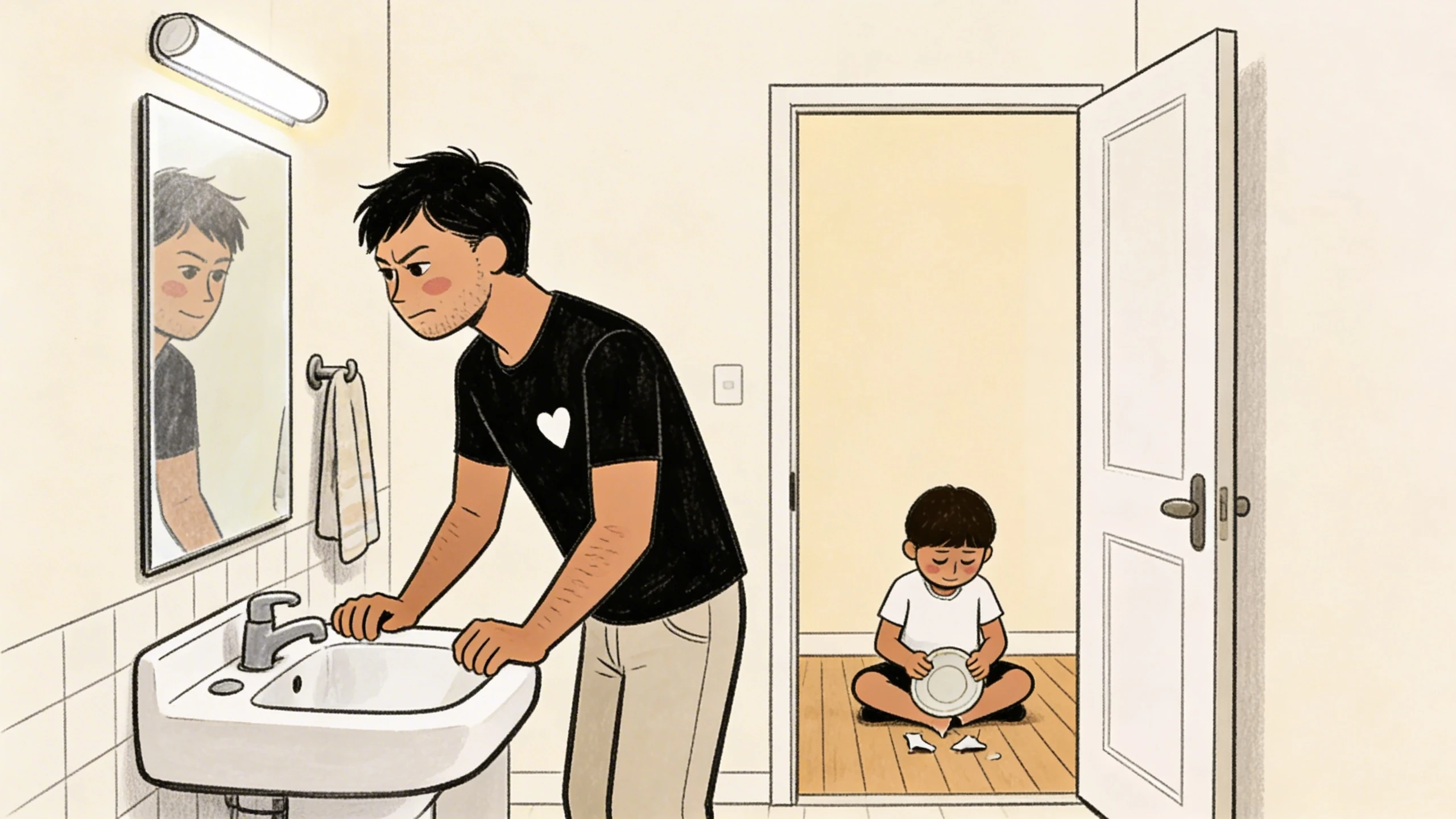
This matters because the voice you use on yourself leaks out onto your kids. When your four-year-old dumps yogurt on the carpet and your inner voice screams you worthless mess, that energy reaches your child before you open your mouth. Kids read all of it.
Here is where it gets practical. You already know what childhood triggers feel like in your body. Reparenting is what you do after you notice them.
Comforting your inner child
The Breaking the Cycle course will walk you through reparenting yourself first
You'll build the internal voice you needed at seven so it's there when your own kid needs you at bedtime.
What reparenting looks like in real life
Forget affirmations in a circle. Reparenting is a series of micro-moments scattered through ordinary days.
The morning version
Your son refuses to get dressed. You feel the heat climbing up your neck. The old script says: Make him do it. You are losing control.
The reparenting version: you notice the heat, place one hand on your chest, and silently say, I am okay. He is three. This is not a power struggle. I can wait ten more seconds.
That sentence is the reparenting. The grounding response nobody gave you when you were three and terrified of being late.
The bedtime version
Your daughter screams that she hates you because you turned off the TV. The words land like a slap. Your stomach drops. Your childhood brain says: She does not love you. Nobody does.
Reparenting: you feel the stomach drop, recognize it as old material, and whisper to yourself, That is a five-year-old who is angry about a screen, not a verdict on your worth. Then you sit on the edge of her bed and wait. The ability to stay in the room when everything in you wants to leave is the reparenting in action.

The three moves of reparenting
You do not need a therapist's couch to start this work (though the breaking the cycle series covers when professional help makes sense). You need three moves, repeated hundreds of times.
Move one: catch the activation
Something your kid does triggers a feeling that is too big for the situation. Your job is to notice the gap between what happened (spilled juice) and what you feel (rage, shame, panic). That gap is the signal that old material is running.
You might feel it as heat in your face, tightness in your throat, or a sudden urge to control everything. Whatever the sensation, name it: There it is.
Move two: speak to yourself like a kind parent
Instead of pushing through the feeling or berating yourself for having it, you talk to yourself the way a steady parent would talk to a scared child.
Scripts that work:
- "Of course you feel this way. This is an old feeling."
- "You are safe right now. This is your kitchen, not your childhood."
- "I see you. I am not going anywhere."
It will feel ridiculous at first. That is because no one ever said these things to you, so hearing them (even from yourself) is unfamiliar. The discomfort is proof that you are reaching the part of you that needs it most.
Self-compassion is the engine that makes this work. Without it, reparenting becomes another performance standard you cannot meet.
Move three: respond to your child from the new voice
Once you have caught the trigger and spoken kindly to yourself (even for three seconds), you respond to your kid. The response will be different. It will be slower, quieter, and more connected.
This is how the intergenerational cycle breaks. You absorb the hit internally, process it with your new internal parent, and send a different signal outward.
How to start reparenting yourself
- Identify your default inner voiceSpend one week noticing what you say to yourself when parenting gets hard. Write it down without editing. Most people discover the voice belongs to someone from their childhood.
- Write three replacement sentencesCreate short, specific phrases you want to hear instead. Keep them grounded and believable. 'I can handle this' works. 'Everything is perfect' does not.
- Practice during low-stress momentsUse your new sentences when you burn dinner or forget a school form. Train the response when the stakes are small so it is available when your kid is screaming.
- Use your body as an anchorPlace a hand on your chest or stomach when you speak to yourself. Physical touch activates the same soothing circuits that a parent's hug would have activated when you were small.
- Repair when you forgetYou will default to the old voice. When you catch it, circle back: 'That was the old script. Here is what I want to say to myself.' The repair is the reparenting.
Why it feels fake (and why that is fine)
The number one objection to reparenting: This feels stupid. I am a grown adult talking to myself like a baby.
Here is what is happening neurologically. Your brain formed pathways around whatever it experienced most during childhood. If criticism was common, the pathway to self-criticism is a highway. The pathway to self-compassion is a dirt road with no signs.
Every time you use the new voice, you are widening that dirt road. The first hundred times feel forced. By the three-hundredth time, the new voice shows up before the old one. Neuroplasticity does not care whether the practice feels authentic. It only cares about repetition.
If you notice that your inner critic fights back hard when you try this, that is normal. The critic evolved to protect you. It will not surrender its role without resistance. But the critic is a guard dog still barking at threats that left decades ago.
What reparenting gives your kids
Here is the part nobody talks about enough. When you reparent yourself, your children get something they cannot get any other way: a parent who can tolerate distress without transferring it.
A reparented parent can:
- Sit with a screaming child without screaming back
- Hear "I hate you" without crumbling inside
- Hold a boundary without needing the child to like them for it
- Give unconditional love because they are starting to give it to themselves
Your kid does not need you to have had a perfect childhood. They need you to be doing the work now. The work changes how you respond in ways they will feel but never name.
Take the quiz on how your kid would describe you if you want to see the gap between the parent you are being and the parent you are becoming.
When reparenting is not enough
Reparenting works on the daily friction. The moments when you catch yourself, redirect, and respond better. But some wounds are too deep for self-guided work.
If you find that you cannot access the kind inner voice at all (only numbness), dissociate when your child cries, or have flashbacks triggered by parenting, then you need more than a practice. Rebuilding your self-esteem as a parent is part of this process, and sometimes it requires support that articles cannot provide.
Reparenting is the daily practice that runs alongside therapy, not a replacement for it. The therapist helps you access what is buried. The reparenting practice helps you use what you uncover in real time with your kids.

Starting today
You do not need to understand your entire childhood to begin. Pick one moment from today that felt too big. Replay it in your mind, but this time, add the kind voice.
What happened to you was hard. You are doing something different now. That matters.
Say it out loud if you can. That tension between wanting to cry and wanting to laugh at yourself is the beginning.
FAQ
Most people notice a shift within two to four weeks of daily practice. The shift is subtle: a half-second pause before yelling, a moment where the old voice starts and the new one catches it. Larger changes in your default reactions take three to six months of consistent repetition.
Yes. Reparenting works for anyone whose inner voice is harsh or dismissive when parenting gets hard. Even well-meaning parents sometimes left gaps in emotional attunement. If your internal response to stress sounds critical, reparenting can help regardless of how your childhood looked from the outside.
You do not need your partner on board to start. Reparenting is internal work. Your partner will notice the results before they understand the method. When you stop snapping as quickly and recover faster after conflict, the evidence speaks louder than any explanation.
Inner child work is one framework for reparenting. Other approaches include Internal Family Systems, compassion-focused therapy, and attachment-based self-reflection. The common thread is building a caring internal response to your own distress. The label matters less than the practice.