
TLDR
- You will never win a parenting argument on the spot. The results of any parenting approach take years to show. Nobody can prove their method is better at a family barbecue.
- Criticism stings hardest when it echoes your own doubts. Most parents doing this differently weren't raised this way. The outside voice lands because it matches your inner one.
- The default move is to smile and redirect. You don't owe anyone a debate. 'Parenting sure is hard, isn't it?' is a complete response.
- When you choose to explain, lead with common ground. You both love your kids. Start there. Then frame your approach as new research, not a judgment of theirs.
- Pediatricians are medical experts, not parenting experts. Their training covers physical health. Parenting advice from a doctor carries no more weight than from anyone else.
The comment that won't leave your head
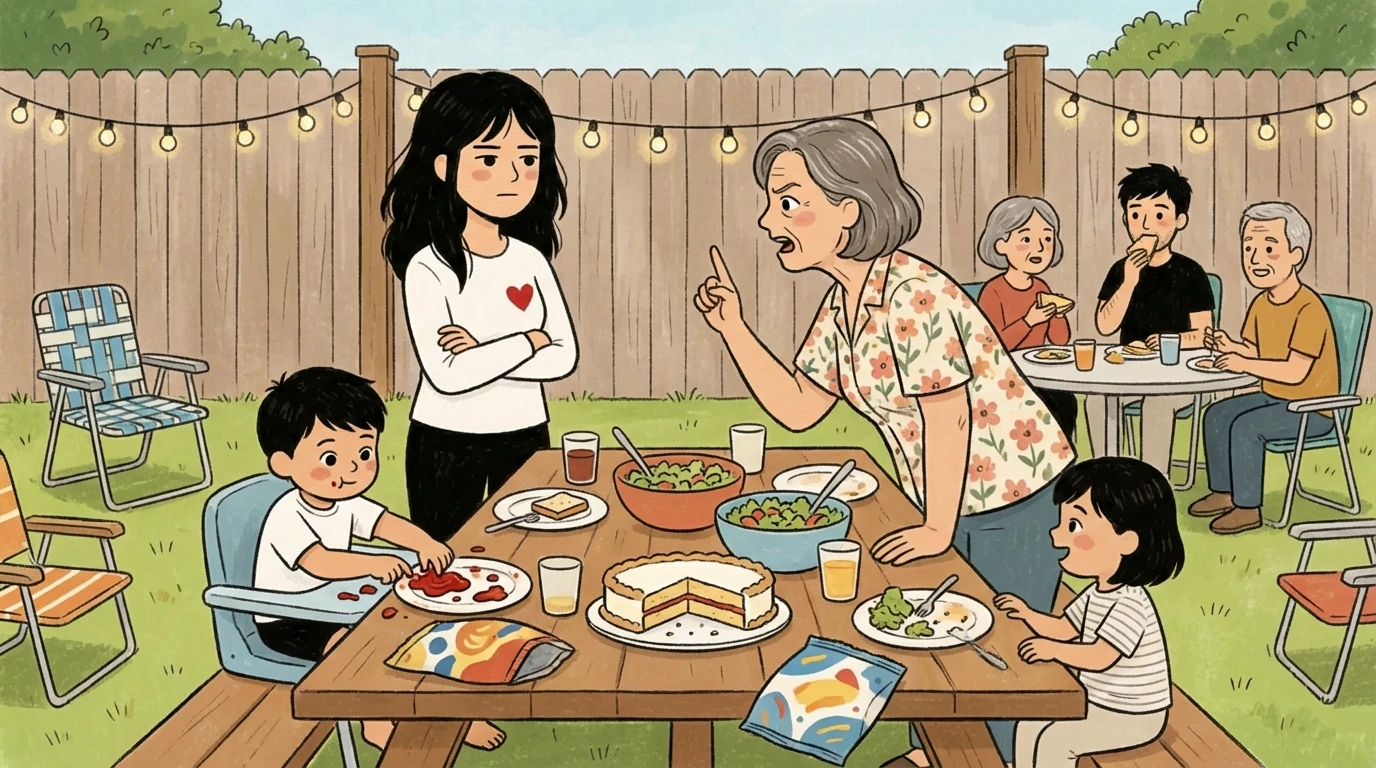
Somebody said something about your parenting. Maybe it was your mother at Thanksgiving, pointing out that your kid "would listen better with a firm hand." Maybe it was a stranger at the playground. Maybe it was your pediatrician, casually suggesting "negative consequences" for your one-year-old.
And here you are, three days later, still replaying it.
The reason that comment is stuck in your head has very little to do with the person who said it. It poked a bruise that was already there. Most parents choosing a non-punitive approach weren't raised that way. You're building something you didn't get a blueprint for. And criticism from your own parents hits a nerve because it echoes patterns you're trying to break.
There is no winning a parenting argument in the moment. The results of your approach take years to manifest. When someone else's three-year-old snaps to attention at "the count of three" and yours is negotiating the terms of putting on shoes, it looks like their way works. You can say your kid will be a more self-directed teenager. But you don't have a receipt for that yet.
So what do you do with the criticism while you wait for the evidence to catch up?
Spanked and turned out fine
The Intentional Parenting course will give you grounded answers to every critic
You'll hear the comment at dinner and respond from clarity instead of shame, because you'll know exactly why you parent this way.
Why it feels like a personal attack (because it sort of is)
When someone questions your parenting, they're doing more than offering an opinion about bedtime routines. They're implying that their way is better, and that your way might be hurting your child. That's a conversation about love and competence, not technique. No wonder it gets your heart rate up.
The short-term compliance trap
Here's what makes it worse. The critics often have a point, at least visually. Kids trained for obedience do comply faster. When humans are threatened with consequences, they usually go along. Over time, this creates a habit of compliance (unless the kid is strong-willed, in which case it creates a habit of defiance instead, but nobody mentions that part at the barbecue).
This short-term compliance is what makes punitive parenting look like it's working. And four decades of research on what happens next doesn't fit on a bumper sticker.
What the research says when nobody's watching
Children raised with empathic limits are more likely to internalize values and carry them into situations where nobody is enforcing anything. Children raised with punishment are more prone to anger, rebellion, anxiety, and susceptibility to peer pressure. The difference doesn't show up at age three. It shows up at age thirteen, when your kid has to make decisions without you standing there counting.
Your approach isn't slower. The payoff timeline is longer. That's a different thing entirely.

The default response: smile, redirect, move on
Most of the time, you don't need to explain yourself. You need a script that ends the conversation without starting a war.
The move is simple: smile, say something neutral, and change the subject.
"Parenting sure is hard, isn't it?"
"We're figuring it out as we go."
"Thanks, we've got a plan that's working for us."
Then in your own head, remind yourself: you've done your research. You're following your own informed judgment. Your child will be fine. You don't owe a defense to everyone who has an opinion.
This approach works for acquaintances, strangers, and relatives you see twice a year. Save your energy for the people who matter.
When your kid acts up in front of the jury
The hardest moments happen in real time. Your child pushes another kid at a family gathering, and every adult in the room swivels to watch how you handle it. They're expecting a timeout or a sharp correction. You're about to do something that looks, to them, like nothing.
How to handle your child's behavior when critics are watching
- Help your child make it rightIf they're not ready to apologize, do it for them while keeping a hand on their shoulder. 'We're so sorry you were hurt. Maya was really mad and forgot to use her words. I know she'll make it right once she calms down.'
- Take it privateMove out of earshot. Empathize first: 'That was a tough situation.' Let them vent. Hug. Then, once they're calm, ask what they could do to make things better with the other child.
- Set limits people can seeUse acknowledgment plus a boundary: 'I hear you. You really wish we could stay longer. And right now we need to go. I know, that's disappointing. Come on, let's go.' Observers see you holding a limit. They just see you doing it without yelling.
- Exit meltdowns without apologizing for your kidSmile at the relatives. 'She'll be fine, she just needs a few minutes with me.' Walk away. Your child needs to feel safe, not judged. Privacy gives them that.
- Prep before the next gatheringOn the drive over, ask your child what rules make sense. Kids follow rules they helped create. 'We look after the little ones. We take turns. We use words when we're mad.'
Repair beats punishment every time. When your child apologizes because they genuinely understand they hurt someone (not because you forced the words out of their mouth), observers notice. They just might not admit it.

When it's someone who matters (and they won't drop it)
Your mother-in-law. Your best friend. Your own parent. When the critic is someone you love, "parenting is hard, isn't it?" won't cut it. They'll keep circling back.
Start with what you share
Point out the common ground before you explain the difference. You both love these kids. You're both doing the best you can with what you know.
For in-laws, try this line: "You raised someone I love enough to build a life with. I'm building on what you started." That sentence does more disarming than any research citation.
Frame it as new information, not their failure
The analogy that works: "Just like medicine has changed in thirty years, what we know about kids' brains has changed too. We're using what the latest research shows." This frames your approach as progress, not a critique of how they did it. Nobody gets defensive about medical advances. If they raise specific myths about your approach, you can address those directly.
When they still push back
End graciously. "I know our kids are both well-loved. Let's compare notes when they're teenagers." Then drop it. You've said your piece. The results will speak for themselves, and understanding why their criticism triggers your own intergenerational patterns can help you stay grounded while you wait.
The pediatrician problem
Doctors carry a specific kind of authority that makes their parenting opinions feel like medical advice. They're not. Pediatricians are trained in physical health. They have almost no training in child psychology or discipline practices.
When a doctor pushes discipline advice, redirect: "We've got that covered, thanks. Anything we need to know about how he's doing physically?" This is polite, firm, and puts the conversation back in their lane.
If they persist, point out that psychological understanding of children has advanced as much as medicine has. But the redirect usually works. Most doctors take the cue.

What you tell yourself at 2 AM
The criticism fades. The doubt that it feeds doesn't, at least not as fast. So here's what you tell yourself when the house is quiet and you're second-guessing everything:
You set limits. You say no. You hold boundaries. You just do it without threats, shame, or withdrawal of love.
That's harder than yelling. Anyone who's done both knows that. The path you chose requires more patience, more self-regulation, and more willingness to sit with discomfort. The people criticizing you are often criticizing something they couldn't do themselves.
And the gap between what your parenting looks like at a family barbecue and what it produces at age fifteen? That gap is exactly where your self-compassion needs to live. You're playing a long game. The scorecard just hasn't been printed yet.
FAQ
Check the distinction. Permissive parenting means no limits. If you set clear boundaries but enforce them without punishment, that's authoritative parenting, which has the best outcomes in research. The test: does your child know the rules? Do you follow through? If yes, you're not permissive.
Acknowledge their love, then reframe: 'I know it looks different from how I was raised. The research on kids' brains has come a long way. I set limits, I just do it without yelling.' If they push, offer to compare notes in ten years.
Only if they ask. Unsolicited reading material feels like a counter-attack. If someone genuinely wants to understand, share one specific resource. Otherwise, let your results speak over time. A well-adjusted kid is more convincing than a bibliography.
That's a different conversation than outside criticism. With a co-parent, you need alignment, not just boundaries. Start with shared goals: 'We both want our kid to be kind and confident. Let's talk about how.' A parenting course you take together can give you common language.
Almost never. A stranger at the grocery store who comments on your parenting is not someone whose opinion should cost you energy. Smile, nod, move on. Save the real conversations for people who are in your life long-term.