
TLDR
- The suffering competition is destroying you. Both partners believe the other has it easier. Neither is right. The argument has no winner, and every round makes you both feel less appreciated.
- Ten minutes a day is the minimum viable dose. Multiple therapists land on the same number. Ten minutes of personal conversation - just the two of you, talking about each other and your lives. That's the floor.
- Drop the word 'should' from your vocabulary. Every sentence with 'should' in it triggers defensiveness. Replace it with what you feel and what you need. Feelings can't be argued against.
- Gatekeeping baby care backfires on everyone. Correcting how your partner holds the bottle or loads the diaper bag trains them to stop trying. Two confident parents are better than one exhausted expert.
- Physical touch matters even when sex is off the table. A hug, a hand on the back while passing in the kitchen, sitting close on the couch. Connection lives in these moments when full intimacy isn't possible yet.

The fight you keep having (and why it never resolves)
Here is the argument. You've had it six times this week in slightly different costumes:
"I was up all night with the baby." "Well, I worked a ten-hour day." "You got to eat lunch sitting down." "You got to nap when she napped." "I haven't showered since Tuesday."
This is the suffering competition. Both of you genuinely believe the other person has it easier. Both of you are wrong. And every round leaves both of you feeling less seen, less appreciated, and more alone.
The reason this fight never resolves is that both of you need someone to say: "What you're doing is really hard, and I see it." That's the request buried under all the scorekeeping.
What to do instead of competing
Skip the comparison. Say what you need. "I need you to take the baby for an hour after dinner so I can be alone" is a sentence your partner can act on. "You have no idea how hard my day was" is a sentence that starts a war.
Remove the word "should" from your conversations entirely. "You should have been up with me last night" sounds like a verdict. "I'm so tired from being up alone, and I need help at night" sounds like an invitation. Same information, completely different outcome.
If you're wondering how well you and your partner function as a team right now, the co-parenting team quiz can give you a honest snapshot.
Scorekeeping with your partner
The New Parent Survival course will help you stop competing and reconnect
You'll replace the nightly who-did-more fight with a conversation that resolves something.
The resentment that builds in silence
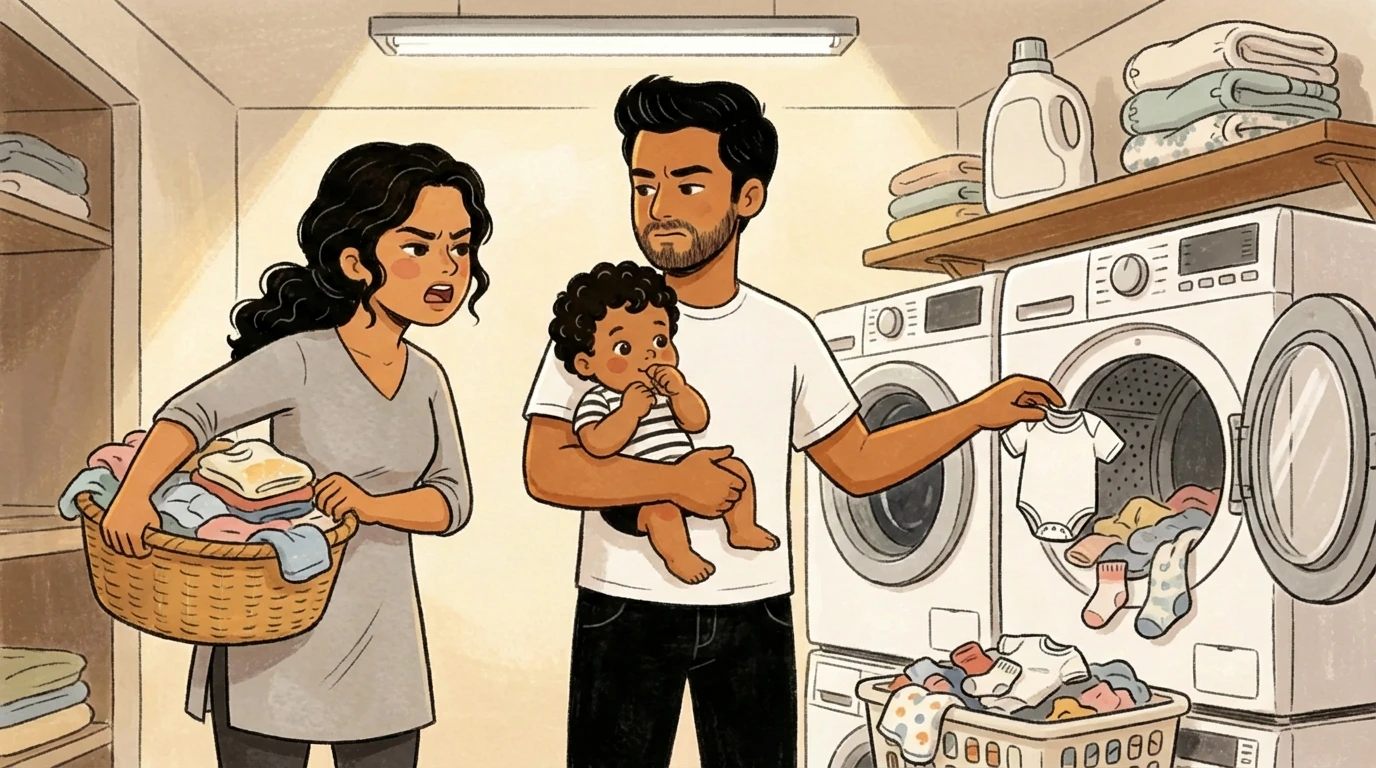
Bitterness between new parents doesn't arrive with a grand announcement. It accumulates. One partner sleeping through a feeding. The other one not noticing the laundry is done. A missed "thank you" here, an eye roll there. Small things that feel enormous at 3 AM when you've been awake for nineteen hours.
The energy that used to flow toward your partner now flows almost entirely toward the baby. The vacuum left behind fills with resentment, and resentment is patient. It will sit quietly for months, compounding interest, until it detonates over something absurd like how the dishwasher was loaded.

The ten-minute fix that sounds too simple
Multiple therapists recommend the same baseline: ten minutes a day of conversation that has nothing to do with the baby, the schedule, or logistics. Before the baby wakes up. After they go down at night. On the couch eating ice cream while the monitor glows green.
It sounds pathetically small. That's the point. You can do ten minutes on your worst day. And ten minutes of "How are you, as a person, not as a parent?" prevents the silent resentment that lands couples in therapy six months later.
If you can't do ten minutes, you're in survival mode, and you need outside help. A grandparent, a friend, a babysitter. Someone who can hold the baby long enough for you to remember you're married.
Gatekeeping will ruin you both
One parent (usually the one who spent more time with the baby early on) starts correcting the other. The bottle angle is wrong. The diaper is on backward. The swaddle is too loose. The burping technique is inefficient.
This is gatekeeping, and therapists see it wreck relationships constantly.
Here's what happens when you correct your partner every time they touch the baby: they stop trying. They retreat to the domain where they feel competent, which is usually work, and you end up doing everything alone, which is exactly the thing you were angry about in the first place.
How to stop the cycle
Let your partner do things differently. The baby will survive a crooked diaper. What the baby won't survive well is one burned-out parent and another who feels useless. Both parents need independent confidence as caregivers. That means making mistakes and not being supervised.
If disagreements about how to parent are becoming a daily source of conflict, that's worth paying attention to. Differences in approach are normal. Contempt for your partner's approach is a red flag.
Sex, or the complete absence of it
Here is the truth nobody posts on social media: many couples go months without sex after a baby. Medical clearance at six weeks does not mean your body or brain is ready at six weeks. Hormonal shifts, physical healing, breastfeeding-related dryness, and bone-deep exhaustion make sex feel like the last item on a list that's already impossible.
The danger is letting this become the new normal without ever talking about it. The longer the silence lasts, the harder the conversation becomes. Both partners get defensive. Blame shows up where nobody is at fault.
What works
Talk about what you miss and what you look forward to, not what's lacking. Start with physical touch that isn't sexual: a real hug (not the side-hug-while-holding-a-baby), holding hands on the couch. These are how you rebuild the wiring.
When you are ready, go slow. Use lube. Keep expectations on the floor. The goal for the first few times is "this happened," not "this was incredible." Think of it like restarting a workout routine. You begin with a walk around the block, not a marathon.
If you feel your temper rising when these conversations go sideways, pause. The conversation can wait an hour. The relationship can't wait another month of silence.
What your kid sees (even now)
Your baby can't understand your words, but they are already absorbing the emotional climate of your home. Tension between parents shows up in a baby's stress hormones. You don't need to be perfect. You need to be a team more often than you're opponents.

If you're fighting in front of your child, even a baby, that matters. Repair matters more. Let your kid see you disagree, and then let them see you come back together. That's the lesson worth teaching: people who love each other fight sometimes, and then they fix it.
How to protect your relationship in the first year
- Replace 'should' with feelingsEvery time you catch yourself saying 'you should,' stop and restate it as what you feel and what you need. 'I'm overwhelmed and I need you to handle bedtime tonight' lands completely differently than 'you should be helping more.'
- Schedule ten minutes of non-baby talkPick a time that works most days. Before the baby wakes, after they go down, during a nap. Talk about anything that isn't logistics. How you're feeling. Something funny. A memory. The bar is low on purpose.
- Stop correcting your partner's parentingUnless the baby is in danger, let it go. A backward diaper still holds. Your partner needs to build confidence through practice, not performance reviews from you.
- Ask for what you need in plain wordsYour partner cannot read your mind, especially not on four hours of sleep. 'I need an hour alone after dinner' is clear. Sighing loudly while doing dishes is not.
- Touch each other without an agendaA six-second hug. A hand on the back. Sitting close enough that your legs touch on the couch. Physical connection that expects nothing in return keeps the wiring alive.
This part is temporary (even though it doesn't feel like it)
The intensity of the first year is finite. Sleep comes back. Independence grows. You will eat a meal together without someone screaming. One parent, weeks after their first baby, couldn't understand why anyone would voluntarily have a second child. They later had two more. The despair is real, and it passes.
Your relationship is the infrastructure your family runs on. Maintaining it during the hardest year is the biggest gift you can give your kid: two parents who still like each other at the end of the day.
FAQ
Completely normal. Most new parents experience resentment during the first year from exhaustion, unmet needs, and feeling unseen. It becomes a problem only when it goes unspoken for months. Name it, talk about it, and make specific requests instead of keeping score.
Ten minutes a day. Before the baby wakes, after bedtime, during a nap. Skip the date night pressure. Just have a conversation where you see each other as people, not just co-workers running a tiny human's life.
Common, yes. Some partners don't take initiative because they've been corrected so often they wait for instructions. Others genuinely don't see what needs doing. A direct conversation about shared ownership works better than keeping score in your head.
Before you think you need one. The best time is when communication starts feeling hard, not when it's already broken. After a first baby is one of the most common times couples enter therapy, and the couples who go early tend to come out stronger than those who wait until they're in crisis.
It will go back to being good, but it probably won't look the same. Your bodies, your schedules, and your energy levels have all changed. Many couples report that rebuilding intimacy slowly, with lower expectations and more communication, leads to a sex life that's different but equally satisfying.