
TLDR
- You cannot pour from a bone-dry cup. Giving 100% of your energy to your baby and leaving 0% for yourself leads to burnout. When burnout hits, everybody loses. Keeping yourself fed, rested, and sane is load-bearing infrastructure.
- The NESTS check-in catches problems early. Nutrition, Exercise, Sleep, Time for self, Support. Run through these five letters once a day. Whichever one makes you wince is the one that needs attention right now.
- Nap time is for resting, not scrubbing the kitchen. The dishes will survive another hour. Your mental health might not. When the baby sleeps, sit down. That is strategy.
- Give helpers specific tasks, not open-ended offers. When someone says 'let me know if you need anything,' they mean it. Tell them exactly what you need: a casserole, two hours of baby-holding, a grocery run. Vague requests get vague follow-through.
- Difficult feelings are part of the deal. Bitterness, anger about sleep deprivation, missing your friends, and grief over your old life are normal responses to an enormous transition. Feeling them does not make you a bad parent.

The math that breaks every new parent
You have a finite amount of energy each day. If you spend all of it on your baby, feeding and rocking and changing and soothing, you have zero left for yourself. Zero is not a sustainable operating level for a human body.
You already know this. You learned it the hard way around day four, when you made it to dinner and realized you had not eaten since the handful of dry cereal you grabbed at 7am. Or day seven, when you used the baby's nap to deep-clean the bathroom instead of closing your eyes, and then spent the evening on the verge of tears over a diaper that leaked.
The instinct to give everything to your baby is biologically correct and logistically catastrophic. Your body also needs fuel, sleep, and at least occasional contact with adults who use full sentences.
The fix is triage. Every day, identify the one basic need most at risk of total failure and address that one first.
Self-care feels like homework
The New Parent Survival course will show you rest that fits your day
You'll find ten-minute resets that work inside the chaos instead of requiring time you don't have.
The NESTS check-in: five things to scan every day
A registered psychotherapist named Jess VanderWier developed a framework called NESTS. It gives you five domains to check when you feel yourself sliding toward burnout. Each letter is a question, not a goal.
N: nutrition
Did you eat today? A real meal with protein, not a handful of your toddler's goldfish crackers. If you are routinely forgetting to eat until dinner, your body is running on cortisol and adrenaline, which works until it doesn't.
The lowest-effort fix: whenever you cook, make double and freeze half. If you didn't meal-prep before the baby arrived, start now. One extra portion per meal adds up fast. And when someone offers to help, hand them a specific task: "Could you make a batch of soup this weekend?" works better than "We're fine, thanks."
E: exercise
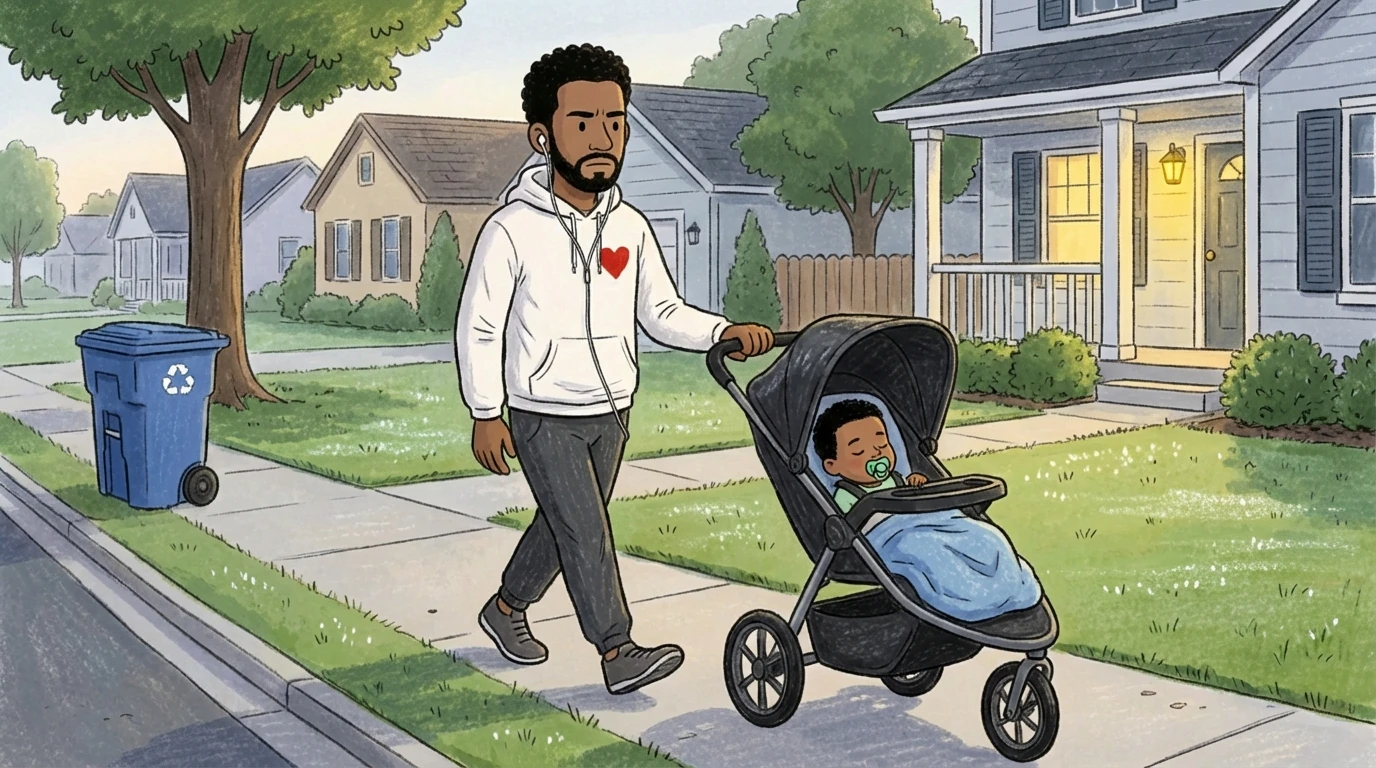
A gym session is overkill. The bar is lower: did your body move today in a way that felt good? A ten-minute walk around the block with the stroller counts. Stretching on the living room floor while the baby does tummy time counts.
The point is movement that restores you, not movement that punishes you for the weight you haven't lost yet.
S: sleep
Are you getting at least four hours of consecutive sleep? Not total. Consecutive. Four unbroken hours is the minimum threshold where your brain can cycle through enough deep sleep to function. Below that, your patience evaporates and everything your baby does feels like a personal attack.
If you are breastfeeding and your partner can give a bottle, trade off one overnight stretch. You sleep from 9pm to 1am. They sleep from 1am to 5am. Nobody gets a full night, but everybody gets a four-hour block.
T: time for self
When was the last time you did something just for you? Scrolling your phone in the bathroom while the baby screams outside the door does not count. What counts varies: reading a chapter, calling a friend, sitting in silence for five minutes without a small human attached to your body.
Real self-care just requires permission to treat yourself as a person who exists outside the role of parent.
S: support
Who is in your village? This is the question that makes a lot of new parents go quiet, because the honest answer is often "nobody, really." Your friends without kids disappeared. Your friends with kids are drowning in their own survival. Your family lives two time zones away.
If your support network is thin, building it is a medical-grade intervention. Join a new parent group. Accept the neighbor's offer to hold the baby. Let your partner's weird uncle bring over that casserole. Isolation is the accelerant for postpartum depression, and community is the firebreak.
When someone says "let me know if you need anything"
They mean it. And you are going to say "oh, we're fine!" because you have been conditioned to believe that needing help is a character flaw.
Here is a script you can use: "That would be amazing. Could you [specific task]?" The specific task can be anything: bring dinner on Thursday, watch the baby for an hour so I can nap, pick up diapers on your way over, sit with me while I eat lunch and talk about something other than infant sleep schedules.
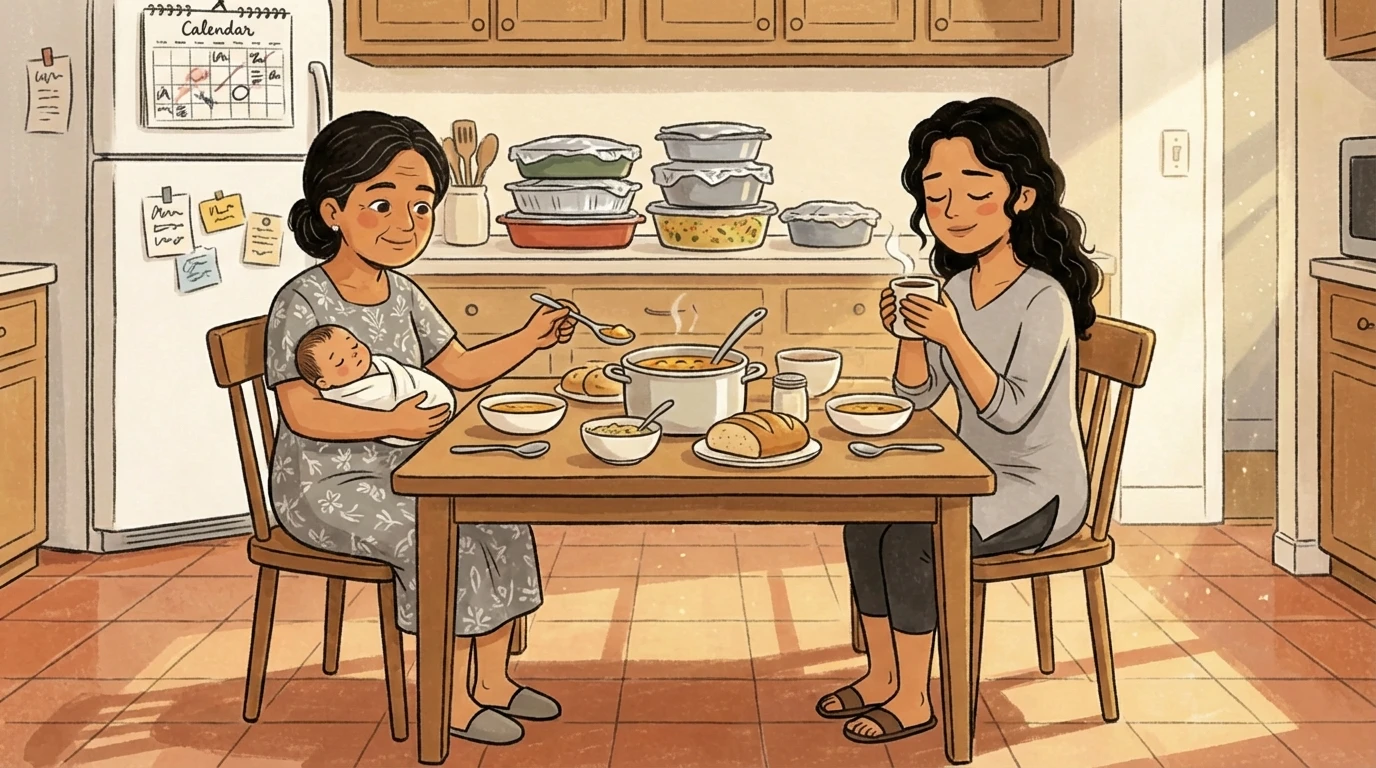
Vague offers get vague follow-through. The friend who says "anything you need" genuinely wants to help but has no idea what a new parent needs. You have to tell them. This feels uncomfortable. Do it anyway.
How to run a NESTS check-in on yourself
- Pick one moment each dayTie the check-in to something you already do, like the baby's afternoon nap or your morning coffee. Consistency matters more than perfection. Two minutes is enough.
- Go through each letterNutrition: did I eat a real meal? Exercise: did my body move? Sleep: did I get four consecutive hours? Time: did I do one thing for myself? Support: did I talk to another adult today?
- Find the weakest linkWhichever letter made you wince is the one to address today. You are not trying to ace all five. You are trying to keep any single one from hitting zero.
- Take one tiny actionEat a sandwich. Text a friend. Ask your partner to take the next feeding so you can sleep. The action does not need to be impressive. It needs to happen.
- Drop the guiltYour brain will tell you that eating lunch while the laundry piles up makes you a bad parent. Your brain is wrong. A fed parent is a better parent than a hungry one with clean towels.
Bonding does not always happen on cue
Some parents look at their newborn and feel an immediate flood of love. Others look at their newborn and feel something closer to "who is this tiny stranger and why does everyone expect me to feel something I don't feel yet?"
Both responses are normal. Bonding is a process, not a lightning strike. It builds through repetition: feeding after feeding, diaper after diaper, 3am wake-up after 3am wake-up. If you are three weeks in and still waiting for the wave of tenderness that everyone promised, you are not broken. You are on schedule.
The pressure to feel instant love creates shame when it doesn't arrive. Letting go of that guilt is one of the most useful things you can do in the first month.
If bonding still feels absent after several weeks and you notice persistent sadness, emotional numbness, or intrusive thoughts, talk to a professional. The line between normal adjustment and postpartum depression is real.

The feelings nobody warns you about
Becoming a parent comes with a set of emotions that nobody puts on the greeting cards. You will feel bitterness when your partner sleeps through a feeding. You will feel anger about never getting a full night of sleep. You will miss your friends with an ache that surprises you. You will grieve the life you had before, even though you love the baby who replaced it.
These feelings are part of adjusting to the biggest identity shift of your life. Suppressing them does not make them go away. It just delays the reckoning.
Take the parenting battery quiz if you want a quick read on where you stand. If the results confirm what you already suspect, treat that as permission to ask for help.
The transition gets easier. The first six weeks are survival mode. Somewhere around month three, you will notice that you ate breakfast two days in a row, or that the baby slept a four-hour stretch, or that you laughed at something that wasn't a delirious hallucination. You are finding your way.
FAQ
No. A depleted parent cannot regulate their own emotions, which means they cannot co-regulate their baby's emotions either. Taking care of your basic needs is what makes consistent caregiving possible. The baby needs you functional, not martyred.
Split the night with a partner or helper so each person gets one four-hour block of unbroken sleep. If you are solo parenting, sleep when the baby sleeps during the day and let the housework wait. Four consecutive hours is the minimum threshold for cognitive function.
If persistent sadness, emotional numbness, loss of interest in the baby, intrusive thoughts, or inability to sleep even when the baby sleeps last more than two weeks, talk to your doctor. Early intervention makes a significant difference. You do not need to wait until it feels unbearable.
Delayed bonding is common and does not predict the quality of your long-term relationship. The bond builds through repeated caregiving interactions over weeks and months. Be patient with yourself and keep showing up. The feeling catches up to the actions.