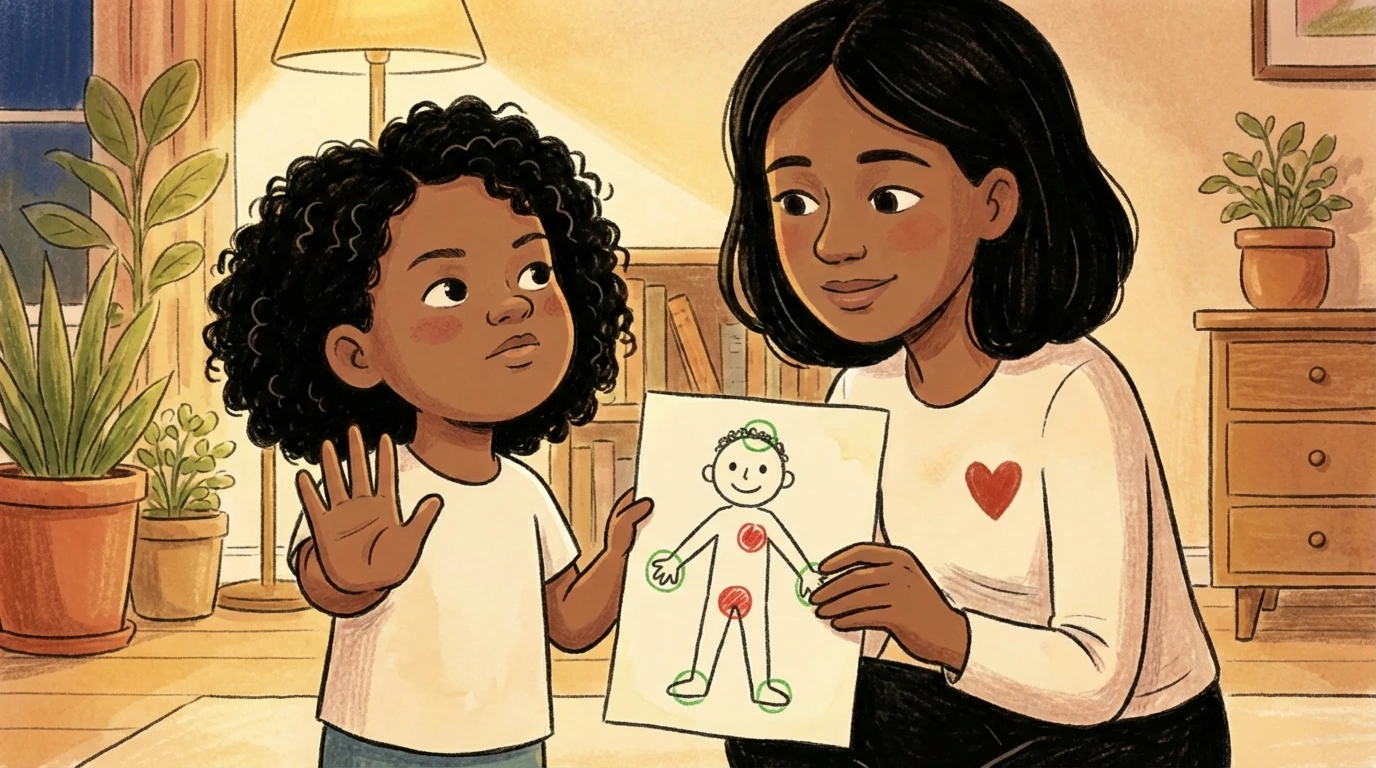
TLDR
- Use real body-part names from day one. Children who know the words penis, vulva, and buttocks are less likely to be targeted and more able to describe what happened if something goes wrong.
- Secrets are banned. Surprises are fine. A surprise has an end date and makes people happy. A secret makes a child feel nervous or scared. Make the rule absolute and share it with every caregiver.
- Build a safety team your child can name. Pick three to five trusted adults your child can go to if they feel uncomfortable, even if they are too nervous to tell you first.
- Role-play with toys before you need it for real. Stuffed animals practicing 'stop, I don't want that' gives a three-year-old the muscle memory to say it when it counts.
- Your reaction to disclosure decides everything. Stay calm, listen without judgment, and thank them for telling you. Panic or anger teaches them never to bring it up again.

The conversation you keep putting off
Somewhere around bath time, your kid discovers they have body parts. They grab, they point, they ask why their sibling looks different. And your brain short-circuits because nobody gave you a script for this moment either.
Most of us grew up in houses where bodies were either ignored or shamed. So we got our information from the school bus, the internet, or nowhere at all.
Kids who learn about body safety from their parents are better protected, more confident in their boundaries, and more likely to tell a trusted adult if something goes wrong. The conversation is uncomfortable. Skipping it is worse.
Why the real words matter
You do not have to love saying "penis" at the dinner table. But your child needs to hear it from you before they hear it anywhere else.
Correct names remove shame
When you call an elbow an elbow but invent a cute name for genitals, your child picks up a message: those parts are different. Embarrassing. That shame becomes a barrier to reporting if someone touches them inappropriately. A child taught that their body parts are too embarrassing to name will struggle to tell you what happened.
Correct names are a protective factor
Studies show that children who use anatomically correct terminology are less likely to be targeted. A child who can clearly describe what happened will be believed. Abusers know this and prefer targets who lack the vocabulary to report.
Start during diaper changes. "I'm going to wipe your vulva now." It feels weird for a week, then becomes as boring as "let me wash your hands." Your child will not bat an eye because you have not taught them to.
Blurry touch categories
The Body Safety Conversations course will replace the old script with one that works
You'll teach consent boundaries your child understands, not a binary that confuses them at grandma's house.
Safe touch, unsafe touch, and the gray area in between
The old framework was simple: good touch versus bad touch. The problem is that "bad" implies the child did something wrong by receiving it.
What safe touch looks like
Safe touch is touch your child has agreed to. High-fives, fist bumps, hugs they chose. The defining feature is consent: the child said yes, and the touch matches what they agreed to.
What unsafe touch looks like
Unsafe touch is touch that hurts or happens without permission. That includes hitting, but it also includes tickling that continues after a child says stop, or a relative who insists on a kiss when the child pulls away.

The most common perpetrators are people kids know
The stranger-danger model is mostly wrong. The vast majority of child abuse is committed by someone the child already knows and trusts. The skills your child needs are about recognizing when a familiar person crosses a line and knowing what to do next.
The no-secrets rule (and how to explain it)
Abusers rely on secrecy. "This is our little secret." "You'll get in trouble if you tell." Every one of those sentences is a red flag, and your child needs to recognize them before they ever hear one.
Your family does not keep secrets. Period. A birthday present is a surprise because it has an end date and makes people happy. A secret makes someone feel nervous or trapped. Teach your child this distinction and make the rule absolute.
Share it with everyone who spends time with your child. Even innocent secrets ("don't tell your parents we had ice cream") teach a child that trusted adults sometimes ask you to hide things. Close that door completely so that broader prevention strategies have a foundation to build on.
Scripts that work:
- "If someone tells you something bad will happen if you share a secret, tell me anyway. Do not believe them."
- "If someone says you will get in trouble for telling, come to me right away. You will never get in trouble for telling the truth."
Building your child's safety team
You cannot be everywhere. Your child needs a short list of adults they can go to if something feels wrong, even if they are too scared or embarrassed to come to you first.
How to set up body safety at home
- Name body parts correctly from infancyUse penis, vulva, buttocks, and mouth during diaper changes and bath time. Treat these words the same as elbow or knee. Your comfort level sets your child's comfort level.
- Establish the no-secrets family ruleExplain the difference between secrets and surprises. Make the rule absolute and share it with every caregiver, grandparent, and babysitter in your child's life.
- Choose three to five safety-team adultsPick trusted adults your child knows well. Name them out loud: 'Your safe people are me, Dad, Grandma, and Ms. Rivera.' Practice saying the names together.
- Teach three response phrasesRole-play saying 'No,' 'Stop, I don't want that,' and 'I don't want to be touched.' Use stuffed animals for younger kids. Repeat until the words come automatically.
- Practice the tell-a-safe-person stepAfter every role-play, add the reporting piece: 'And then you go tell one of your safe people.' The boundary only works if the child knows to follow through.
- Do regular check-ins after activitiesAfter playdates, school, or family gatherings, ask: 'Did anything happen that made you feel uncomfortable?' Keep the question casual and routine.
The safety team typically includes parents, a grandparent, an aunt or uncle, and a teacher. The point is redundancy. If your child cannot reach you, they know exactly who to go to next.

What to do when your child tells you something
Your response in the first thirty seconds after a disclosure shapes whether your child ever brings you difficult information again.
Stay calm and listen
Your stomach will drop. Hold it together in front of your child. You can fall apart later, privately. Right now, your child needs to see that telling you was the right decision. Do not press for details. Do not ask leading questions. Let them talk.
Say the right things
"Thank you for telling me." "This is not your fault." "You are safe now." "You will never get in trouble for telling me the truth."
Those four sentences cover what a child needs to hear. Your job after that is to contact authorities and find professional support. Teaching your child to speak up for their boundaries and knowing how to respond when they do are two halves of the same skill.
Keeping it going (this is not a one-time talk)
Body safety is not a lecture you deliver once and check off the list. It grows with your child.
During infancy, you narrate diaper changes and use correct names. During the toddler years, you model consent by respecting their "no" to hugs and stopping tickle fights the instant they say stop. During preschool, you role-play with toys and teach private versus public spaces. By school age, you are doing regular check-ins.
The goal is to be so boringly normal about bodies that your child never hesitates to come to you with a question. If the topic feels charged, they will read that energy and decide it is too risky to bring up. You can teach body safety without creating excessive fear by keeping your tone matter-of-fact.
After playdates: "How was it at Alex's house? Anything happen that felt weird?" After school: "Anything tricky on the bus today?" After family gatherings: "Did you feel like the boss of your body at the party?"
These check-ins are low-pressure, routine, and powerful. They tell your child this topic is always open.

FAQ
From birth. Start by using correct anatomical names during diaper changes. By the time your child is verbal, they will already know the words and feel zero awkwardness about them. The earlier you start, the more normal it feels for everyone.
Treat it the same way you would if they yelled 'elbow.' Do not shush them, laugh nervously, or correct them. A calm non-reaction teaches them the word is ordinary, which is exactly what you want.
Tell your child that a doctor may need to check private parts sometimes, but only when a parent is in the room and the doctor explains what they are doing first. If those two conditions are missing, your child should tell a safe person.
No. Forcing physical affection teaches your child that their boundaries can be overridden by adults they trust. Offer alternatives like a wave, a high-five, or a fist bump. Relatives who love your child will understand.
Take a breath before you respond. Say 'thank you for telling me' and 'this is not your fault.' You can process your own emotions later with another adult. Your child needs to see that telling you was safe, not that it caused an explosion.