TLDR
- Secrets are banned. Surprises are fine. A surprise makes people happy and has a reveal date. A secret asks someone to stay quiet about something that feels bad. Teach your child this distinction before anyone else tries to blur it.
- Abusers rely on secrecy as their primary tool. The phrase 'this is our little secret' is how the vast majority of abuse stays hidden. Children who have been trained to reject that sentence are harder to manipulate.
- One rule is not enough. You need layers. The no-secrets rule works best alongside a safety team, practiced refusal scripts, and casual check-ins after activities. Each layer backs up the others.
- Every caregiver in your child's life needs to know the rule. Grandparents, babysitters, coaches, family friends. Even innocent secret-keeping ('don't tell parent about the candy') trains a child that hiding things from parents is normal.
- Your child's body autonomy starts with you. If you force hugs at family gatherings, you are teaching your child that adults can override their physical boundaries. That lesson directly undermines everything else.

The phrase that keeps abuse hidden
Every prevention program, every child psychologist, every forensic interviewer will tell you the same thing: abusers do not operate in the open. They operate in silence. And the sentence that buys that silence is almost always some version of "this is our little secret."
Your child will hear it eventually. From a peer, a relative, a coach, a neighbor. What matters is whether they have been pre-loaded with an automatic response or whether they freeze because nobody prepared them.
The no-secrets rule is the single most effective sentence-level intervention you can teach your child. It sounds simple because it is. "Our family does not keep secrets." That sentence, repeated often enough, becomes a reflex. And reflexes work faster than reasoning, which matters when a five-year-old is being pressured by an adult.
But the rule alone is not enough. It needs backup. Here is how to build a system around it that holds up when it matters.
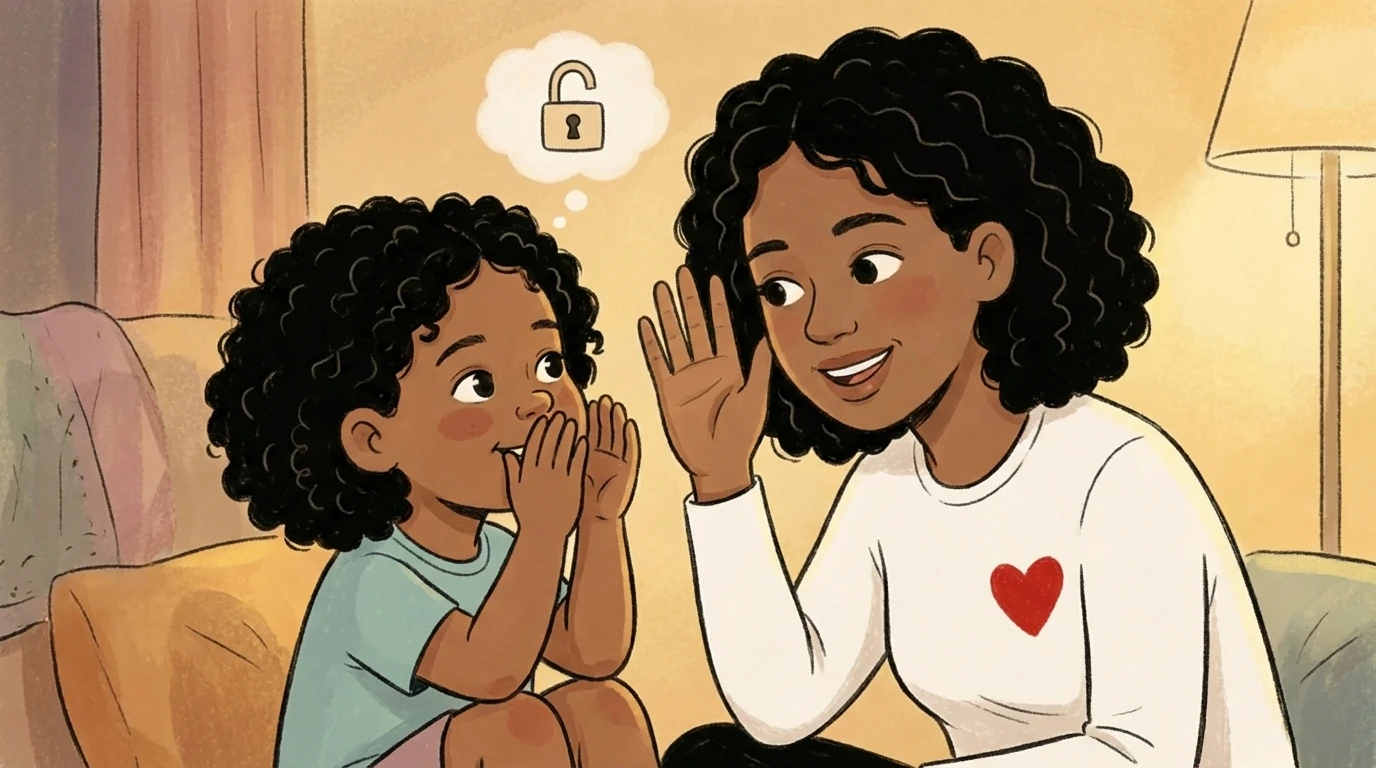
Whispered secrets between kids
The Body Safety Conversations course will help you build family safety rules that stick
You'll have a no-secrets framework your child repeats back to you — and uses when it counts.
Secrets versus surprises (and why the distinction matters)
Kids love surprises. Birthday presents, surprise visits from grandma, the hidden dessert after dinner. You do not want to kill that.
So you need language that separates the good kind of hidden information from the dangerous kind.
How to explain it
A surprise makes people happy and has an end date. Daddy's birthday present is a surprise because we will give it to him on Saturday and he will smile. A surprise always ends with someone finding out, and that finding out is the fun part.
A secret is different. A secret asks you to keep something hidden forever, and it usually makes you feel nervous, scared, or confused. If someone tells you to keep a secret and you feel bad inside, that is a signal to tell a safe person right away.
Scripts to practice:
- "Surprises have happy endings. Secrets feel heavy."
- "If someone says 'don't tell your parents,' that is the exact moment you tell your parents."
- "You will never be in trouble for telling me a secret someone asked you to keep."
Why "innocent" secrets are dangerous
Here's where most families get tripped up. Grandpa slips your kid an extra cookie and whispers, "Don't tell mom." The babysitter lets them stay up late: "This is our secret." A friend at school says, "I'll show you something but you can't tell anyone."
None of these people are predators. But every one of those moments teaches your child that trusted adults sometimes ask you to hide things from your parents. That lesson, stacked up over months and years, makes the real danger harder to spot. When an actual predator says "keep this between us," it does not register as a red flag because the pattern is already familiar.
Close the door completely. Tell every caregiver in your child's life: we do not do secrets in this family. Not small ones, not fun ones, not harmless ones. Surprises only.

Building a safety team
You cannot be everywhere. Your child needs a short list of adults they can report to even when you are not available, or even when you are the one they are afraid to tell.
Who belongs on the list
Pick three to five adults your child knows well and sees regularly. Name them out loud: "Your safe people are me, Dad, Grandma, Ms. Rivera at school, and Uncle Marco." Practice the names. Quiz your child on them casually.
The people on this list should know they are on it. Tell them: "We've named you as one of the adults our daughter can come to if something is wrong. If she ever tells you something, please listen and then tell us."
Why redundancy matters
If the only safe person your child knows is you, the system breaks down the moment you are unavailable, asleep, or (worst case) part of the problem. A safety team creates multiple exits. Your child should be able to reach at least one safe person in any situation, including situations where you are not there. This pairs with the broader body safety framework you are building piece by piece.
Teaching refusal scripts
Knowing the rule is step one. Being able to say something out loud under pressure is step two. Those are very different skills.
How to install the no-secrets system
- Explain secrets versus surprisesUse concrete examples. A birthday gift is a surprise because it has a reveal date and makes people happy. A secret asks you to hide something that feels bad. Practice until your child can explain the difference back to you.
- Make the rule absolute and publicTell every caregiver, grandparent, babysitter, and coach: our family does not keep secrets. Even small, fun ones. Surprises only. No exceptions.
- Build a safety team of trusted adultsName the adults your child can go to. Practice the names. Let those adults know they are on the list and what to do if your child comes to them.
- Practice refusal phrases with role-playUse stuffed animals or puppets. Have the toy say 'keep this a secret' and coach your child to say 'I don't keep secrets from my parents.' Repeat until it feels automatic.
- Run casual check-ins after activitiesAfter playdates, school, sports, and family gatherings, ask: 'Did anyone ask you to keep a secret today?' Keep it light and routine so it stays comfortable.
Role-play makes it stick
Knowing the phrase "I don't keep secrets" and being able to say it to an adult who is pressuring you are two completely different things. Young children need muscle memory for this.
Use stuffed animals. Have the bear whisper, "Let's keep this a secret." Coach your child to say, "I don't keep secrets from my parents." Then have the bear push back: "But you'll get in trouble." Coach the response: "I won't get in trouble. I'm going to tell my mom."
Run this a few times a month. It takes three minutes. The repetition builds a neural pathway that fires before your child's conscious brain has time to freeze.

Extending the rule to the digital world
The no-secrets rule does not stop at face-to-face interactions. As your child gets older, the same principles apply online. "Don't tell your parents about our conversation" is the same red flag whether it comes from a neighbor or a stranger in a chat room.
Teach your child that the rule applies everywhere: in person, on a screen, in a game, in a text. If anyone, anywhere, asks them to hide a conversation or interaction from you, that is the signal to come tell you immediately.
Why forced affection undermines everything
You cannot teach your child that their body belongs to them and then override that lesson at Thanksgiving.
If your child does not want to hug Aunt Carol, they do not hug Aunt Carol. Offer alternatives: a wave, a high-five, a fist bump, or just saying "bye." Forcing physical affection teaches children that their boundaries can be overridden by trusted adults, which is precisely the dynamic abusers exploit.
This is uncomfortable for relatives. It will generate comments. Your child's safety is more important than anyone's feelings about a hug.
Check-ins that work
The final layer is ongoing conversation. Body safety is a standing topic you bring up casually and often, not a single lecture you deliver and forget.
After school: "Did anything weird happen today? Did anyone ask you to keep a secret?"
After a playdate: "How was it at Jake's house? Did you feel comfortable the whole time?"
After a family gathering: "Did anyone touch you in a way you didn't like?"
Keep the tone casual. You are checking in, not interrogating. The goal is to make these questions so routine that your child barely notices them, and so normal that answering honestly feels like the obvious choice.
The children who disclose abuse are overwhelmingly the ones who had an adult regularly asking. Kids rarely volunteer this information unprompted. You have to build the conversation before you need it, not after. And you need to know what prevention looks like beyond the home so your system covers every angle.

FAQ
Start the rule now and explain the change. Tell your child and the adults involved that you are switching to a surprises-only policy. Kids adjust quickly. The adults may need a gentle reminder once or twice, but most people understand when you explain the safety reasoning.
As soon as your child understands the concept of hiding information, usually around age three. Start simple: 'In our family, we tell each other everything. We do surprises, but we do not do secrets.' Build complexity as they grow.
Thank them for telling you. Every single time. Even if the secret was that grandpa let them have extra ice cream. Your reaction to small disclosures trains their willingness to make big ones. Never punish a child for telling you a secret someone asked them to keep.
No. As your child matures, you can introduce the idea that some information is private (like what you talked about in therapy or what grade someone got). Privacy is different from secrecy. Privacy protects you. Secrecy protects someone else at your expense.
Hold the line. You can be kind about it: 'We are teaching our kids that secrets are a red flag, so we need everyone on board.' If someone is offended by a child safety policy, that tells you something worth paying attention to.