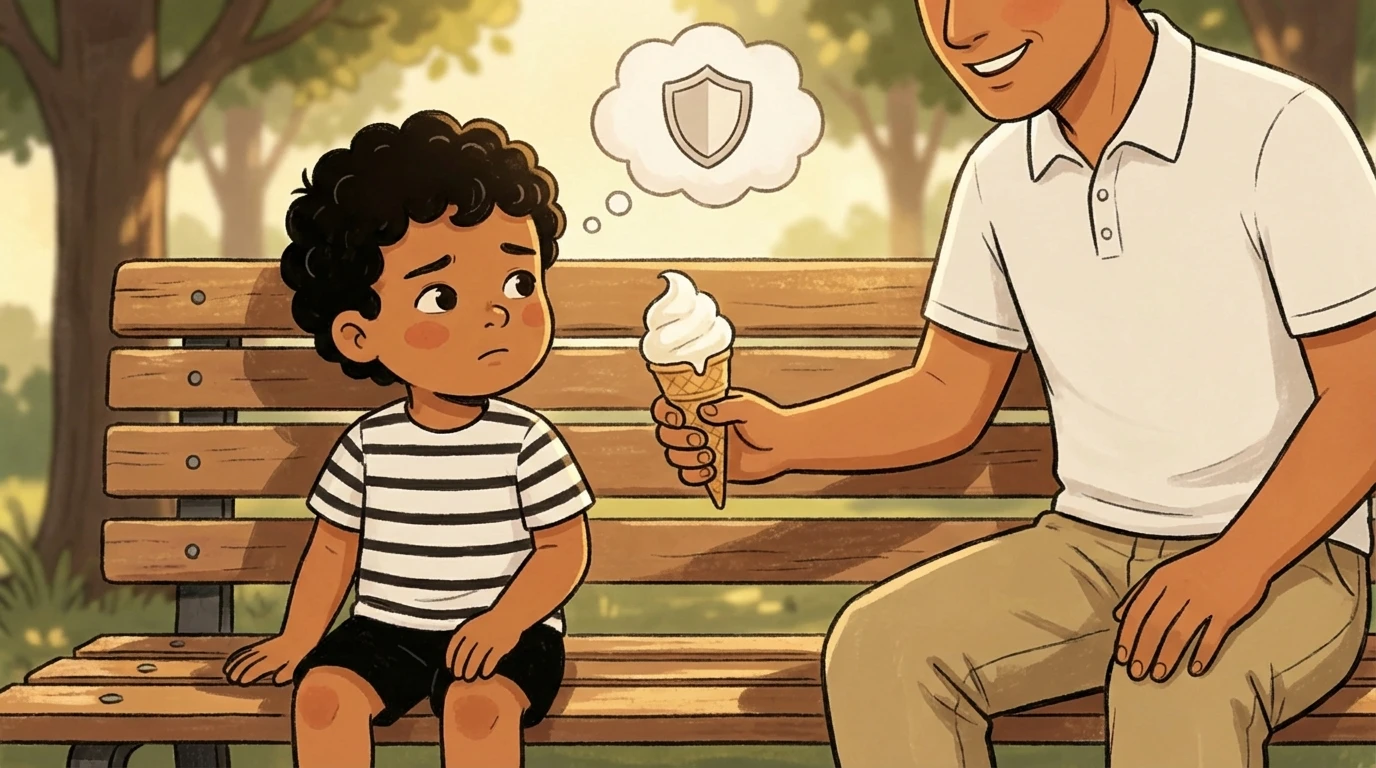
TLDR
- Stranger danger is backwards. It trains kids to fear the wrong people. Over 90% of child abuse is committed by someone the child knows and trusts, not a stranger in a trench coat.
- Young kids cannot hold two truths at once. A preschooler taught that strangers are dangerous will refuse help from a store clerk when they are lost. Their brain cannot process 'stranger' and 'safe' simultaneously.
- Teach strange behaviors, not strange people. Shift your child's attention from who someone is to what someone does. An adult asking a child to keep a secret, find a lost pet, or get in a car are red flags regardless of familiarity.
- A family safety plan gives real tools. Concrete rules like checking in before changing plans, identifying safe adults by uniform, and knowing which behaviors are never okay give your child actionable skills instead of vague fear.
- Role-play makes it stick. Talking about safety once is a lecture. Practicing responses through play builds muscle memory so your child can react when it counts.

The problem with "don't talk to strangers"
You have probably said some version of it. "Don't talk to strangers." "Strangers are dangerous." "If someone you don't know approaches you, run."
It sounds like a safety lesson. It feels responsible. And it falls apart the second your four-year-old gets separated from you at the zoo and needs to ask someone for help.
A child taught that all strangers are dangerous will treat a uniformed park ranger and a predator with the exact same level of fear. They have no way to tell the difference because you gave them one rule ("stranger = bad") and zero tools for reading the situation.
The data makes this worse. According to the National Center for Missing and Exploited Children, more than 90% of child sexual abuse is committed by someone the child already knows. A family friend. A coach. A relative. The fixation on strangers creates a false sense of security around the very people who pose the greatest statistical risk.
Your child froze at hello
The Body Safety Conversations course will teach situational safety instead of stranger fear
Your kid will assess behavior, not faces — and know when to find a safe adult without panicking.
Why young brains cannot process "stranger danger"
Toddlers and preschoolers think in black and white. Their brains have not developed the capacity to hold two contradictory ideas simultaneously.
So when you say "strangers are dangerous" and then tell your child to say thank you to the cashier at the grocery store, you have created a logic problem their brain cannot solve. Is this person dangerous? You just told me to talk to them. But you also said don't talk to strangers.
The lost-child problem
Picture this: your five-year-old gets separated from you at a department store. A clerk in a uniform with a name tag approaches and says, "Are you lost? I can help you find your parents."
A child trained on stranger danger has one response: refuse to speak, turn away, cry. The very teaching designed to protect them just prevented them from getting help. This is the most common failure mode of the stranger danger approach, and it creates the kind of generalized anxiety that leaks into everything from school drop-offs to birthday parties.
The familiar-person blind spot
The other failure is quieter but more dangerous. When "stranger" is the threat category, "not a stranger" becomes "safe." Your child's brain builds a simple equation: I know this person, therefore this person is fine.
This is the blind spot that matters most. Because the uncle who asks your child to sit on his lap, the older cousin who wants to play a "secret game," the coach who texts your kid at night, none of them are strangers. And a child who has been taught that danger wears an unfamiliar face has no framework for recognizing it in a familiar one.

The modern approach: strange behaviors, not strange people
The shift is simple but changes everything. Instead of teaching your child to fear people based on identity (stranger vs. known), you teach them to recognize behaviors that are red flags regardless of who is doing them.
What counts as a "strange behavior"
Here is what to teach your child, adapted from the National Center for Missing and Exploited Children:
- Someone offers you candy, money, or a toy for no reason
- Someone says they need your help finding a lost pet
- Someone tells you there is an emergency and you need to go with them
- Someone says your parents sent them to pick you up (and you have not heard this from your parents)
- Someone asks to touch your private parts or show you pictures of people without clothes
- Someone asks you to keep a secret from your parents
The key sentence to repeat: "It does not matter if you know the person or not. These behaviors are warning signs no matter who does them."
For younger kids, start with two or three of these. For school-age children, cover the full list. The point is to shift from an identity-based filter to a behavior-based one.
Building your family safety plan
A safety plan turns abstract awareness into concrete rules your child can follow. This is where the teaching gets practical.
How to build a family safety plan
- Define safe adults by visible markersTeach your child to look for uniforms, name tags, or store aprons. Before every outing, point out who the safe adults are in that specific location: 'See the people in blue shirts? They work here.'
- Teach the check-in ruleEvery change of plan requires checking with a parent. Going somewhere new, accepting something from someone, getting in a car. Make 'check with me first' the default, and practice it until it is automatic.
- Name the strange behaviorsUse age-appropriate language to describe behaviors that should trigger alarm: someone offering gifts, asking for help finding a pet, saying there is an emergency, asking to touch private parts, or claiming your parents sent them.
- Role-play the scenarios regularlyAct out situations with toys or in person. 'A person at the park says they lost their puppy and need help finding it. What do you do?' Practice until the right response comes quickly.
- Establish the no-trouble promiseTell your child repeatedly that they will never be in trouble for telling you something that felt wrong. This removes the single biggest barrier to disclosure. Say it often enough that they believe it.
Pair it with the no-secrets rule
Your family safety plan works best alongside a clear no-secrets policy. Surprises have an end date (a birthday gift you will reveal next week). Secrets ask a child to hide something that makes them uncomfortable, forever. Make that distinction explicit, share it with every caregiver in your child's life, and enforce it consistently.

Scripts that work in real life
Your child needs words they can say out loud when something feels wrong. Abstract understanding is useless without rehearsed language.
For when someone offers something
Teach your child: "No thank you. I have to check with my parent first." Practice this at home until it comes out automatically. The phrasing is polite (which matters to kids who have been taught to respect adults) but firm.
For when someone says "your parents sent me"
"My parents did not tell me about that. I am going to go find them." Then walk toward the nearest adult in a uniform. Rehearse this scenario specifically because it is one of the most common lures.
For when something feels wrong but they cannot name why
"I do not want to. I am going to go now." Then leave. Your child does not need to explain themselves. Teach them that saying no to any adult is a skill worth practicing, and that you will always back them up when they use it.
When your child is the extra-friendly type
Some kids will hug the pizza delivery driver. They will wave at everyone in the grocery store. They will try to hold hands with the stranger at the bus stop. If this is your child, the stranger danger approach is especially useless because you would be asking them to override their wired-in temperament.
Instead: channel the friendliness. "You can wave and say hi. But we check with a parent before going anywhere with someone or accepting something from them." The sociability stays. The safety layer goes on top.
And check your own anxiety. A child hugging a Comcast technician while you are standing right there is socially awkward, not dangerous. Save your alarm for situations that warrant it. Kids can tell when you are panicking, and if everything triggers the same panic response, they stop taking any of it seriously.
The ongoing conversation
This is a thread that runs through years of body safety conversations, starting with correct anatomical names in toddlerhood and building toward discussions about physical autonomy and consent.
Every few months, revisit the safety plan. Quiz your child casually. "What would you do if someone at the park said they needed help finding their puppy?" "Who are the safe adults at your school?" Make it low-pressure. Make it routine. The goal is that when the moment comes (and statistically, for most children it will not), the right response is already rehearsed and ready.

FAQ
Start around age three with simple concepts like staying within eyesight and identifying safe adults by uniform. Build complexity as language and reasoning develop. By five, most children can grasp the concept of strange behaviors versus strange people.
High sociability is a temperament trait, not a defect. Channel it by teaching which situations require checking with a parent first. Role-play scenarios regularly so your child learns to read context without losing their natural warmth and openness.
Focus on what to do, not what to fear. A child who knows how to identify a safe adult, check in before changing plans, and say no to strange behaviors feels competent rather than scared. Competence is the antidote to anxiety.
Freezing is a normal stress response. Practice the safety scripts during calm moments so the words become automatic. Also teach your child that running away, screaming, or finding another adult are all valid responses when their voice will not come.