TLDR
- There is no single Talk. There are hundreds of small ones. The 'birds and bees' conversation is a myth. Effective sex education is an ongoing series of age-matched discussions starting in the bathtub and continuing through the teen years.
- Your discomfort is the biggest barrier. Children absorb your awkwardness before they absorb your words. If you cannot say 'penis' without flinching, your child learns that body part is unspeakable.
- Early conversations are protective. Research from the American Academy of Pediatrics shows that thorough, parent-led sex education delays sexual activity, increases contraceptive use, and reduces risky behavior.
- Kids will learn about sex with or without you. The average child encounters pornography by age eight. If your only plan is silence, the internet will fill the gap with material you would never choose.
- Consent starts before the sex conversation does. Teaching body autonomy from toddlerhood lays the groundwork for every future discussion about boundaries, relationships, and sexual health.

It is coming whether you are ready or not
Your child is going to ask where babies come from. It might happen at bedtime, at a birthday party, or (statistically most likely) in a checkout line where fourteen strangers can hear the answer.
And in that moment, your brain will split into two camps. Camp one: Give them the facts. Camp two: Say something vague and change the subject before this gets worse.
Camp two usually wins. And that is where the trouble starts.
Because here is what your child learns when you dodge the question: this topic makes the adults in my life panic. Which means it must be dangerous, shameful, or both. And when something feels dangerous and shameful, children stop asking about it. They don't stop being curious. They just take their curiosity somewhere else. To the kid on the bus. To a Google search. To a friend's older sibling who has information that is colorful, graphic, and wildly inaccurate.
The alternative is you. And you are better than all of those options, even when you are fumbling.
Where do babies come from
The Body Safety Conversations course will give you age-right answers for every stage
You'll handle the question at dinner calmly, with words sized to your child's actual developmental level.
Why "the Talk" is the wrong approach
The classic approach to sex education involves one mortifying conversation, usually delivered sometime around fifth grade, usually involving a lot of throat-clearing and zero eye contact.
It doesn't work. And there is a simple reason: you cannot teach twelve years of body literacy in forty-five minutes. You wouldn't cram all of math into one afternoon and expect your kid to understand calculus by dinner. Sex education works the same way. It builds cumulatively.
Ongoing conversations beat one-time lectures
The research is clear on this point. Children who receive ongoing, age-appropriate information from parents about bodies, reproduction, consent, and relationships show measurably better outcomes. They delay sexual activity. They use protection more consistently when they become active. They report higher comfort with their own bodies. States that rely on abstinence-only education, which is the school version of "the Talk," have the highest rates of teen pregnancy and sexually transmitted infections.
You become the trusted resource (or you don't)
If your child learns that sex is too uncomfortable to discuss at home, they will not bring their questions to you later. They will bring them to whoever seems willing to answer. Being the parent your child comes to with hard questions requires years of proving you can handle them.
That foundation starts with using the correct names for body parts when your child is eighteen months old and continues every time you answer a question honestly instead of deflecting it.

What to say at every age
The whole system works better when you stop thinking of it as "the sex talk" and start thinking of it as "answering questions honestly as they come up." The detail level changes with age. The honesty stays the same.
Babies and toddlers: name everything
During bath time and diaper changes, name body parts as you wash them. "I'm washing your vulva now. And now your toes." When genitals show up in the same list as shoulders and knees, they lose their mystique. That is the entire goal at this age.
If your toddler discovers that touching their genitals feels good (they will), acknowledge it without drama. "That feels good, and it's private, so that's just for your room." Same tone you would use if they picked their nose at the table. Matter-of-fact redirect, no shame attached.
Three to five: answer the big question simply
When "where do babies come from?" arrives, try this: "Babies grow inside a mom's uterus." If they ask how the baby got there: "A tiny sperm from a dad joins with a tiny egg from a mom, and together they grow into a baby."
Most kids under five will accept this, nod, and go back to their sandwich. They do not need a dissertation. Match the depth of your answer to the depth of their question. If they ask a follow-up, answer it. If they walk away satisfied, let them go.
This is also the age to start teaching body safety and the difference between safe and unsafe touch. The body-safety conversations and the sex-education conversations run on the same track.
Five to seven: add consent and relationships
Your child can now understand that sex is something grown-ups do when they both want to. Introduce consent as a concept: we never touch someone without their permission, and nobody touches us without ours.
Frame sex within relationships. "When two adults love each other and both say yes, they can be close in a special way that feels good to grown-up bodies." Keep it connected to care and respect, which your child already understands from their own friendships.
This is also a good time to acknowledge that families look different. Some have two moms. Some have two dads. Some have one parent. Handling hard questions honestly and age-appropriately is a skill that applies far beyond sex education.

Eight to twelve: get ahead of the internet
How to build ongoing sex education at home
- Use correct body-part names from birthSay penis, vulva, and testicles the same way you say elbow and knee. During bath time, diaper changes, and getting dressed, name every part. This removes the taboo before your child is old enough to absorb it.
- Answer questions as they come upWhen your three-year-old asks where babies come from, say 'babies grow inside a mom's uterus.' Match the detail to their developmental level. If they ask a follow-up, answer that too. If they wander off, let them.
- Establish the parent-child discussion ruleTell your child that some topics are things each family talks about privately. They can always ask you anything, but these are not topics to share with friends at school. This prevents playground-telephone misinformation.
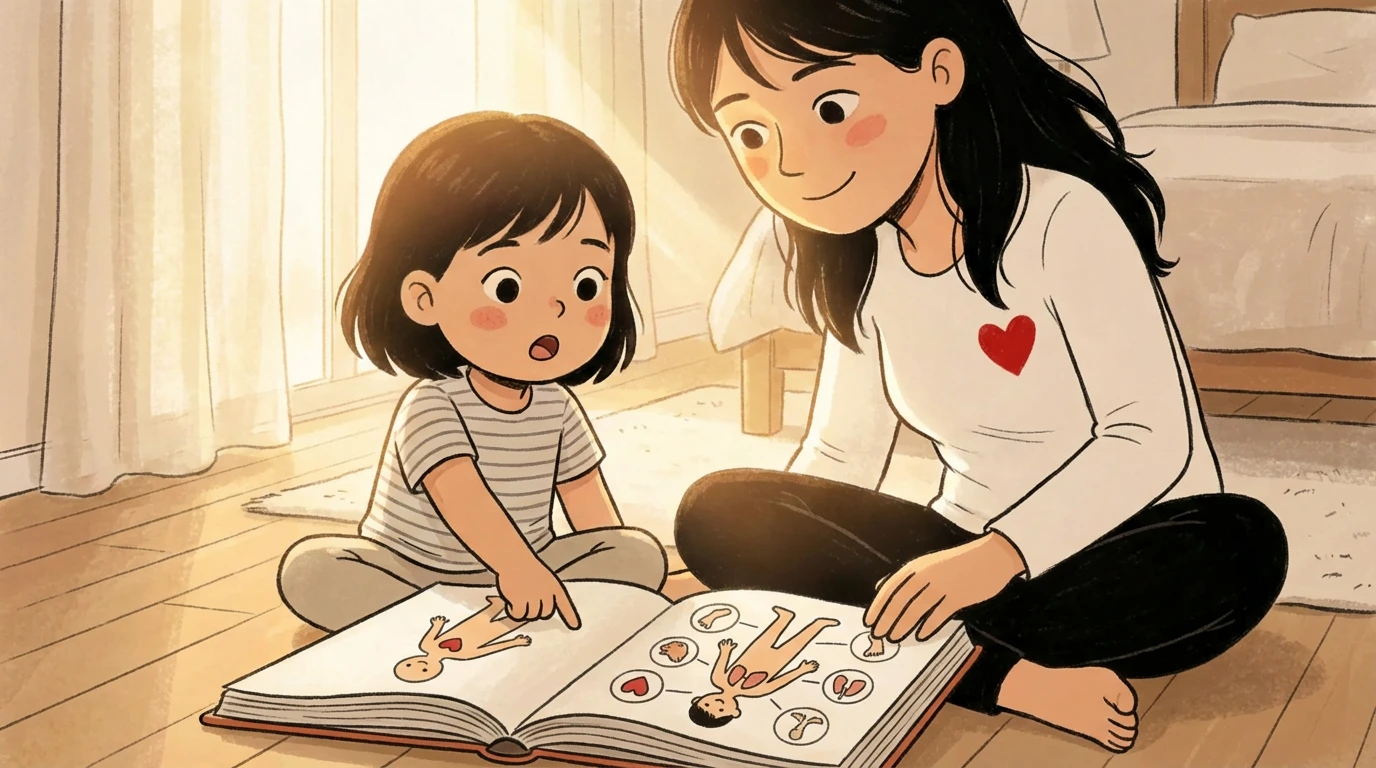
- Use books as conversation startersAge-appropriate books about bodies and reproduction give you a structure. Read them together, pause, ask what they think. The book does the heavy lifting so you don't have to improvise every sentence.
- Add consent and relationships by age fiveTeach that nobody touches their body without permission and they don't touch others without asking. Explain that sex is something for adults in loving relationships. Keep it matter-of-fact, like explaining why we wear seatbelts.
- Get ahead of puberty and pornographyBy age eight or nine, discuss what puberty will feel like. Explain that pornography exists, it shows pretend versions of sex, and they should come to you if they see it. Kids who hear this from parents first are far less confused when they encounter it.
The average age for puberty to begin is now nine or ten. By eight, your child needs to know what is coming: body changes, mood shifts, periods for girls, erections and wet dreams for boys.
Don't wait for signs of puberty to start talking about it. At ten or eleven, embarrassment kicks in and the window narrows. At eight or nine, kids are still curious enough to listen without cringing.
Pornography: the conversation you cannot skip
Statistically, most children stumble across pornography by age eight. Before that happens, proactive education protects kids from learning about sex through pornography. Tell your child: "There are pictures and videos online that show pretend versions of sex. They're made for adults, and they don't show what real love or real sex looks like. If you ever see something like that, come tell me. You won't be in trouble."
That one conversation, delivered calmly, does more protective work than any parental control software.
The timer technique for reluctant kids
If your eight-year-old groans and says "Mom, stop, that's gross," try this: "I get it. I'll be fast. I'm setting a timer for two minutes. My job as your parent is to make sure you hear this from me first. Ready? Go."
Deliver the information warmly and factually. When the timer goes off, ask if they have any questions. If they say no, hug them and move on. Two minutes of mild discomfort buys years of open communication.
Teens: keep talking, keep listening
By the teen years, your child needs to know about contraception, sexually transmitted infections, and what a healthy relationship looks like. These conversations about hard topics are only possible if you spent the previous decade proving you could handle them.
Ask questions that create dialogue:
- "At what age do you think people are ready for a relationship?"
- "If someone says yes to something and then changes their mind, what should happen?"
- "Do you know anyone at school who's dealing with pressure around this stuff?"
These questions reveal what your teen is thinking without turning the conversation into a lecture. Your job at this stage is more listening than teaching. They have the information. What they need is someone safe to process it with.
Preparing your child for puberty conversations is the bridge between the childhood talks and the teen years. If you built the bridge, walking across it together is the easy part.

FAQ
Answer briefly and honestly, same as any other question. 'Babies grow inside a mom's uterus.' You can add detail later at home. The goal is to never make them feel like asking was wrong. A short, calm answer in public teaches them the topic is normal, not scandalous.
There is no too young. Bath time body-part naming starts in infancy. Answering 'where do babies come from' happens around three or four. The conversations grow with your child. Starting early makes every later conversation easier because you have already established that bodies and reproduction are speakable topics.
Research shows the opposite. Children who receive ongoing, accurate sex education from parents delay sexual activity, have fewer partners, and use protection more consistently when they do become sexually active. Silence and mystery are what create risky behavior, not information.
Stay calm and ask where they heard it. Correct any misinformation factually, without shaming them for repeating it. Then explain that some topics are parent-child discussions, meaning they can always ask you, but these are not things to discuss with other kids at school.