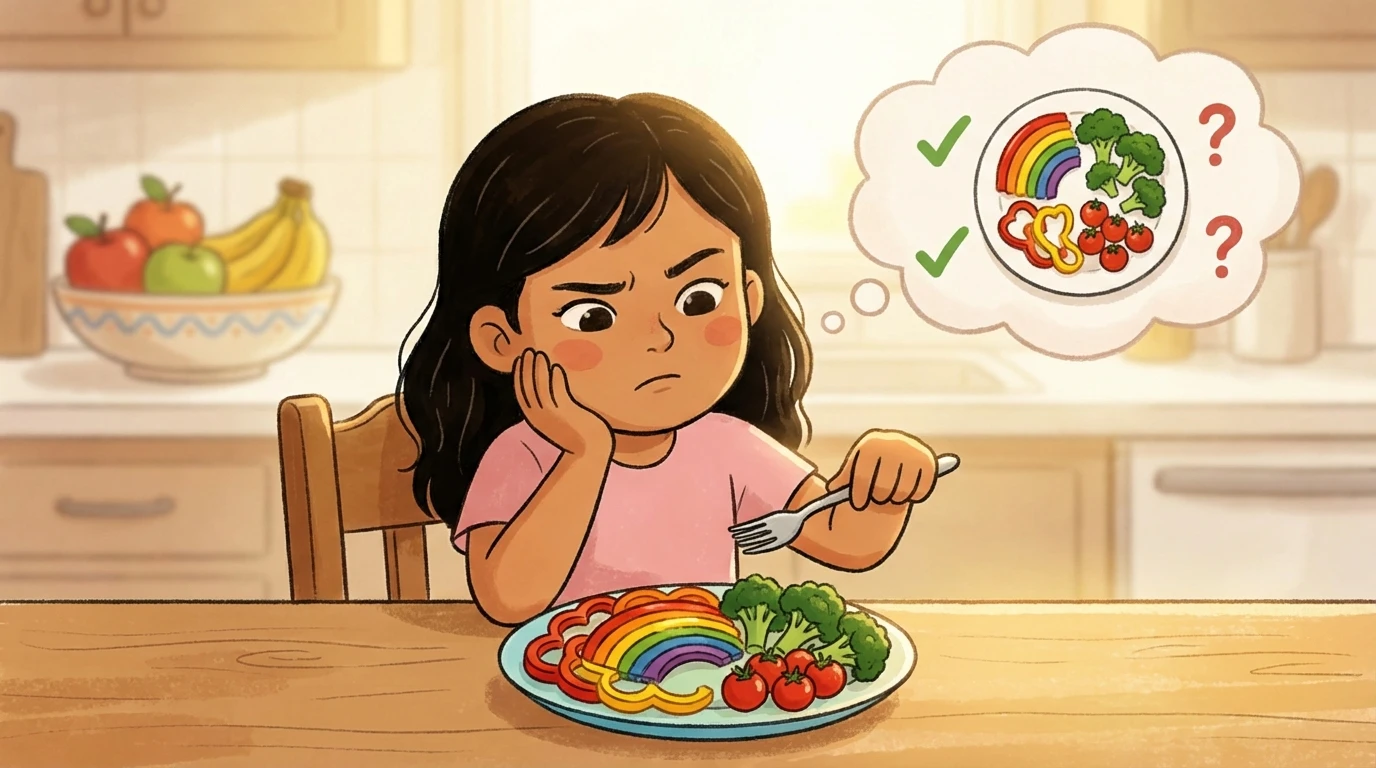
TLDR
- Picky eating is biology, not rebellion. Food neophobia is an evolved survival mechanism. Your toddler refusing broccoli is their brain running the same software that kept ancient children from eating poisonous berries.
- Exposure is the mechanism, not persuasion. Research shows kids may need 15 to 30 neutral exposures to a food before accepting it. Keep serving it. Skip the commentary.
- Rewards make vegetables feel like punishment. Offering dessert for eating peas tells your child that peas must be terrible. The bribe confirms what they already suspected.
- Snack time is your secret weapon. Kids eat vegetables more willingly at 4pm when veggies are not competing with pasta or bread on the dinner plate. Serve cut peppers and carrots when they are genuinely hungry.
- The long game always wins. Most children end up eating diets similar to what they grew up with. Model healthy eating consistently and the trajectory takes care of itself.

The evolutionary reason your kid won't touch that casserole
Your child ate sweet potatoes at eight months. Inhaled mashed avocado. Then somewhere around 18 months, the same kid who demolished salmon started acting like you're serving them garden mulch.
This is food neophobia, one of the oldest survival instincts humans carry. Children who ate anything unfamiliar in ancestral environments sometimes ate something that killed them. The ones who refused new foods lived long enough to pass on their genes.
This also explains why most young kids hate when foods touch or get mixed together. Your child picking peas out of fried rice is their brain running a threat assessment, not a commentary on your cooking.
The good news: this instinct fades with repeated, pressure-free exposure. The bad news: "repeated" means 15 to 30 times for some foods.
Hiding veggies in sauce
The Peaceful Mealtimes course will replace the bribing with something that expands their range
You'll watch new foods land on the plate without sneaking, bargaining, or dessert as leverage.
What pressure does to a kid's appetite
Here is where most parents go wrong. The food is on the plate. The child won't touch it. So you start coaching. Just one bite. You liked this last Tuesday. Three more forkfuls and then you can have yogurt.
Every one of those sentences teaches your child the same lesson: eating is something that requires external management, and their own hunger signals are not trustworthy.
The clean plate trap
"Clean your plate" is generational muscle memory. But research from Ellyn Satter's institute shows that children who are pressured to eat more consume less of the pressured food over time. The pressure itself becomes the problem.
Why dessert bribes backfire
Telling a child "eat your green beans and you can have ice cream" sends a specific message: green beans are the price of admission, and ice cream is the reward. Your child correctly concludes that green beans must be terrible, because why else would you need to bribe them? Research confirms that children who are rewarded for eating vegetables develop stronger aversions than children who are simply exposed to them without fanfare. Skip the sticker charts and dessert deals that undermine your child's willingness to eat.

The division of responsibility (your new best friend)
The single most useful framework for feeding kids comes from dietitian Ellyn Satter: you decide what food is served, when meals happen, and where the family eats. Your child decides whether to eat and how much.
When you stop pressuring your child to eat, you are not giving up. You are respecting a boundary that makes the entire system work.
What this looks like at dinner
You cook. You put it on the table. You sit down and eat. Your child decides what they want from what is available. If they eat two bites and say they're done, dinner is over for them. No lecture. No countdown.
If they come back an hour later saying they're hungry, reheat what they didn't eat, or offer something simple (yogurt, a scrambled egg, raw carrots). You're not making a second dinner.
Why the family table still matters
Even when your child eats like a sparrow, keep them at the table. They learn conversation. They learn manners. They watch you eat roasted cauliflower and their brain files it away. This is how modeling works as a strategy for building food acceptance. The sparrow phase is temporary.
How to expand your child's food range
- Serve vegetables at 4pm snack timeKids eat vegetables more willingly when the veggies are not competing with pasta on the dinner plate. Cut up red peppers, offer celery with peanut butter, or put out a bowl of frozen peas. Hungry kids at 4pm will surprise you.
- Always include one safe foodPut at least one thing on the table you know your child will eat. This safety net means they never leave hungry, even on nights when they reject the main dish. It removes the panic from both sides.
- Offer a vegetable substituteIf your child rejects the broccoli at dinner, let them grab raw carrots from the fridge instead. The structure stays intact (vegetables are part of every meal) while giving them genuine choice within it.
- Try the muffin tin approachPut tiny amounts of different foods in each cup of a muffin tin. Small portions feel less overwhelming, the variety looks interesting, and the cups keep foods from touching each other.
- Drop all commentary about eatingNo 'good job finishing your peas.' No disappointed sigh when they skip the salmon. When the food hits the table, your job is done. Their job started. Let the silence do the work.

The 4pm window (and other timing tricks)
The same carrot stick your child ignores at dinner becomes acceptable at 4pm when their stomach is growling and nothing else is competing with it.
Why snack time beats dinner
At dinner, vegetables sit next to bread, pasta, or rice. Your child picks the carbohydrate every time. But at snack time, the vegetables are the only option. A hungry child will eat a sweet potato wedge they would have thrown on the floor at 6pm.
Snacks that work: baked sweet potato slices with a pinch of salt, zucchini sticks, celery with peanut butter, or roasted vegetables left over from dinner served at room temperature. The gradual exposure approach works for food the same way it works for fears: familiarity reduces resistance.
The grazer versus the meal eater
Some children are natural grazers. Their bodies run better on six small eating events than three big meals. If your child barely touches lunch but asks for a snack 45 minutes later, they may simply be wired for smaller, more frequent fuel-ups.
Stop thinking meal by meal and start thinking about eating events. Each event gets one nutrient category in: protein from a scrambled egg, calcium from a glass of milk, Vitamin A from a few carrot sticks.
What to do when they discover sugar (and everything falls apart)
There is a specific moment in every household where a child who ate salmon and yams discovers cookies. After that, cookies are all they want. Human biology responding to concentrated sweetness exactly the way it was designed to.
The removal approach
The most effective strategy: stop keeping sweets in the house. Make fruit the default dessert. You will encounter plenty of sugar at birthday parties and grandparents' houses without needing a supply at home.
When your child asks for treats, empathize and hold the boundary. "You love those cookies. We don't have cookies at home, but we have strawberries." They may reject meals for a few days. They will not starve. The healthy food becomes appealing again because it is the only option available.
Making healthy food look interesting
Presentation matters more than ingredients when you're winning back a sugar-trained palate. Tiny broccoli florets with melted cheese ("cheesy trees"), small colored pasta shapes, anything arranged to look novel. A muffin tin with six different small portions feels festive in a way that a plate of broccoli never will.

The long game (and why it always works)
Every parent locked in a dinner standoff needs to hear this: most children end up eating diets similar to what they grew up with. Your four-year-old who survives on buttered noodles and apple slices will, if you keep serving a variety without pressure, become a teenager who eats most of what the family eats.
There will be phases where your child eats five foods total. But the exposure is working even when it looks like nothing is happening. Every time asparagus appears on their plate without comment, the food becomes slightly more familiar.
Keep the variety coming, keep the pressure off, and trust the biology that got us here. Someday you will watch them voluntarily eat a salad and wonder what all the fuss was about.
FAQ
Research suggests 15 to 30 exposures for many foods, though some children need fewer. An exposure counts even if your child just sees the food on their plate and ignores it. Keep serving it without comment and let familiarity do the work over weeks and months.
Blending spinach into pasta sauce or adding squash to mac and cheese is fine as long as you frame it as how your family cooks rather than a trick. Kids who discover hidden vegetables feel deceived, but kids who grow up with 'our special sauce recipe' accept it as normal.
Keep serving carbs alongside proteins and vegetables. Include one food you know they will eat at every meal so they are never hungry. Over time, as they feel zero pressure, they will start reaching for the other items on the table. Their carb phase is not permanent.
Some kids are natural grazers who eat better with small frequent portions than three big meals. Let them sit with the family at mealtimes for the social learning, then offer healthy snacks between meals. Track their nutrition across a full week rather than meal by meal.
Talk to your pediatrician if your child eats fewer than 20 foods total, gags or vomits when trying new textures, is losing weight, or shows extreme distress around food. Most picky eating is developmental and resolves on its own, but a feeding therapist can help if the range is severely limited.