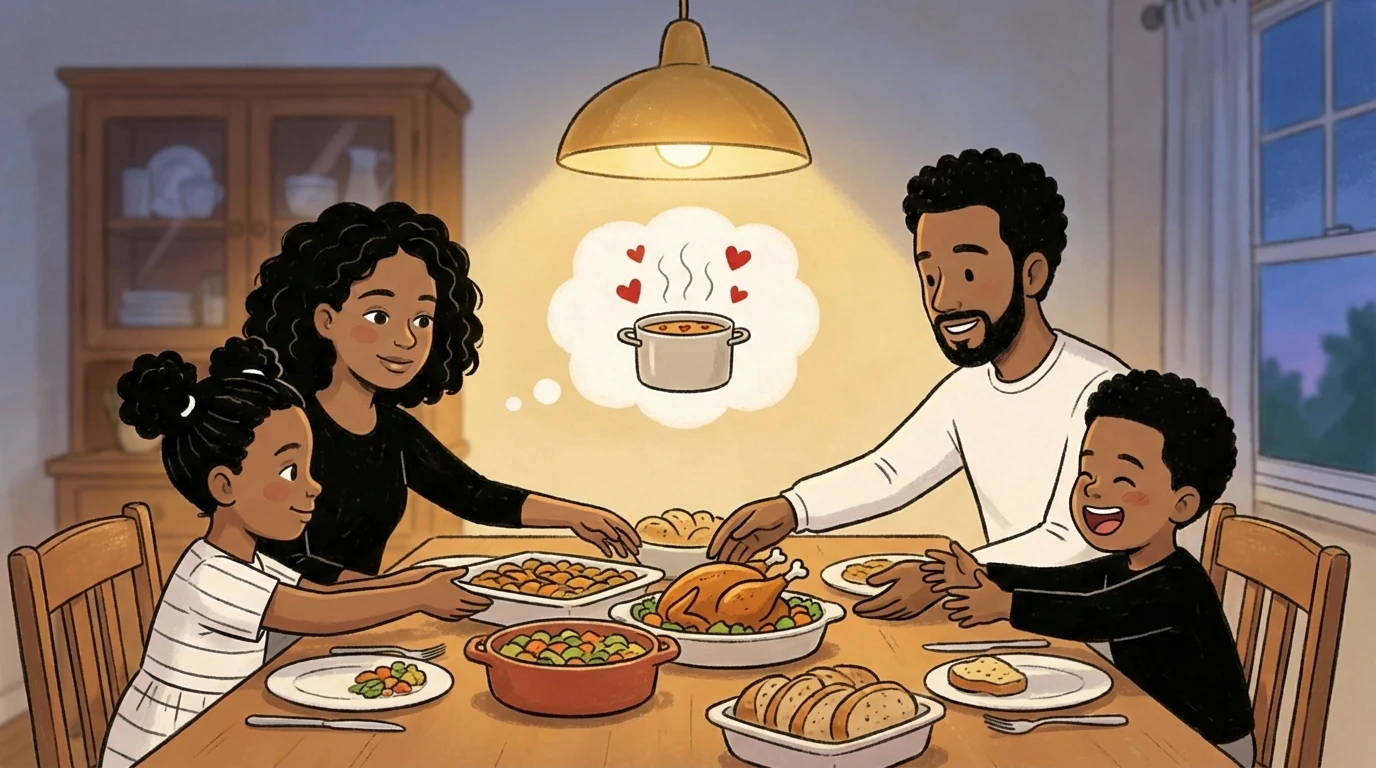
TLDR
- Three meals a week is the research threshold. Most documented benefits kick in at three or more shared family meals per week. Two is better than none, and five is better than three.
- The food is not the point. Scrambled eggs and raw carrots count. Connection at the table matters more than what's on the plate.
- Screens at dinner cancel the benefits. Eating in front of a screen builds your relationship with the screen, not each other.
- Quality of interaction determines outcomes. Yelling, pressuring, or stone-cold silences at dinner produce worse results than skipping dinner entirely.
- Five minutes of real talk beats an hour of forced togetherness. A short routine your family can count on every night does more than occasional marathon dinners.

What twenty years of research found
Here's what you'd expect the data to say: families who eat together produce kids who do better. Fine. Obvious.
Here's the part that's less obvious. Researchers at Columbia University tracked the dose-response curve and found it's nearly linear. Two dinners a week is substantially better than zero. Four is substantially better than two. There's no magic number where the benefits suddenly appear. Every additional meal together shifts the needle.
The outcomes across multiple studies include better academic performance, lower rates of depression in adolescence, reduced substance use, healthier eating patterns that persist into adulthood, and improved vocabulary in younger kids.
The mechanism behind the magic
Why does dinner do all this? Researchers point to five overlapping theories:
- Communication density. Families who eat together talk more. These conversations create openings that don't happen when everyone is in separate rooms.
- Parental engagement signal. Showing up to eat with your kids signals availability. Parents who prioritize dinner tend to show up in other ways too.
- Structure spillover. The discipline required to maintain a dinner routine extends into homework and bedtime.
- Group identity. Dinner transforms individual family members into a unit. During adolescence, this provides an anchor against peer pressure.
- Predictable security. Children need something to count on every day. Sharing food with people who love them is one of the most basic forms of felt safety.
The part nobody wants to hear
Here's the catch. The research on family connection shows benefits depend on interaction quality. Sitting together while a parent pressures a child about grades or has a cold standoff with their partner produces no benefits. In some cases, it's actively harmful.
Hostile family dinners are worse than no family dinners. The table has to feel safe. Kids need to believe that sitting down won't result in an interrogation or a fight between their parents.
What "quality" looks like in practice
The research points to two ingredients: warmth and structure. Warmth means your kid feels liked (not just loved) at the table. Structure means there's a predictable shape to the meal.
You don't need conversation cards, themed nights, or Instagram-worthy place settings. You need to look happy to see your kid, ask one real question, and listen to the answer.
Eating standing at the counter
The Peaceful Mealtimes course will help you sit down together
You'll build a twenty-minute family meal that works even with a toddler who won't stay put.
Making it work when you're exhausted
After work and activity schedules, parental exhaustion is the single biggest obstacle to family dinners. And the cruel irony is that cooking an elaborate meal makes you too depleted to enjoy eating it with your family.
The oxygen mask trick
Put out healthy snacks (carrots and hummus, cheese and crackers) as the "first course" while you take ten minutes to decompress. Cold water on your face. A few deep breaths. Then get dinner on the table.
You're not useful to anyone running on empty. A parent who shows up relaxed with scrambled eggs beats a parent who shows up resentful with a three-course meal.

Simple meals that count
The point of family dinner is conversation, not cuisine. Ten-minute meals that work:
- Spaghetti with jar sauce and bagged salad
- Tacos with pre-seasoned meat
- Scrambled eggs and raw carrots
- Leftover rice with frozen peas and grated cheese
- Pizza from the place down the street
Nobody in the research papers measured the quality of the food. They measured the quality of the interaction. Keeping young kids at the table is hard enough without adding a complicated recipe.
Screens off, phones away
Eating in front of a screen builds your relationship with the screen, not with each other. TV dinners don't count toward the benefits. The value comes from conversation, and conversation requires eye contact.
Put phones in a drawer. Position the TV where it can't be seen from the table. Transitioning kids away from screens before dinner prevents the battle at the table. The world will still be there in thirty minutes.
The conversation problem (and how to solve it)
You sit down. You say "How was your day?" Your kid says "Fine." You eat in silence. This is the part where most families give up.
Rose, thorn, and bud
Each person shares three things: the best part of their day (rose), the hardest part (thorn), and something they're looking forward to (bud). It takes two minutes per person and gives everyone a structure to follow.
How to start a family dinner routine
- Pick two or three nightsDon't aim for every night. Choose the nights that work and protect them. Consistency on a few nights beats sporadic attempts at seven.
- Keep the food dead simpleScrambled eggs, jar sauce on pasta, tacos. Save your energy for the conversation, not the cooking.
- Put all screens in another roomPhones in a drawer, TV off. This is the one non-negotiable. Thirty minutes without a screen won't hurt anyone.
- Use rose-thorn-bud for structureEach person shares their best moment, hardest moment, and something they're looking forward to. Takes two minutes per person.
- Listen more than you talkWhen your kid shares something hard, resist the urge to fix it. Ask 'How can we help?' and then listen to the answer.
Questions that get real answers
Keep a stash of conversation starters in a kitchen drawer. When you're too tired to think, pull one out:
- "What would you ask me if I said yes to anything right now?"
- "What was one mistake you made today?"
- "What's one kind thing you saw someone do today?"
Specific questions get specific answers. "What makes rap music interesting to you?" will get a longer response than "How was school?"

The listening part
When someone raises something hard at the table, don't solve it. Listen. Commiserate. Ask "How can we help?" but don't launch into advice mode.
When you minimize unsolicited advice, kids become more willing to bring up what's bothering them. The ten-year-old who talks about hard stuff at dinner becomes the fifteen-year-old who calls you when something goes wrong at a party.
Making the table a safe space
The dinner table should feel like a refuge, not a courtroom.
Ground rules worth establishing
- No lectures about homework, chores, or behavior during dinner
- No teasing that hurts feelings (common in families with older boys)
- Sibling squabbles get redirected: "Tell your sister three things you appreciate about her"
Table manners matter, but they're a long game, not a dinner-by-dinner battle. If you spend the whole meal correcting how your four-year-old holds a fork, you've turned connection time into correction time.
Getting kids involved
There's no reason dinner prep and cleanup can't be part of the connection.
A toddler can wash vegetables. A five-year-old can set the table. A teenager can cook one night a week (and they often enjoy deciding what the family eats). Group cleanup goes faster when someone picks the music.
Start small: everyone gathers to set the table. That five minutes of shared effort creates ownership. It's our dinner, not dinner that appeared while they watched a show.
The five-minute version
If the full family dinner feels impossible on a given night, here's the minimum: sit down together for five minutes with any food, tell your kids one story from your day, and ask them one question about theirs.
That counts. A short routine children learn to expect every night creates the psychological benefit of predictability. Your kid knows that every day, there's a moment when you sit down, look at them, and want to hear about their life.

What to skip
A few common traps:
- Waiting for perfect conditions. Your toddler will cry. Your baby will throw food. Your preschooler will leave after ten minutes. Still counts.
- Making it about nutrition. If you spend the meal policing bites of broccoli, you've replaced connection with control.
- Forcing it every night. One night per week of dinners on the run is fine. The problem starts when the family can't sit down at all.
- Treating dinner as the only fix. If you eat together three times a week but yell the rest of the time, dinner alone won't undo that.
FAQ
Research shows benefits starting at three per week, with a dose-response relationship where more is better. Two dinners per week is substantially better than zero. If you can only manage one or two right now, start there. The consistency matters more than hitting a specific number.
Any shared meal counts. Breakfast, lunch, weekend brunch. The specific meal matters less than the regular shared experience. If weeknight dinners are impossible but weekend breakfasts are doable, those weekend breakfasts carry real weight.
Ask specific questions instead of open-ended ones. 'What was the funniest thing that happened at recess?' works better than 'How was school?' Use the rose-thorn-bud structure to give quiet kids a framework. And be prepared for wise-cracking from older kids. Keep your humor. They'll engage on their own terms.
Hostile dinners are worse than no dinners. If tensions are high between adults, agree beforehand that dinner is a conflict-free zone. Save disagreements for after bedtime. Your kids are learning what relationships look like by watching you at that table.
No. Screens at the table cancel the conversational benefits that drive the research outcomes. Put phones in another room for the duration of the meal. Thirty minutes without a phone won't hurt anyone, and it might be the only face-to-face conversation your family has all day.