TLDR
- Potty talk is a developmental phase, not a discipline failure. Children between 4 and 7 are learning about social taboos. Bathroom words are their first experiment with the power of language to provoke a reaction.
- Your reaction is the fuel. The bigger your response (positive or negative), the more rewarding the behavior becomes. A flat, brief redirect is the fastest way to drain the fun.
- Shame makes it worse and last longer. When potty talk becomes forbidden and loaded with guilt, it gains emotional weight. The child fixates instead of moving on.
- Give them a sanctioned outlet. A designated potty talk time or place lets children get the giggles out in a contained way. Suppressing it entirely just moves it underground.
- Persistent obsession may signal something underneath. If potty talk doesn't fade after consistent handling over a few weeks, or if a teacher flags it, look deeper at what might be driving it.

Why your kid won't stop saying "poop"
You were in the grocery store. Your child was sitting in the cart, looking angelic. And then, at full volume, in the cereal aisle: "POOPY BUTT POOPY BUTT POOPY BUTT."
Every parent within earshot either winced or stifled a laugh. You did both.
Your child has discovered that certain words have superpowers. They say "poop" and adults change their facial expressions, other kids collapse into giggles, and the whole room shifts. For a person who has very little control over their daily life, that's intoxicating.
This phase is tied directly to cognitive development happening in the 4-7 age range. Children are learning about categories: what's polite, what's rude, what's private, what's public. Bathroom words sit right on the boundary, and boundaries are exactly what developing brains want to test.
The science behind the giggles
Taboo words and brain development
Between ages 4 and 7, children develop a sharper understanding of social rules. They learn that some things are said at home but not at school, and some topics are mysteriously off-limits.
Bathroom humor is their first contact with the concept of taboo. The same mechanism that makes horror movies fun for adults makes the word "butt" hilarious to a five-year-old. It's the thrill of crossing a line in a context that feels safe enough to cross it.
The attention loop
Potty talk operates on a simple feedback loop. Child says forbidden word. Adult reacts. Child's brain registers: that worked. Repeat.
Anger, shock, and lectures are just as reinforcing as laughter. Your child's brain isn't sorting reactions into "good attention" and "bad attention." Attention is attention. Every gasping "We do NOT say that" is, from your child's perspective, a standing ovation.
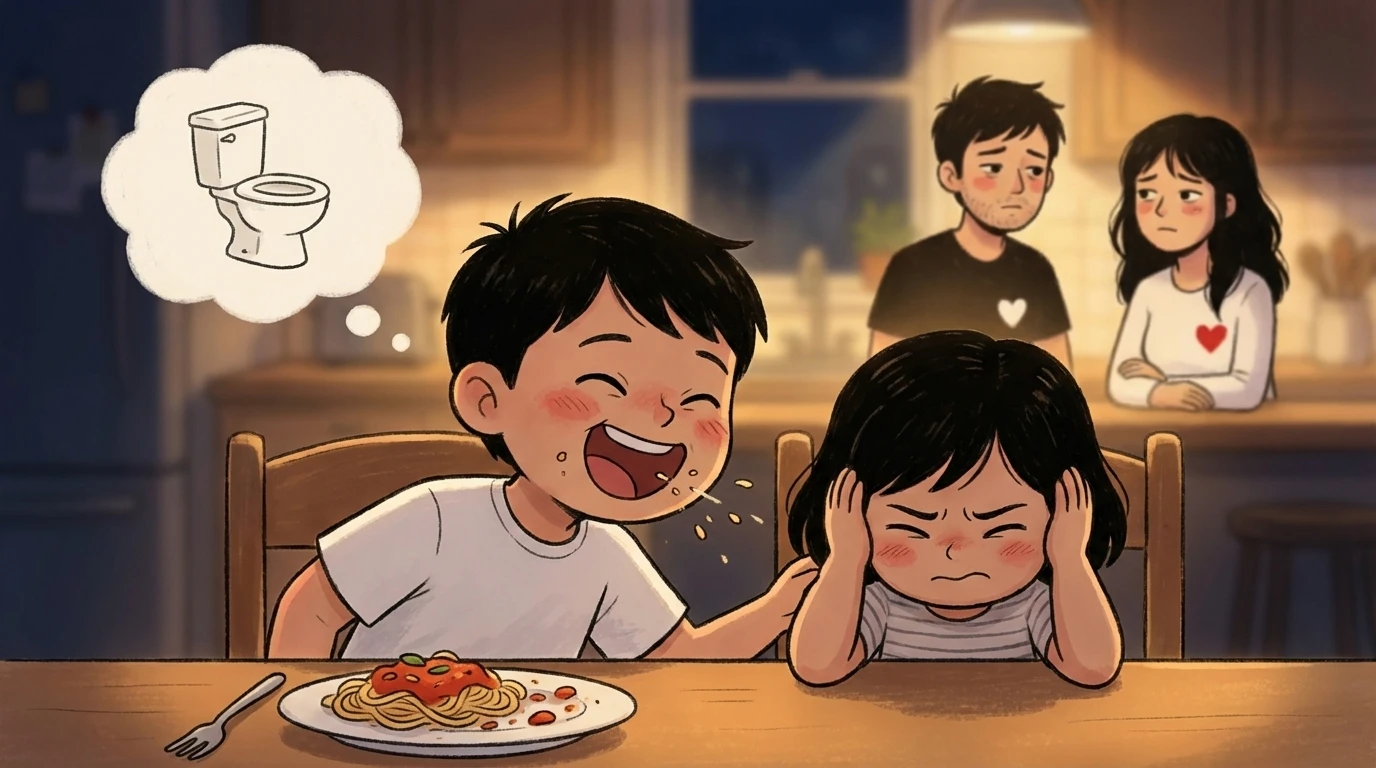
Poop jokes at the dinner table
The Potty Training course will show you how to handle the bathroom humor phase
You'll set clear boundaries on where potty words belong without turning it into a bigger spectacle.
What not to do
Don't shame the words
Telling a child they're "disgusting" for saying potty words adds emotional charge to the words, making them more powerful. It also teaches your child that parts of their body and its functions are shameful.
That second outcome has consequences beyond the potty talk phase. Children who learn that bodily functions are unspeakable have a harder time when they need to talk about body safety and correct anatomical terms. You want your child comfortable enough with their body to tell you if something happens to it.
Don't laugh (even when it's funny)
Your five-year-old will construct a joke so absurd and perfectly timed that you will want to laugh. Do not. Or if you do, turn around first. Every laugh is a booking for another show.
Don't ignore it entirely
Going completely silent doesn't work because your child will escalate. If "poop" doesn't land, "poopy butt" will. If that fails, they'll find something worse. The goal is a response that's boring, not no response at all.
Setting limits that work
You can't shame it, laugh at it, or ignore it. What's left? Containment. You create a boundary around where and when potty talk is acceptable, and you enforce it with the most unexciting energy you can summon.
The script is simple. Get close. Make eye contact. Say: "That's bathroom talk. Bathroom talk stays in the bathroom." Then move on. Setting limits calmly and consistently is the whole strategy.
The potty talk zone
Designate a time and place where all the poop jokes are welcome. Bath time works well. So does a silly five-minute window before bed. Some families use a "potty word minute" where the child can say every bathroom word they know, as fast as they can.
Giving children permission to do the thing in a contained context reduces their need to do it everywhere else. The forbidden fruit effect is real. Make it unforbidden in one specific spot and the compulsion drops.
When the limit triggers a meltdown
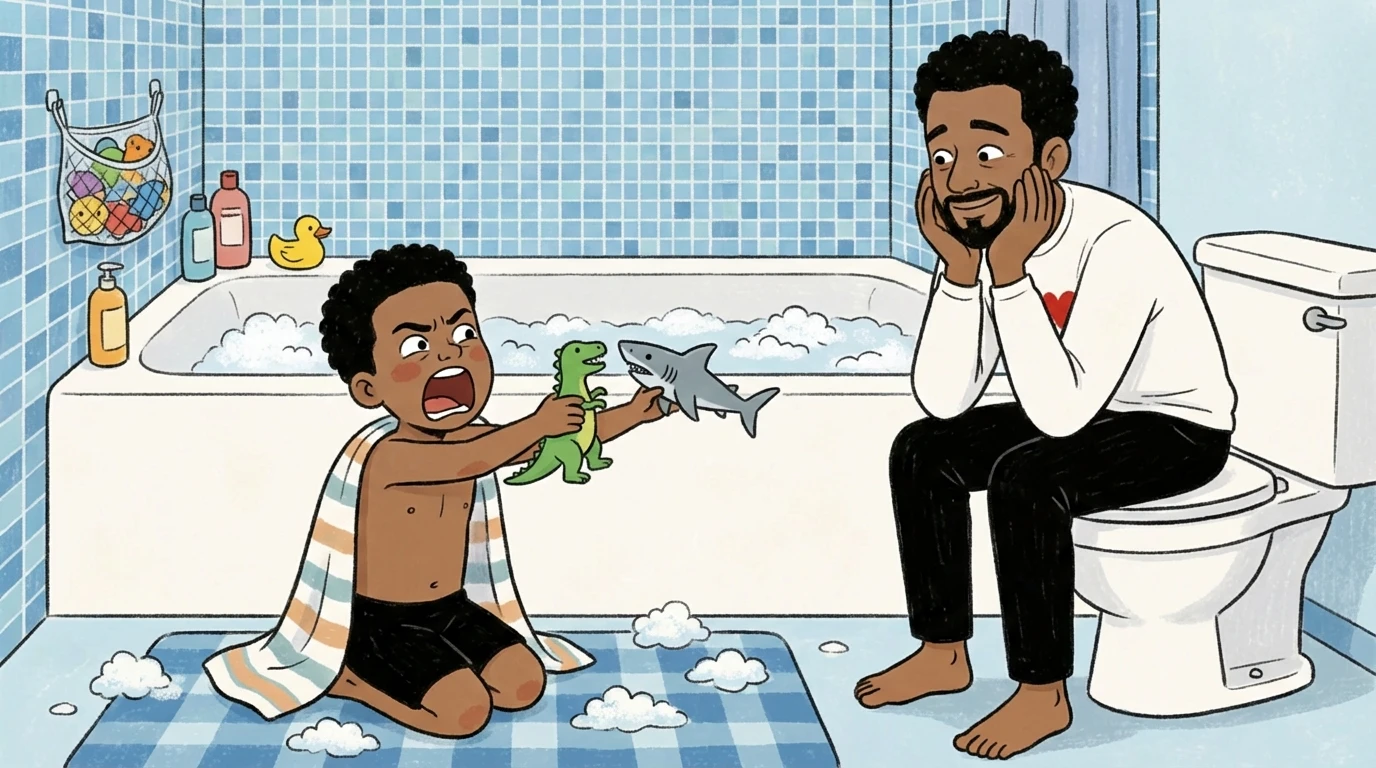
If your child melts down when you set the potty talk boundary, pay attention. If your child pushes back on all limits, this is a broader pattern. The potty talk boundary is just today's power struggle.
But if defiance isn't typical for this child, and the potty talk limit specifically triggers big emotions, something else might be going on. The words might be a pressure valve. The meltdown is useful information. Let it happen. Stay close. The emotional release is part of the resolution.
How to handle a potty talk phase
- Name the boundary without shamingSay 'That's bathroom talk, and bathroom talk stays in the bathroom.' State it once, calmly, with eye contact. No lecture, no disappointment face. The boundary is the message.
- Create a sanctioned potty talk zoneDesignate a time and place where all the poop jokes are welcome. Bath time, a silly five-minute game before bed, or a 'potty word minute' where they get it out of their system. Containment works better than suppression.
- Make your reaction boringThe magic ingredient in potty talk is your face when they say it. Wide eyes, gasps, and laughter are fuel. A flat, brief redirect drains the fun. Practice your most unimpressed expression.
- Use therapeutic play for persistent casesStuffed animals having a potty word contest, silly songs about bodily functions, or a game where you pretend not to understand why the words are funny. Laughter in a safe context releases the tension driving the behavior.
- Watch for emotional undercurrentsIf potty talk spikes during stress, transitions, or after a specific event, the words may be a pressure valve. Address what is underneath rather than just managing the surface behavior.
The social skills angle
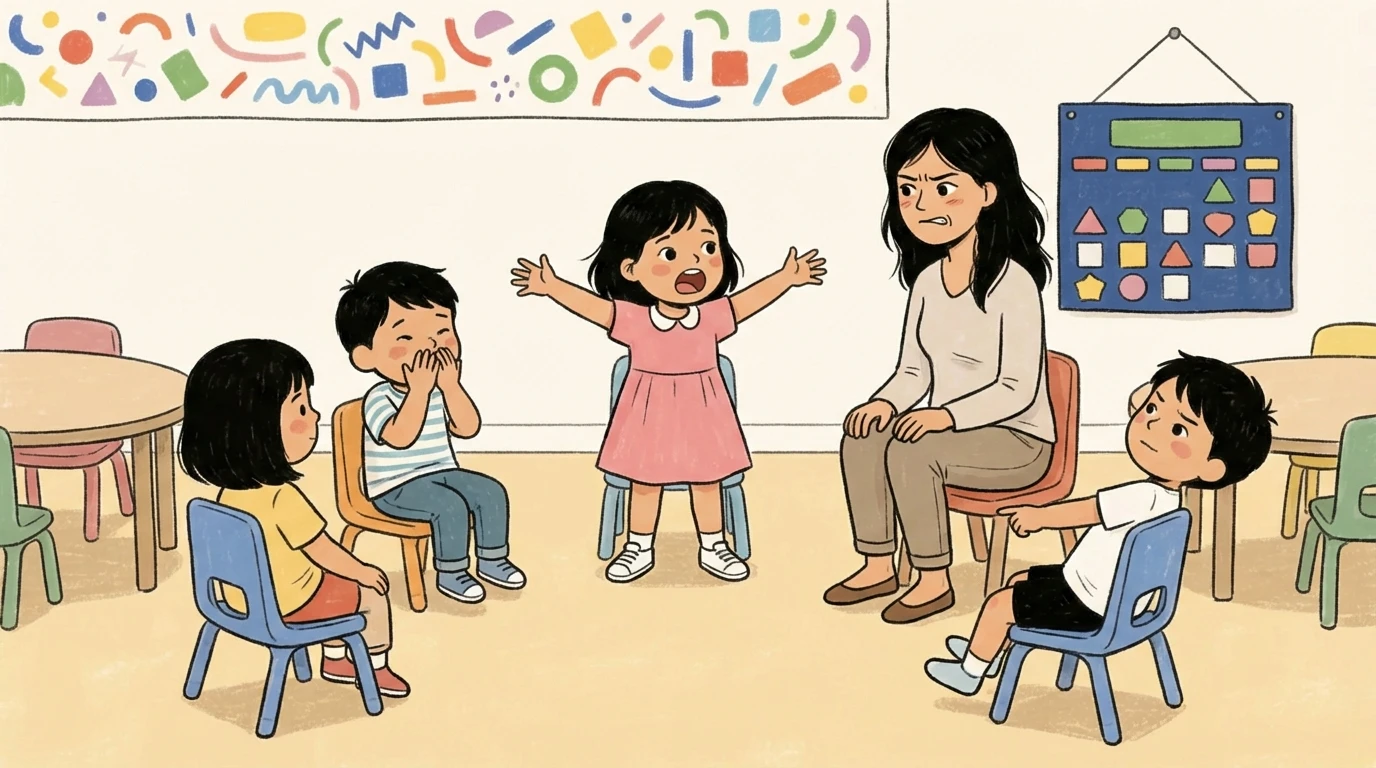
At some point, your child needs to learn that context matters for language. Bathroom words at home during silly time? Fine. Bathroom words during a class presentation? Different situation.
This is a sophisticated social skill you're teaching. Code-switching (using different language in different settings) is something adults do constantly. Your child is learning the early version of it.
Frame it that way. "Those words are for home. At school, we use different words." You're not saying the words are bad. You're saying they belong in a specific context. That's a lesson with a longer shelf life than "don't say poop."
When to look deeper
Most potty talk phases resolve on their own with boring reactions and consistent boundaries. But some situations call for a closer look.
If potty talk has been constant for more than a year and shows no signs of fading, the child may be stuck on something they can't process alone. Normal developmental phases move through. When a child stays fixed on the same material, something is blocking the natural progression.
If a teacher flags the frequency, take that seriously. They see hundreds of kids. Their baseline for "normal" is well-calibrated. When a professional says "this is more than usual," that's data.
If the language moves beyond bathroom words into sexual content a child their age shouldn't know about, that requires immediate attention and a conversation with your pediatrician. Our potty training readiness quiz can also help you gauge whether your child's bathroom-related behaviors fall in the expected range.
This too shall pass
The average potty talk phase runs a few weeks to a few months with consistent handling. The parents who report it lasting years are almost always the parents who can't stop reacting. Every gasp, every lecture, every whispered "not HERE" at the dinner party resets the clock.
Your child is going to stop saying "butt" at the dinner table. They'll move on to the next developmental experiment (probably lying, which is its own adventure). In the meantime, practice your bored face. It's your most effective tool.
FAQ
Yes. The peak of potty humor happens between ages 4 and 7 as children learn that certain words carry social power. They are experimenting with taboo language, not regressing. If the behavior is limited to words and jokes rather than unusual physical behaviors, it falls within the expected range for this age.
Punishment increases the thrill factor of forbidden words. A firm, boring redirect works better. State the boundary once, follow through consistently, and give zero theatrical reaction. The less entertaining you make it, the faster the phase runs its course.
Occasional bathroom humor is normal. Persistent obsession lasting many months, potty talk that disrupts school daily, or language that includes sexual content beyond basic body parts warrants a conversation with your pediatrician. A teacher flagging the frequency is also a signal worth taking seriously.
Keep it brief and boring. Get close, make eye contact, and say 'That's bathroom talk. We save that for home.' Then move on. Do not lecture, laugh, or give a speech. The less energy you invest in the moment, the less rewarding the behavior becomes for your child.