TLDR
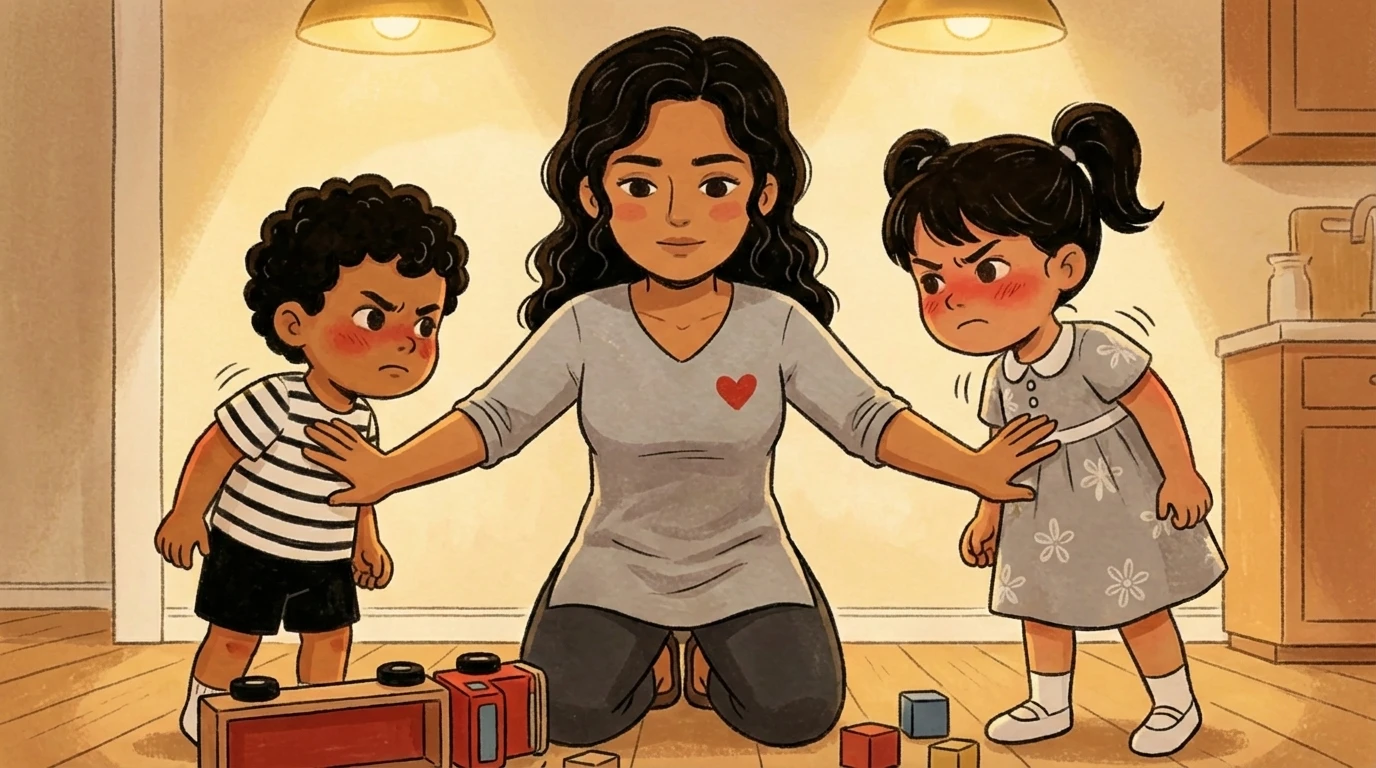
- Do not try to figure out who started it. You will never get an accurate answer, and the child who 'loses' the verdict will resent the sibling more. Treat both kids the same when you walk in.
- Your calm is the intervention. Children cannot access their thinking brains while their nervous systems are in fight-or-flight. Your regulated presence is what brings them down enough to listen.
- Describe what you see, not what you think happened. Say 'I hear loud voices and I see two upset kids' instead of 'Why did you hit your sister?' Neutral observation keeps both children's dignity intact.
- Coach words, not compliance. Getting your kids to stop fighting right now is less valuable than teaching them to express what they need without attacking each other. The skill outlasts the moment.
- Let them generate the solution. When children come up with their own fix, they follow through. When you impose one, you become the referee they need every time.
The screaming starts and you have about four seconds
You are stirring pasta. From the living room: a shriek, a thud, and then the unmistakable sound of a child who has been wronged telling you about it at maximum volume.
Your blood pressure spikes. You want to storm in there and figure out who did what.
Here is the problem with that plan: you will never accurately determine who started a sibling fight. The chain of provocations stretches back further than either child can report honestly. One took a toy. The other said something mean at breakfast. By the time it erupts, both kids believe with full conviction that the other one started it.
Trying to play detective creates victims and bullies. Whoever "loses" your verdict becomes convinced you love the other one more. That conviction fuels the next fight.
Standing between two screaming kids
The Sibling Harmony course will teach you the intervention sequence
You'll know who to address first, what words to use, and how to end it without picking a side.
Before you open your mouth: regulate yourself
Take one breath. Seriously, just one. The breath activates your parasympathetic nervous system and pulls you out of fight-or-flight mode. Your children need you to be what researchers call a "holding environment," a steady presence that signals safety even when everything feels chaotic.
If you walk in already yelling, you have joined the fight instead of intervening in it. Your children will escalate to match your energy. They have to, because their nervous systems are wired to mirror yours.
The script for entering: "I hear some loud, angry voices. I'm here. We're going to work this out."
That sentence names what you observe without blame, announces your presence, and expresses confidence that resolution is possible. Nobody has been accused of anything yet, and both kids can still breathe.
If someone is physically hurt
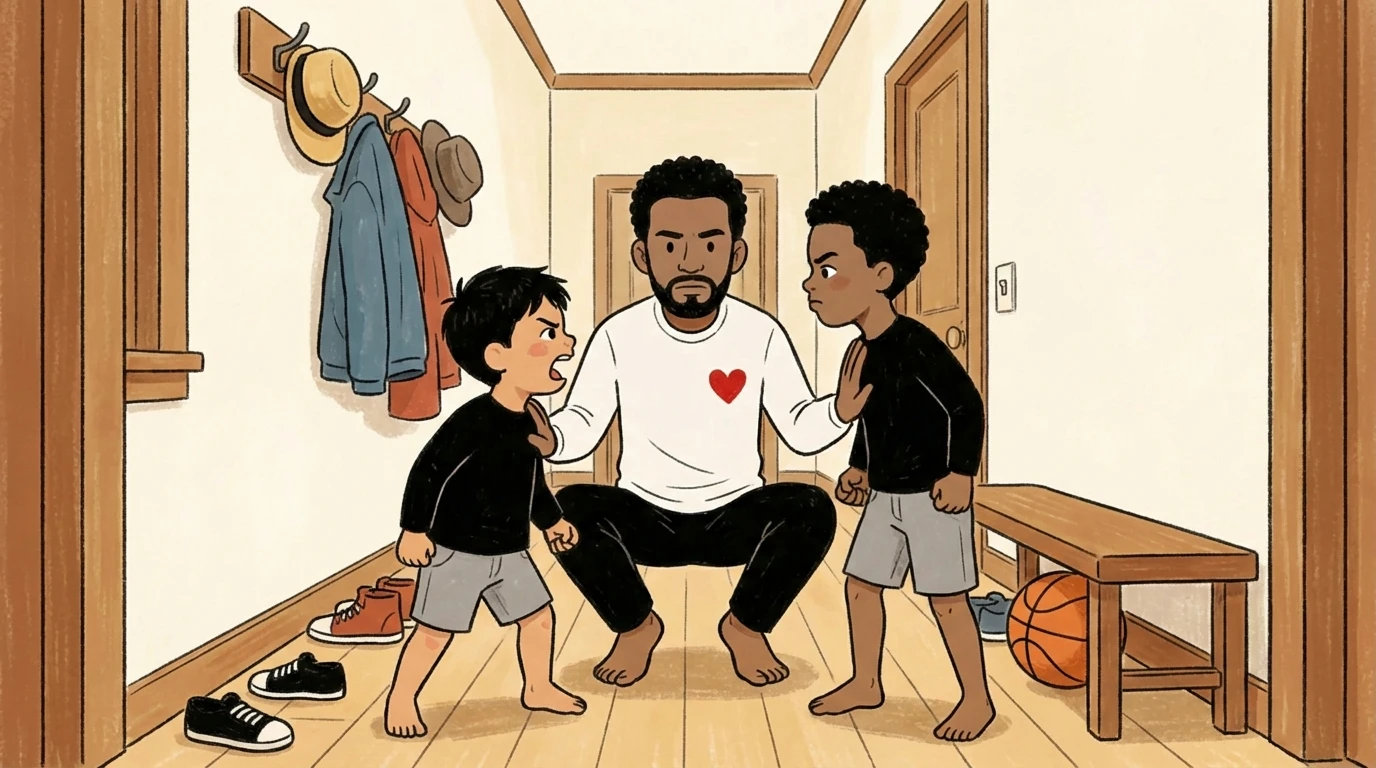
Go to the injured child first. Attend to the wound. "Ouch, that must hurt." Do not turn around and rage at the other child while you are holding the hurt one. That public condemnation will increase resentment, not decrease aggression.
If you need to separate them to tend to an injury, do it without commentary. The accountability conversation happens later, when everyone's cortisol has dropped.

The step-by-step script for when both kids are losing it
Sit down and create structure
"Let's all sit down. Come here next to me. You too." Put yourself physically between them. Both children sit beside you, not facing each other as opponents. You are the buffer.
"Now let's take three deep breaths together. One... two... three."
Breathing together activates the calming branch of the nervous system for all three of you and creates a shared ritual that signals the transition from screaming to talking.
Let each child speak, one at a time
"I want to hear what happened from both of you. One at a time. Last time your sister went first, so this time you go first."
Alternate who speaks first. Enforce the structure firmly: "Hold on. It's your brother's turn right now. You'll get yours in a moment." When a child speaks, reflect back what you hear. "So you were building your tower and she knocked it over, and you're really angry about that. Did I get that right?"
Restating their words does not mean you agree with their actions. It means you heard them. Children who feel heard stop escalating. Children who feel unheard get louder.
Restate both sides without taking one
"So you knocked over the tower because she wouldn't let you play. And you're angry because you worked on that tower all afternoon. Both of you are upset."
Notice what this summary does not contain: a verdict. Both perspectives get equal airtime. Both children hear that their experience was registered.
How to intervene in a sibling fight
- Breathe before you enterOne deep breath. Your calm nervous system is the tool. If you walk in already activated, you have joined the fight instead of mediating it.
- Describe, do not judgeSay what you observe: 'I hear loud voices and I see two upset kids.' Do not assign blame. Do not ask who started it.
- Sit between themPut yourself physically in the middle. Both children sit next to you, not facing each other as adversaries. This changes the geometry from confrontation to conversation.
- Let each child talk in turnAlternate who goes first. Reflect back what each one says. 'So you're angry because she took the remote. Did I get that right?'
- Ask them to solve itRestate both needs: 'You want X. She wants Y. What can we do?' Children who generate their own solutions follow through on them.
After the fire is out: teach, do not lecture
Once both kids are calm enough to think, you have a narrow window to build something useful.
Help them see the escalation pattern
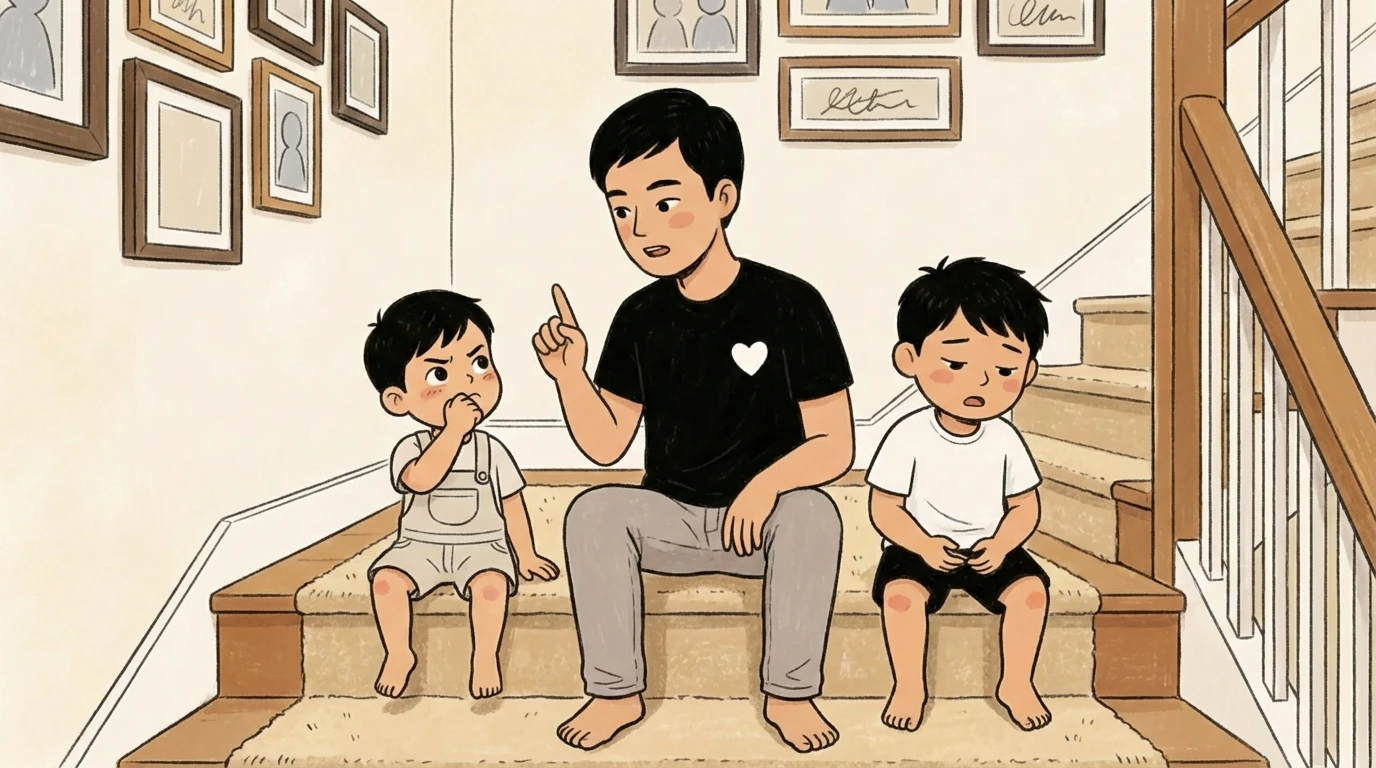
"You were hurt that she took your spot on the couch. And when you're hurt, you got angry, right? And when you got angry, you shoved her. And then she got angry and hit you back." Tracing the chain out loud helps children see how one feeling cascaded into the next. Without this reflection, fights just repeat.
Ask what each could have done differently
"Is there anything you could have done that would have made this go differently?" If they deflect ("But she started it!"), redirect: "Right now I'm asking whether you see anything you had the power to do that would have changed how this went."
The phrase "had the power to do" reframes the question from blame to agency. You are not asking who was wrong. You are asking each child to notice their own influence over the outcome. When a child says "I could have used my words instead of shoving," that insight is worth more than any punishment you could impose.
Coach the words they will need next time
Children cannot be expected to produce conflict resolution language under stress if they have never practiced it. Give them scripts they can use when a sibling fight turns physical:
"You can say: 'I was using that. No grabbing.'" "Try: 'I don't like that. Stop.'" "If they don't stop: 'I'm going to get a parent.'"
Repeat these scripts. Repetition builds automaticity so the words come out in moments when thinking is hard.
What not to do (the short list)
Do not punish both kids to be "fair." Blanket punishment teaches children that your intervention is something to avoid, not seek. Next time, they will hide the conflict until it escalates beyond what either can handle.
Do not always side with the younger child. When parents consistently protect the younger sibling, the older child accumulates resentment that leaks out in sneakier ways. The younger child learns that being small and upset is a winning strategy.
Do not expect them to work it out alone before you have taught them how. Research shows that "let them figure it out" without prior coaching just means the more powerful child wins. That reinforces bullying. Every child deserves to feel safe at home.
The long game: you will not do this forever
This process is slow. It interrupts dinner. It takes the entire bath time window. Some nights you will be too tired and you will just separate them and move on. That is fine.
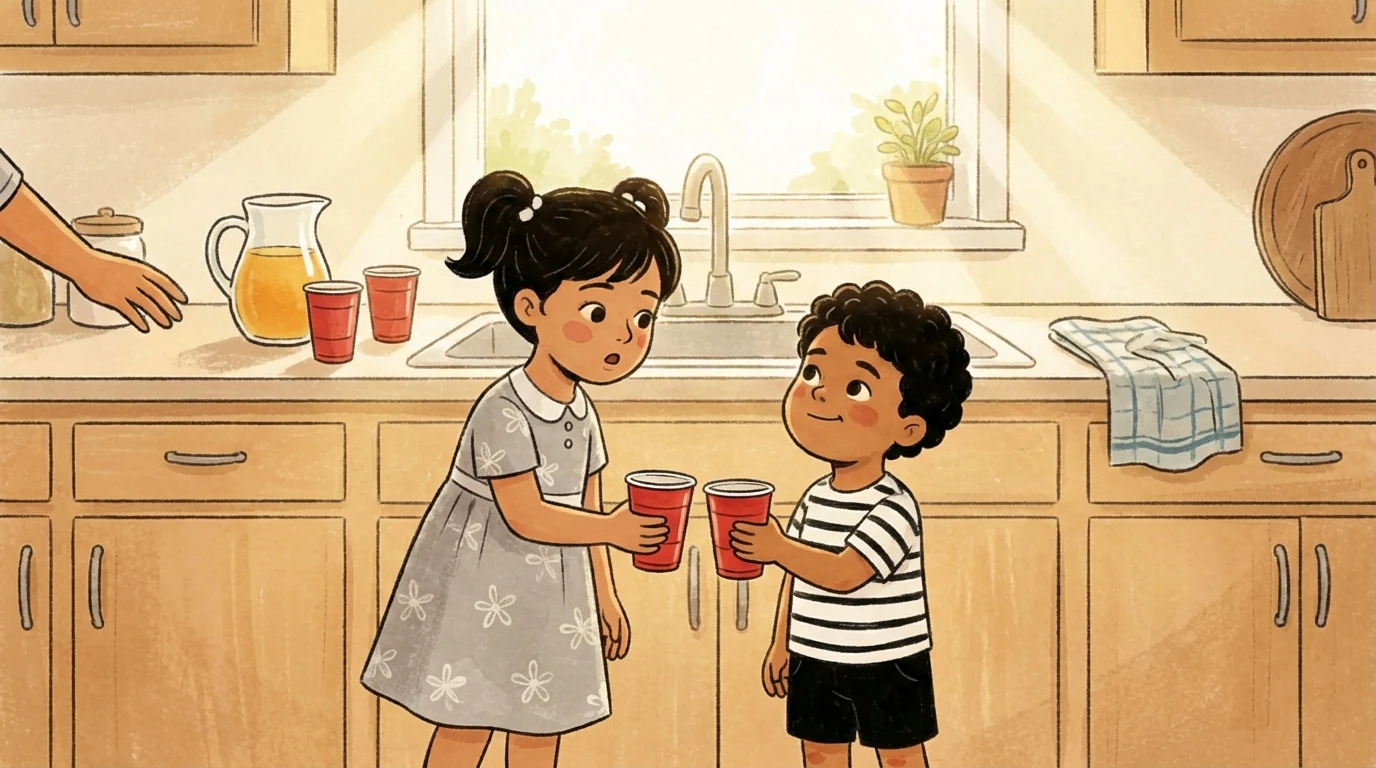
But if you do this consistently for a few months, something shifts. Your kids start naming their own feelings without prompting. They start saying "I don't like that, stop" before it becomes a shove. They come to you with a problem and a plan: "We both wanted the red cup so we decided to take turns."
That is the goal. A house where they know how to fight and come back together. Those are the skills that will carry them through every relationship they ever have.
If you are looking for ways to reduce the frequency of fights before they start, the prevention strategies here are a solid next step.
FAQ
No. If tempers are low and they seem to be working it out, let them practice. Intervene when someone is getting hurt, when one child is consistently overpowering the other, or when the conflict is a good teaching opportunity. You are building toward them not needing you.
That is fine. Say 'You don't have to talk right now. I'll check back in a few minutes.' Some children need a cooldown before they can verbalize. Forcing speech while a child is still dysregulated produces defensive nonsense, not honest communication.
Stop asking who started it. Treat both children the same when you walk in. Give the older child daily one-on-one time so they do not feel like the family scapegoat. If resentment has built up, it needs to be addressed outside the heat of a fight.
Most children can begin managing mild conflicts independently around age six or seven, but only if they have been explicitly coached. Without teaching, even older children default to whoever is louder or stronger winning. The coaching is the prerequisite, not the age.
Yes, but you adjust expectations. A ten-year-old and a three-year-old are not having a negotiation between equals. Coach the older child with scripts, protect the younger child's safety, and do not expect the older one to have adult-level patience. They are still a child too.