
TLDR
- The routine that worked six months ago is probably wrong now. Children's sleep pressure, wake windows, and emotional needs shift every few months. A routine built for a two-year-old will actively fight against a four-year-old's biology.
- Bedtime tantrums are usually a timing problem. An overtired child releases stress hormones that make them wired. An undertired child stalls because their body genuinely cannot sleep yet. Fix the timing before changing anything else.
- Process the day before you start the routine. Children carry unprocessed stress into bedtime. Spending five minutes recapping the day, before pajamas, prevents that stress from exploding at lights-out.
- Roughhousing before bed works. Ten minutes of physical play that gets your child laughing releases pent-up tension. Do it 40 minutes before bed, not right before. The laughter is the mechanism.
- End with a ritual, not a departure. A special song, a specific phrase, a predictable goodbye. The ritual signals safety. Abrupt exits signal abandonment.

The routine that stops working every few months
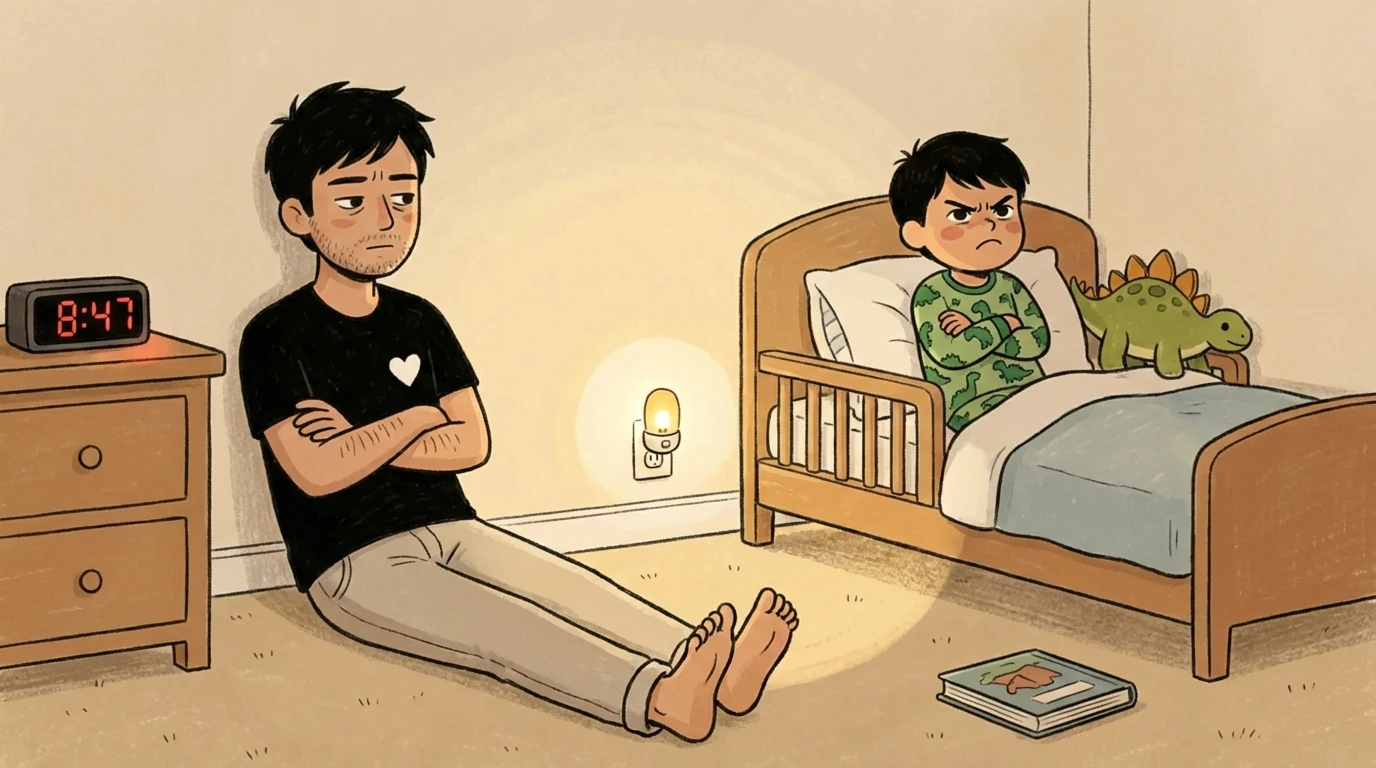
You built a bedtime routine. Bath, pajamas, two books, one song, lights out. It worked for three months. Then your kid aged six months and the whole thing collapsed. Negotiations over book count. A child who was drowsy at 7:30 now bouncing off walls at 8:15.
Your child's sleep biology changed and the routine didn't change with it.
Between ages one and twelve, wake windows (how long a child needs to be awake before sleep pressure builds enough to fall asleep) shift dramatically. A two-year-old who naps until 3 PM might need sleep by 7 PM. A four-year-old who dropped their nap needs 11 to 14 hours of awake time before sleep pressure kicks in. Using a toddler bedtime on a preschooler is like putting a teenager to bed at 7 PM.
Here's the part most parents miss: when your kid fights bedtime, the problem is usually not the routine. The problem is when it starts.
Outgrown the old routine
The Sleep Solutions course will help you build routines that evolve
You'll have a bedtime sequence that adapts as your child grows instead of collapsing every few months.
Overtired vs. undertired (and why it matters more than the routine)
Before you redesign anything, figure out which problem you're solving.
The overtired child
An overtired child has been awake too long. Their body has released cortisol and adrenaline to compensate. That wired, bouncing-off-furniture energy at 8 PM means stress hormones have overpowered their sleep pressure.
Signs: clinginess, fussiness, eye rubbing mixed with manic energy, uncontrollable giggling, irritability over nothing.
The fix: move bedtime earlier. If your child wakes at 6:30 AM and needs 10.5 hours of sleep, they need to be asleep by 8 PM. That means lights out by 7:30 and the routine starting by 7.
The undertired child
An undertired child hasn't been awake long enough. Their nap ran too late, or bedtime is set too early for their age. If your child takes more than 30 minutes to fall asleep after lights out, suspect undertiredness before anything else.
Signs: stalling, procrastinating, asking for one more book, one more drink, one more bathroom trip.
The fix: shorten or shift the last nap earlier, or push bedtime later to match actual sleep pressure. A two-year-old who naps until 3 PM and fights a 7 PM bedtime might sleep easily at 8 PM.
What the routine should look like (by age)
Wake windows are the backbone. Everything else layers on top.
Ages 1 to 2 (wake window: 4 to 6 hours after last nap)
Keep it short and physical. Bath, pajamas, one book, one song, bed. The routine should take 20 to 30 minutes. These kids need sensory input to settle, so don't skip the bath. A toddler who seems wired at bedtime often needs more physical contact, not less. Rocking, bouncing, a tight swaddle if they still tolerate one.
If your toddler only wants one parent at bedtime, that's normal at this age. The preferred parent becomes a sleep association, which is fine short-term but worth gradually diversifying.
Ages 3 to 5 (wake window: 6 to 7 hours if napping, 11 to 13 if not)
This is where most routines break. The nap drops, the wake window doubles, and parents keep using the toddler bedtime.
Add two things: emotional processing time and a goodbye ritual. Before pajamas, spend five minutes recapping the day. "What was the best part of today? Did anything feel tricky?" Children this age carry an invisible backpack of small worries that dump out the moment the lights go off. Front-loading this conversation prevents the 9 PM meltdown.
End the routine with the same closing every night. A specific song. A specific phrase. "I love you, I'll check on you in five minutes, it's sleep time." The predictability of the ending is what makes separation tolerable. Abrupt departures create anxiety that compounds night after night.
If your preschooler melts down during transitions between routine steps, preview the whole sequence before starting: "Tonight we're going to do bath, then teeth, then two books, then your song."
Ages 6 to 12 (wake window: 12 to 15 hours)
The routine gets shorter but the emotional component gets longer. School-aged kids have real worries: friendships, tests, things they overheard. A child who seems angry or restless before bed might be processing something that got stuck during the day.
Cut screens at least an hour before bed. Screen light suppresses melatonin, and the content gives their brain material to chew on at 10 PM. Replace screen time with a bath (aromatherapy helps: lavender, vanilla), then reading, then a relaxation technique.
How to build a bedtime routine that adapts
- Calculate the wake window firstWork backwards from your child's required wake time and sleep needs. Everything else follows from getting this number right. If they can't fall asleep, this is wrong.
- Add roughhousing 40 minutes beforeTen minutes of physical play that gets genuine laughter. Pillow fights, chase games, wrestling. This discharges the day's anxiety through the body instead of letting it surface at lights-out.
- Build in a day-processing conversationBefore pajamas, recap the day together. Ask what felt tricky. Let them talk. Five minutes of this prevents thirty minutes of bedtime resistance.
- Keep the routine steps consistentSame steps, same order, every night. The predictability itself is calming. If the routine stops working after months, change the content but keep a structure.
- Close with a ritual goodbyeSame song or phrase every night. Promise to check in five minutes. Then come back in five minutes. Reliability is the whole game.
The roughhousing trick that sounds wrong
Your instinct says to keep things calm before bed. That instinct is half right.
Ten to fifteen minutes of physical play that produces real, uncontrollable laughter works like a pressure valve. Wrestling on the carpet, pillow tower demolition, chase games where you're the incompetent monster who keeps tripping. The laughter is the mechanism, not the activity.
Three rules. First, do it 40 minutes before lights out, not right before. The child needs the rest of the routine to come down. Second, give it a clear endpoint: a timer, a defined goal ("climb the pillow mountain three times"), something predictable. Third, this works brilliantly for sensory-seeking kids but can backfire for sensory-avoiders. You know which one you have.

When to tear it up and start over
A routine that produces tantrums every night for two weeks is a design problem. Consistency matters, but consistently doing the wrong thing just entrenches the wrong thing.
Three signals the routine needs rebuilding, not reinforcing:
- Your child takes more than 30 minutes to fall asleep after lights out (undertired, push bedtime later or cut the nap)
- Your child melts down within the first ten minutes of the routine (overtired, start earlier)
- Your child was fine for months and suddenly fights every step (developmental shift, recalculate the wake window)
Rebuild the routine around the new wake window, add or remove steps to match their current processing needs, and take the bedtime quiz to find the specific combination that fits your child right now. Not last month. Right now.

Progressive relaxation for the kid whose brain won't stop
Some children lie in bed with their body still and their mind racing. These kids need a physical shutdown technique.
Touch each part of your child's body in sequence, saying goodnight to it. "Goodnight feet. Goodnight knees. Goodnight belly." Have them breathe in, and as they breathe out, imagine that body part melting heavy into the mattress. Start at the feet and work up. By the time you reach their shoulders, most kids are asleep or close.
This works because it gives the racing mind a single focus point. The child stops trying to force sleep and instead follows a sequence, which is what their anxious brain needs.
FAQ
As close as possible. Shifting bedtime by more than 30 to 45 minutes on weekends disrupts the sleep pressure cycle and makes Monday brutal. You can flex the content slightly (longer story time, extra songs) but keep the timing and sequence consistent.
Fighting every step usually means the routine starts too late (child is already overtired and dysregulated) or too early (child has no sleep pressure and knows it). Recalculate the wake window before changing anything else. If timing is correct, the routine content may need rebuilding.
There is no universal deadline. Many seven and eight-year-olds still need a parent nearby. Gradually withdraw your presence over weeks: sit on the bed, then beside it, then at the door, then outside. The pace should stretch your child slightly without panicking them.
For toddlers, 20 to 30 minutes is the target. Over an hour usually means the routine has accumulated extra steps that function as stalling. Strip it back to the essentials: bath, pajamas, one book, one song, bed. Add back only what genuinely helps the child settle.