TLDR
- There is always a reason behind the rule-breaking. Your teen did not violate curfew or sneak the phone just to spite you. Something is going on underneath, from social anxiety to a new crush to a problem they cannot figure out how to tell you about.
- Cracking down without understanding backfires. Punishing first and asking questions never positions you as the enemy. Once you are the adversary, your teen stops confiding in you, which is the opposite of what you need.
- Removing privileges is still punishment. Calling it a 'consequence' does not change how your teenager experiences it. Taking the phone from a teen is taking their social lifeline, and they will resent you for it.
- Your self-discipline matters more than theirs. If you lose your composure when they lose theirs, you are modeling the exact behavior you want them to stop. The adults set the emotional floor.
- Trust rebuilds through conversation, not surveillance. Real conversations where you listen more than you lecture are what repair broken trust. The relationship itself becomes the reason your teen follows the rules.

The rule broke. Now what?
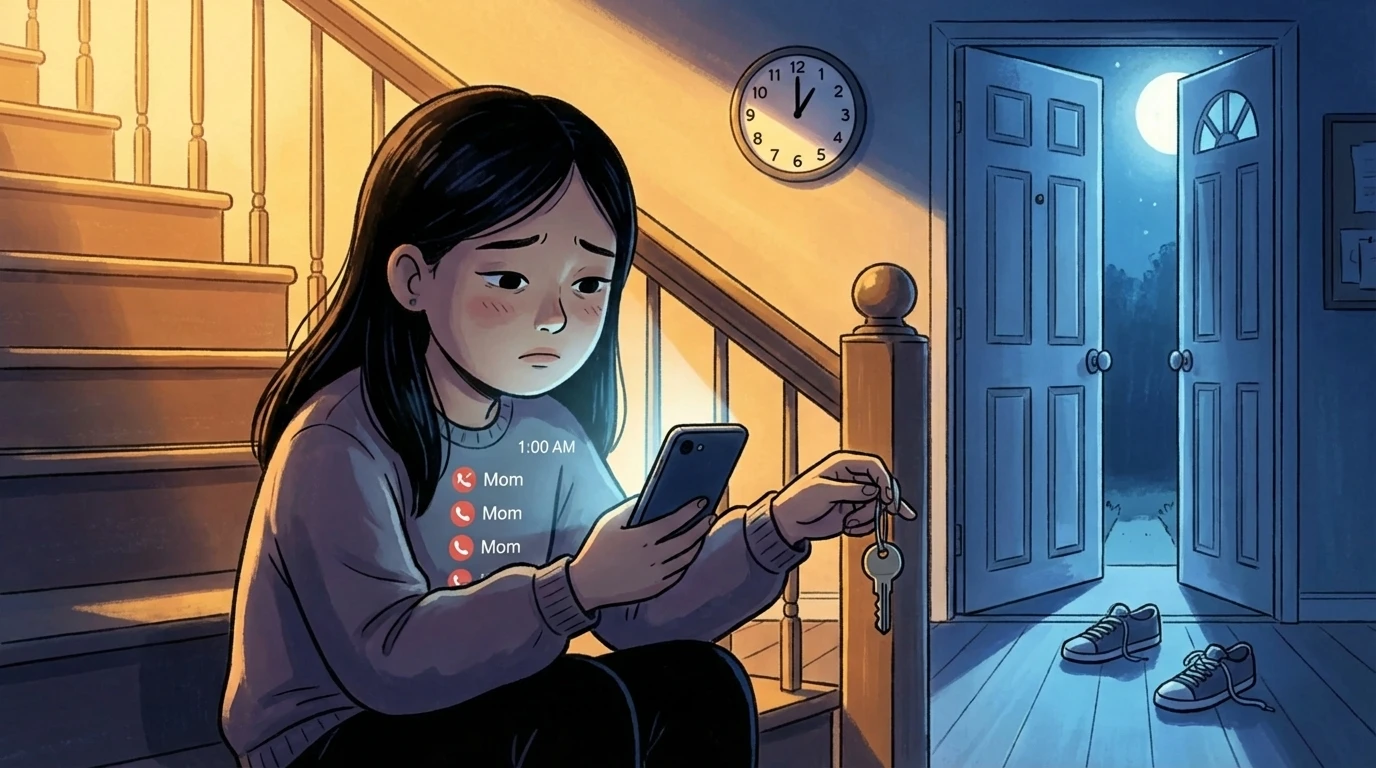
Your teen missed curfew. Or you found the phone under their pillow at midnight. Or the browser history tells a story that contradicts every promise they made last week.
Your gut reaction is to crack down. Confiscate something. Ground them. Deliver the lecture you have been rehearsing in your head since you discovered the violation.
Hold that impulse for ten minutes. Because what you do in this moment determines whether your teenager talks to you about the next problem or hides it better.
A teen who breaks a house rule is telling you something. Maybe the rule feels unfair. Maybe something happened at school that made them desperate to stay on their phone past bedtime. Maybe the anxiety of being cut off felt worse than the risk of getting caught.
You will not find out which one it is if your opening move is punishment.
The reason matters more than the rule
On the benign end, your kid stayed up texting because a new crush finally responded. On the serious end, they are anxious about something happening tomorrow and they need help but do not know how to ask.
Cracking down without knowing which scenario you are dealing with does not help anyone. When you punish without understanding, two things happen: you increase your teen's anxiety, and you become the person they avoid next time they are in trouble. The communication channel you need most is the one you just shut down.

Why "consequences" are still punishment
Parents love the word "consequence." It sounds measured. Responsible. Different from punishment.
But taking your teenager's phone is not a neutral consequence. For a teen, that phone is their connection to their entire social world. Removing it carries enormous emotional weight, and calling it a "logical consequence" does not change how it lands.
What matters is what it does to the relationship and your teen's willingness to cooperate going forward.
The escalation trap
Here is the pattern that plays out in thousands of homes every week:
- Parent discovers rule violation
- Parent enforces the predetermined consequence
- Teen blows up
- Parent blows up back
- Everyone says things they regret
If the adults in the house respond to a teen's emotional outburst with their own loss of control, you cannot expect the teen to model self-discipline. You are teaching them that whoever has more power wins. That is the lesson, whether you intend it or not.
It takes real self-discipline to not escalate when your kid is in your face about a rule they clearly broke. But you are the adult. That responsibility is yours.
Broken agreement, shattered trust
The Parenting Teens course will show you how to rebuild trust after a rule break
You'll have a repair sequence that restores accountability without destroying the relationship you both still need.
The approach that rebuilds trust
So your teen broke a rule. Instead of reaching for consequences, try this sequence.
Start with a kind question. "What made you take the phone into your room last night?" Ask it like you genuinely want to know. This is curiosity, not interrogation.
Acknowledge their perspective. Maybe all their friends stay up later. Maybe the rule feels arbitrary now that they are older. You can validate their feelings and still keep the rule. Understanding why it feels unfair is not the same as caving.
Express confidence in them. "I know it feels like you will miss everything between 9pm and 7am. You will not." Address the fear underneath the behavior (social exclusion, missing out) rather than dismissing it.
Set clear expectations going forward. Tell them you expect them to follow the rule, OR to come to you with a special request if circumstances warrant an exception. This gives them agency. A teen with a legitimate path to negotiate will use that path instead of sneaking around.
Then tonight, and every night for a while, check. Go to bed after them. Verify the phone is where it should be. After a few weeks, it fades into routine.
How to handle a broken house rule
- Pause your gut reactionDo not confiscate, lecture, or punish in the first ten minutes. Your initial impulse is driven by frustration, not strategy. Take a walk around the block if you need to. The conversation will be better for it.
- Ask what happened with genuine curiositySit down and ask what made them break the rule. Not 'why did you do that' in an accusatory tone. More like 'help me understand what was going on.' The phrasing matters.
- Listen more than you talkBite your tongue. The natural parental impulse to explain, defend, or correct must be actively suppressed in this moment. Receive the information. Do not respond to it yet.
- Acknowledge your own roleAsk whether they broke the rule because they were afraid of your reaction to the truth. If the answer is yes, that is your information to work with, not theirs.
- Set expectations and follow throughState the rule clearly, offer a path for exceptions, and then verify compliance consistently. Not as punishment but as support while trust rebuilds.

When lying is the problem
Sometimes the rule-breaking comes with a lie on top. Your teen did not just miss curfew. They told you they were at Jake's house when they were somewhere else entirely.
Lying is a safety response. There is only one reason a teenager lies to a parent: telling the truth has historically led to consequences they want to avoid. Punishment, anger, long lectures, loss of autonomy. The lying is a rational strategy from their perspective.
This does not mean lying is acceptable. It means the path to honesty runs through safety, not through crackdowns.
A script that works
Sit down and say something like: "When you lie to me, it makes it impossible for me to trust you. And I want to be close to you. I want to know what is going on in your life. So I need to understand why the truth felt too dangerous to tell me."
Do not argue about whether they lied. Do not prosecute the specifics. Focus on the relationship, not the infraction.
If they get defensive or angry, keep steady. Express sadness rather than anger. Anger feels threatening. Sadness communicates that you are hurt but not attacking. If they start a fight, do not engage. Say: "I can't talk when I feel attacked, but I am ready whenever you are." Then get up and leave.
You just modeled three things: that you can handle hard emotions without escalating, that you have boundaries, and that the door stays open.
The "can't answer truthfully" option
Try proposing a middle ground: your teen can say "I can't answer that honestly right now" instead of lying. They are not forced to reveal everything, but they are not allowed to actively deceive you. This respects their growing autonomy while keeping a baseline of honesty intact.
The long game with trust
The relationship is the discipline. A teen with a strong connection to their parent does not want to burn that relationship down any more than they would burn your house down. The relationship itself becomes the protective factor.
This is why punitive approaches like grounding miss the point. The goal is cooperation through mutual respect.
The repeated practice of having real conversations means you know what is going on in your teen's life. When they feel connected to you, they want to follow your rules. When they do not, they get creative about breaking them.
And here is the part most parents resist: you have to do more than half the work. You are the parent. Your teen did not create the family dynamic alone. If the environment makes honesty feel dangerous, that is yours to fix. If your temper is part of why they hide things, acknowledging that takes real strength, and that kind of honest repair changes everything.

Your teenager who broke curfew last weekend will probably wander into the kitchen on Tuesday and tell you something real while pretending to look for a snack. That unguarded moment is the payoff for every conversation where you chose curiosity over crackdown.
Do not miss it.
FAQ
Rules matter. Punishment for breaking them is the part that backfires. Hold clear expectations, explain the reasoning behind them, and give your teen a path to negotiate exceptions. The rules stay. The crackdowns when they break go.
Repeated rule-breaking usually signals that something about the rule, the enforcement, or the relationship needs attention. Ask your teen what would make the rule feel more reasonable. Check whether your reaction to violations is making honesty harder. Sometimes the rule itself needs adjusting for their developmental stage.
Name the broken trust directly without shaming. Ask what they will do to repair it. Remove the temptation temporarily if needed, then reintroduce with clear agreements. Trust rebuilds through small, consistent moments of honesty over weeks, not through a single conversation.
Completely normal. Testing limits is how adolescents figure out autonomy, negotiate independence, and develop their own value system. A teen who never pushes back may be compliant out of fear rather than genuine cooperation, which is more concerning long-term.